



Moorish Armchair
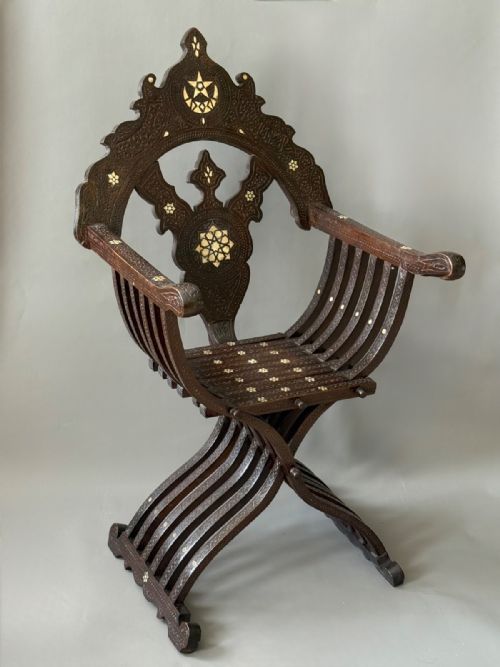
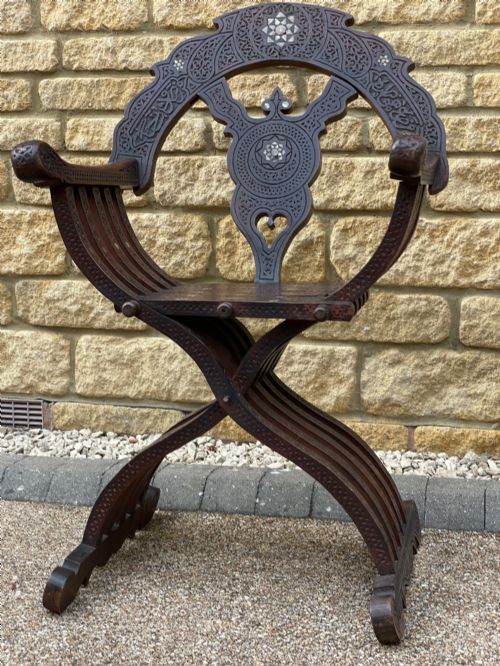
These moorish armchair examples combine intricate joinery and geometric inlay, bringing distinctive Islamic Revival ornament to a room.
Moorish Armchair
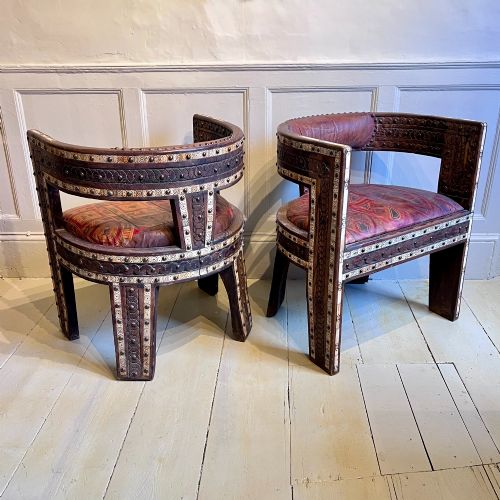
A moorish armchair brings together distinct regional forms including folding X-frames, corner chairs, and low seating suites rooted in Ottoman and North African traditions. Buyers seeking this aesthetic will find examples spanning the nineteenth century through the early twentieth century, encompassing styles from Syrian and Levantine workshops to Spanish and Moroccan production.
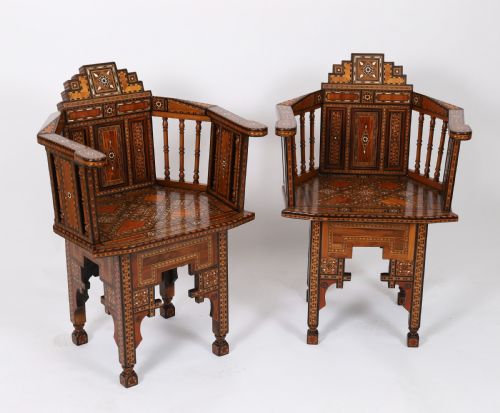
The most common formats on this page are heavily inlaid armchairs featuring mother-of-pearl, bone, and parquetry work. Alongside individual armchairs, makers produced pairs and conversation seats, often integrating traditional architectural elements such as mashrabiya panels into the woodwork.
Materials and construction
Makers constructed these chairs using hardwoods and walnut as a base, applying intricate surface decoration through carved details and fitted panels. Geometric inlay utilising mother-of-pearl, bone, and contrasting wood veneers defines the decorative scheme across Syrian, Levantine, and Moorish pieces.
Structural variety includes turned wood spindles, folding X-frame supports, and pegged hip-joint construction. Leather upholstery appears alongside painted wood finishes and specialised joinery that secures delicate parquetry without modern mechanical fasteners.
Moorish Armchair Retail Price Guide 2026
Typical asking prices for moorish armchair among the pieces listed under this phrase on Sellingantiques today, from the lower quarter to the upper quarter. They describe what is for sale here now, not the wider market.
Listings feature walnut, hardwood, bone, and mother-of-pearl across nineteenth-century and early twentieth-century periods.
Assessing quality in inlaid seating
The distinction between standard and finer examples rests on the precision of the parquetry and the density of the mother-of-pearl or bone inlay. Superior pieces exhibit tight, flush fitting of small geometric tesserae across complex curved surfaces rather than simple painted simulation.
Structural integrity of the carved woodwork and the crispness of mashrabiya lattice panels further differentiate the work. Fully intact inlay without missing tesserae indicates careful historical maintenance and higher initial workshop standard.
Liberty and Co
The Moorish Armchair Glossary
- Mashrabiya
- A traditional architectural wooden lattice screen formed of turned bobbins, incorporated here into chair backs and panels. This technique allows for intricate geometric shadow play and ventilation.
- Parquetry
- Geometric mosaic woodwork created by fitting small veneer pieces together to form patterned surfaces. It forms the primary decorative skin on many nineteenth-century frames.
- Moorish Revival
- An eclectic nineteenth-century architectural and decorative style drawing on Islamic, Spanish, and North African motifs. It informs the intricate ornamentation seen on these armchairs.
- Hip-Joint Chair
- An ancient folding chair construction method utilising pivoting intersecting slats held by a central axis. This format appears in Spanish and Andalusian seating.
- Mother-of-Pearl
- The iridescent inner layer of mollusc shells, shaped into thin plaques and embedded in wood. It provides the bright reflective highlights characteristic of Syrian and Damascus pieces.
Moorish Armchair: Frequently Asked Questions
What is a moorish armchair?
A moorish armchair is a nineteenth or early twentieth-century seat reflecting Islamic Revival and North African design traditions. These pieces typically feature dense geometric wood inlay, mother-of-pearl embellishment, and turned spindle work.
They serve as decorative statement seating rather than utilitarian lounge chairs. The construction often employs specialised joinery like folding frames or fixed low stances suited to Levantine and Syrian interiors.
How were they used historically?
Historically, these armchairs functioned as reception or salon seating in fashionable European and Ottoman-influenced domestic spaces. Their ornate surfaces were designed to showcase artisanal skill and cosmopolitan taste during the late nineteenth century.
They were frequently manufactured in pairs or as part of larger conversation suites and settees. Their low profiles and intricate detailing made them focal points for drawing rooms and smoking dens.
How do I live with one?
Living with a moorish armchair requires placing it in a stable environment away from direct heat sources and strong sunlight, which can dry out the wood and loosen inlaid tesserae. Because the mother-of-pearl and bone inlay are delicate, these chairs are best suited to gentle use.
Pair them with neutral furnishings so the complex geometric patterns and carved woodwork can stand out. Regular dusting with a soft, dry cloth is sufficient for routine maintenance.
How do I date these chairs?
Dating relies on analyzing the timber species, the style of inlay, and structural clues such as hand-cut pegs versus machine-made fasteners. Pieces span the nineteenth century through the 1930s, with Edwardian examples often showing lighter painted finishes.
Stylistic markers like Moorish Revival or Syrian Ottoman attribution help narrow the period of origin. Comparing the density and material of the inlay against documented nineteenth-century workshop practices provides further chronological context.