
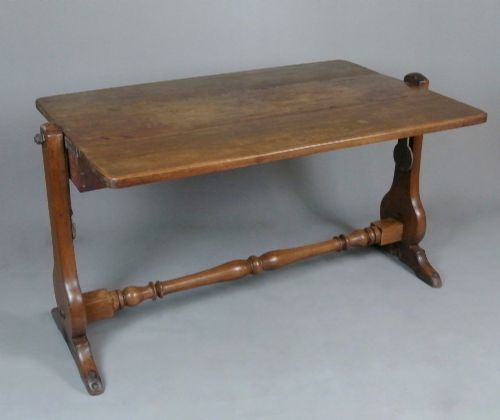
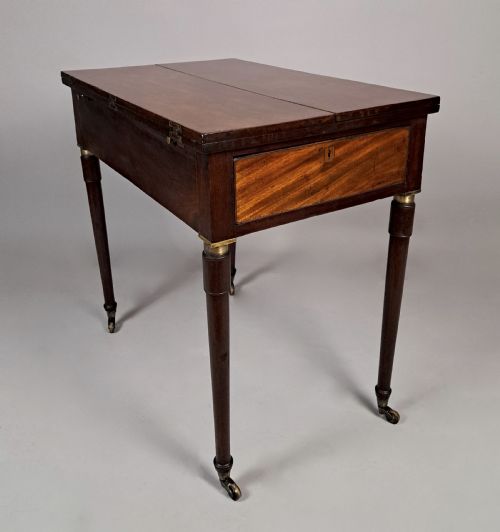
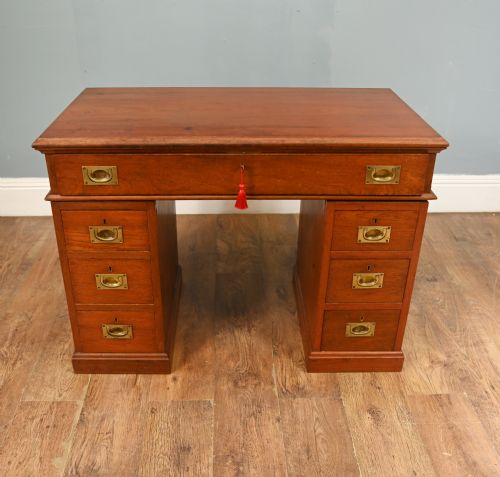


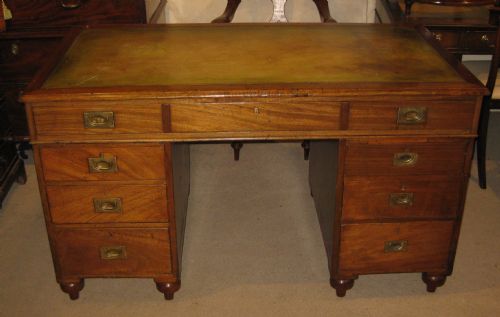


Military Writing Table
A military writing table is a sturdy, portable desk built for officers on campaign, prized for clever folding mechanisms and brass-bound corners.
Military Writing Table
A military writing table is a portable desk designed for officers on the move, merging a functional workspace with collapsible construction. These pieces surface primarily from the Georgian, Victorian, and Edwardian eras, spanning the eighteenth and nineteenth centuries into the early twentieth.
Many examples reflect global service through styles like Anglo-Indian, Chinese Export, and Victorian Campaign. Buyers encounter both utilitarian pieces built for the field and finer cabinetwork intended for colonial residences.
How they were made
Cabinetmakers utilised dense timbers like solid mahogany, teak, amboyna, and ebony to withstand the rigours of transport and tropical climates. These woods were chosen for stability and resilience, ensuring the furniture endured long sea voyages and rough overland journeys.
Brass hardware played a structural and protective role, reinforcing corners, forming flush-fitting drop handles, and securing joints against splitting. Leather provided a durable writing surface, while clever folding mechanisms allowed heavy desks to break down into portable sections.
Some officers carried desks with hidden compartments deep enough to keep a bottle of port secure from inquisitive subalterns.
What varies in quality
Quality rests in the precision of the mechanics and the integrity of the timber. Superior pieces feature seamless dismantling systems, tightly fitted brass work that remains flush with the wood, and substantial secondary timbers rather than thin veneers.
The refinement of the cabinetwork dictates the tier of the piece, distinguishing utilitarian barrack furniture from high-status commissions with secondary compartments, amboyna details, or attribution to notable workshops like Gillows.
Gillows
The Military Writing Table Glossary
- Campaign furniture
- Portable furnishings designed to dismantle or fold for military officers on active service. It prioritises robust construction and space-saving ingenuity.
- Brass bound
- Furniture edges and corners reinforced with recessed brass strips and brackets. This protected the timber from heavy knocks during transport.
- Kneehole desk
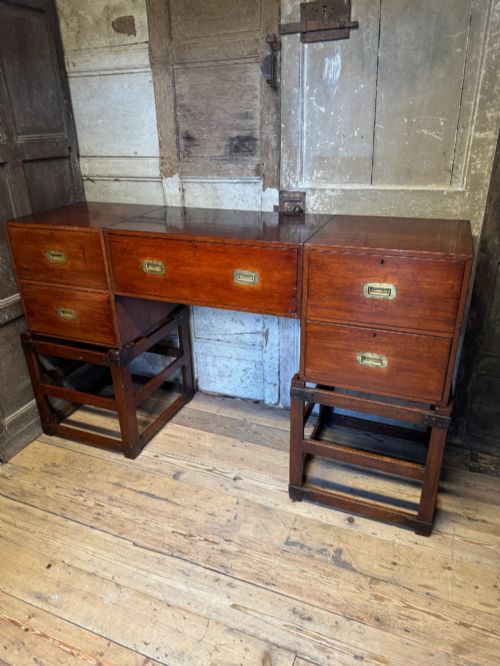
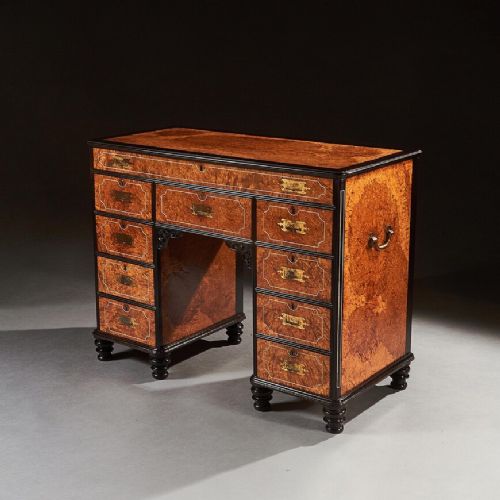
- A freestanding desk featuring a central recess for the user's legs, flanked by pedestals of drawers. They often split into sections for travel.
- Writing slope
- A portable box with a sloping lid that opens to reveal a writing surface and compartments for stationery. Some rested on dedicated stands.
- Metamorphic furniture
- Pieces designed to transform into different forms or uses, such as combining a writing desk with a dressing or dining table.
Military Writing Table: Frequently Asked Questions
What is a military writing table?
A military writing table is a portable desk built for officers during the eighteenth and nineteenth centuries. These pieces were engineered to withstand travel while providing a proper surface for correspondence.
They appear in forms ranging from compact folding tables to heavy pedestal desks, usually outfitted with brass reinforcement and durable timber construction.
How did officers use campaign desks?
Officers utilised these desks in tents, barracks, and temporary quarters during campaigns and colonial postings. The built-in compartments held ink, paper, and despatches securely during transit.
Many designs disassembled into smaller sections or folded flat to fit inside wooden chests for transport on pack animals or ships.
How do I tell Victorian from Georgian tables?
Georgian campaign tables, often dating from the late eighteenth century, tend to feature solid teak or mahogany with restrained, functional lines. Victorian examples from the nineteenth century frequently incorporate elaborate brass detailing, pedestals, and exotic woods like amboyna.
Construction methods also shift over time, with earlier pieces showing distinct hand-cut joinery and later Victorian models benefiting from more standardised hardware.
Are all campaign desks made of mahogany?
While mahogany is the most common timber seen, makers utilised other durable woods depending on the region of manufacture. Solid teak was frequently chosen for its resistance to moisture, particularly in Anglo-Indian and colonial pieces.
Exotic accents such as ebony and amboyna also appear on high-status export desks, while secondary woods were used for internal drawer linings.
How do I live with a campaign desk?
Living with a military writing table involves appreciating its historical utility while accommodating its compact proportions. These desks work well in studies or living spaces where surface area and integrated storage are useful.
Maintenance requires simple care for the leather writing surface and occasional polishing of the brass hardware to keep the metal from dulling.