



Military Percussion Firearm
A military percussion firearm brings nineteenth-century combat history to your collection through solid steel, brass, and walnut construction.
Military Percussion Firearm
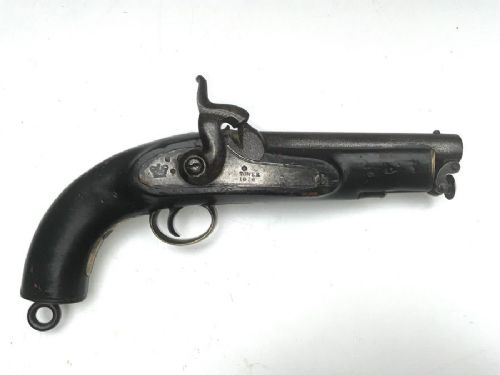
A military percussion firearm represents nineteenth-century combat and ordnance development across Britain, America, and Europe. You will encounter belt pistols, cavalry pistols, and muskets alongside carbines and revolvers dating from the eighteen-forties onwards. These pieces served regular troops, officers, and volunteers in various campaigns.
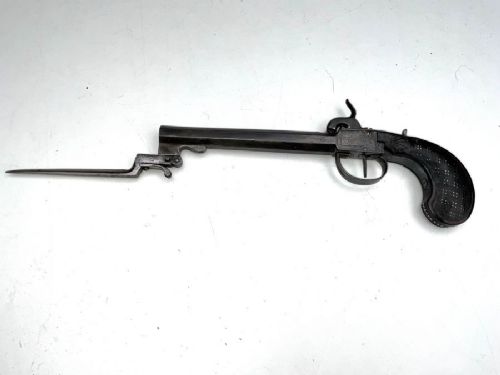
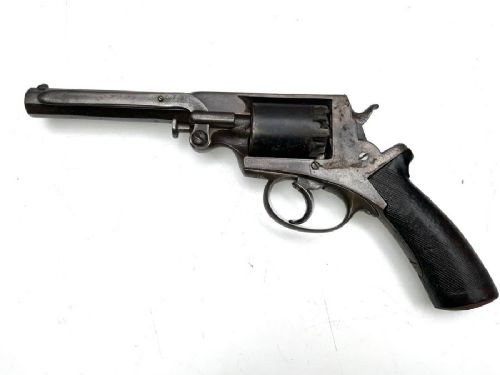
Most examples date from the mid-nineteenth century, specifically the eighteen-fifties and eighteen-sixties. Forms range from smoothbore belt pistols with bayonets to two-band Enfield rifles and boxed Beaumont-Adams revolvers. These arms span standard infantry service and private purchase officer equipment.
Materials and construction methods
Makers built these arms using robust steel and iron for barrels, locks, and internal components. Stocks were shaped from dense walnut and other durable woods to withstand field conditions. Brass furniture such as trigger guards and butt caps added structural reinforcement and corrosion resistance.
Workshops utilised precision machining for rifled bores alongside hand-finishing for locks and stock fitting. Government arsenals like Tower and private contractors stamped inspection marks and dates directly into the metal and wood. Bayonets, socket attachments, and captive ramrods were integrated to complete the service weapon.
Military Percussion Firearm Retail Price Guide 2026
Typical asking prices for military percussion firearm among the pieces listed under this phrase on Sellingantiques today, from the lower quarter to the upper quarter. They describe what is for sale here now, not the wider market.
Distinctions in grade and execution
Quality separates standard government issue arms from private purchase officer pieces commissioned by individual gentlemen. Superior examples retain crisp metal stamps, matching serial numbers, and well-defined stock contours without excessive sanding. Preserved accessories like fitted boxes, correct bayonets, and distinct regimental markings elevate the standing of a piece.
The integrity of the percussion lock mechanism and the condition of the bore dictate the mechanical merit of the arm. Original walnut surfaces displaying clear grain and minimal replacement parts show superior preservation compared to heavily restored or pitted items. Maker attribution, such as signed London locks or official East India Company stamps, clearly distinguishes finer specimens.
Tower·East India Company·A.W Spires·Beaumont-Adams·Colt
The Military Percussion Firearm Glossary
- Percussion lock
- An ignition system utilising a hammer that strikes a percussion cap placed on a nipple, creating a spark to ignite the powder charge. This replaced the earlier flintlock mechanism in military service during the nineteenth century.
- Smoothbore
- A barrel lacking internal rifling grooves, designed to fire lead balls or shot without imparting spin. Many early pistols and muskets featured smooth bores before rifled barrels became standard.
- Socket bayonet
- A triangular blade fitted to the muzzle end of a longarm via a tubular socket that locks around the barrel sight. It allowed muskets and rifles to function as thrusting weapons in close combat.
- Cavalry pistol
- A compact firearm carried by mounted troops, typically featuring captive ramrods and sturdy brass or iron mounts. These pieces were designed for close-range deployment from horseback.
- Two-band Enfield
- A mid-nineteenth-century military rifle secured to its wooden stock by two metal barrel bands rather than the three found on full-length infantry muskets. This pattern was favoured by sergeants, volunteers, and rifle regiments.
- Beaumont-Adams revolver
- A double-action percussion revolver patented in the mid-nineteenth century, widely adopted by British military officers. It allowed the shooter to cock the hammer manually or fire continuously by pulling the trigger.
Military Percussion Firearm: Frequently Asked Questions
What is a military percussion firearm?
A military percussion firearm is a nineteenth-century weapon that uses a percussion cap and hammer ignition system. These arms were issued to infantry, cavalry, and officers across various global conflicts.
The category includes single-shot pistols, multi-shot revolvers, muskets, and carbines. Each piece reflects the standard ordnance or private purchase requirements of its respective era.
How do I identify the date of a piece?
Dates are often stamped directly onto the lock plates, barrels, or wooden stocks by arsenals and private makers. Model designations, such as the 1853 Enfield or 1860 Colt, also provide clear chronological markers.
Inspecting serial numbers, proof marks, and regimental stampings helps narrow down the period of manufacture. Historical context from the military campaigns associated with the model confirms the operational window.
Were these arms used in actual combat?
Many examples saw active service in nineteenth-century conflicts, including colonial campaigns, the American Civil War, and domestic volunteer deployments. Regimental markings and unit stamps often record their military history.
Private purchase officer arms were acquired individually for active duty rather than general government issue. Their wear patterns and historical provenance usually reflect personal service in the field.
How should I display a percussion firearm?
Displaying these pieces requires a stable environment away from direct sunlight, excessive moisture, and temperature fluctuations. Secure wall mounts or glass-fronted cabinets protect the wood and metal from physical contact.
Preserving the original walnut and steel involves occasional light maintenance with museum-grade conservation products. Keeping the action uncocked relieves tension on the internal mainspring during display.