

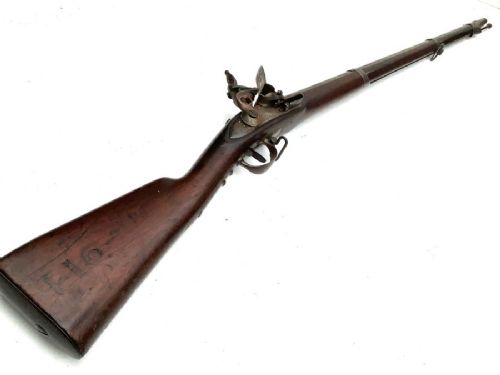


Military Flintlock
Military flintlock arms are historical ordnance designed for government service, prized for their mechanical ingenuity and tangible connection to eighteenth and nineteenth-century warfare.
Military Flintlock
Military flintlock pieces encompass heavy muskets, blunderbusses, and service pistols issued to troops during the eighteenth and nineteenth centuries. You will most frequently encounter regulation sidearms and longarms originating from British, French, and European arsenals during the Georgian and Napoleonic periods.
The selection here ranges from standard-issue Tower and Charleville muskets to cavalry holster pistols and dragoon arms. These examples document the tactical weaponry utilised by infantry and cavalry regiments through eras of widespread conflict.
How they were made
Makers constructed stocks from dense hardwoods such as walnut and general timber, fitted with brass or iron furniture to secure the barrels and mechanisms. Iron and steel formed the heavy-duty barrels, lock plates, and internal springs required to withstand repeated discharges.
Gunsmiths shaped smooth-bore tubes by hand, pairing them with flintlock ignition systems that generated sparks via a piece of flint striking a steel frizzen. Ordnance marks, proof stamps, and maker signatures were typically engraved or stamped directly onto the metal components.
Military Flintlock Retail Price Guide 2026
Typical asking prices for military flintlock among the pieces listed under this phrase on Sellingantiques today, from the lower quarter to the upper quarter. They describe what is for sale here now, not the wider market.
Some dragoon pistols arrived with belt hooks so troopers could dangle their firepower without dropping it in a gallop.
What varies in quality
Quality depends upon the originality of the components and the clarity of maker signatures or military inspection stamps on the lock and stock. Surviving pieces retain crisp metal engraving, legible barrel proofs, and stock timber free from extensive replacement or modification.
The crispness of the flintlock action mechanism dictates the mechanical standard of each firearm. Examples retaining distinct ordnance markings and unaltered barrel lengths command greater interest among collectors.
T. Potts·Henry Nock·Sargant and Son·Brasher·Wilson
The Military Flintlock Glossary
- Flintlock
- An ignition mechanism that uses a piece of flint held in a cock to strike a steel frizzen, creating sparks to ignite gunpowder. This system dominated military firearms technology for centuries.
- Brass furniture
- Decorative and structural metal fittings made of brass, including trigger guards, butt caps, and side plates, commonly found on military service pistols and muskets.
- Smooth-bore
- A barrel interior lacking rifling grooves, designed to fire lead balls from muskets and pistols. This was the standard barrel type for military firearms of the Georgian and Napoleonic periods.
- Proof marks
- Official stamps struck onto the barrel and lock to verify that the firearm passed safety tests against regulated gunpowder charges. These marks assist in dating and localising the origin of the piece.
Military Flintlock: Frequently Asked Questions
What is a military flintlock?
A military flintlock is a firearm manufactured for state armies and naval forces using a flint-and-steel ignition system. These weapons include muskets, carbines, and holster pistols issued during the eighteenth and nineteenth centuries.
They served as standard infantry and cavalry equipment before percussion cap technology replaced them in the nineteenth century. Today, they survive as historical artefacts of European and British military campaigns.
How do I identify a military flintlock?
Identification relies on examining inspection stamps, proof marks, and government acceptance cyphers stamped onto the lock plate and barrel. Marks such as the British Crown over GR and the Tower stamp indicate official military issue.
Stock timber quality, barrel length, and brass or iron furniture styles also help determine whether a piece was built for government service or civilian trade. Maker signatures inscribed on the lock provide further historical context.
How should I display a military flintlock?
Display these firearms in stable environments away from direct sunlight and excessive humidity to preserve the walnut stocks and steel components. Wall mounts or secure glass display cabinets protect the pieces while keeping them visible.
Ensure the piece is unloaded and stored with the lock mechanism at rest. Periodic light oiling of the metal surfaces helps prevent corrosion.
What periods do military flintlocks cover?
The pieces available span the eighteenth and nineteenth centuries, concentrating heavily on the Georgian era and the Napoleonic Wars. This timeframe covers significant developments in military firearm standardisation.
Earlier examples reflect mid-eighteenth-century design, while later pieces date up to the transition towards percussion cap ignition systems in the nineteenth century.