

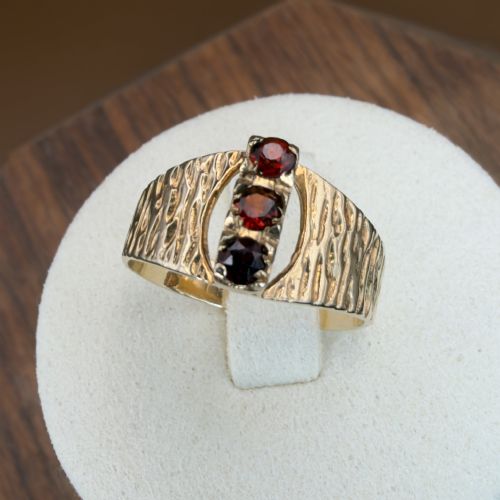
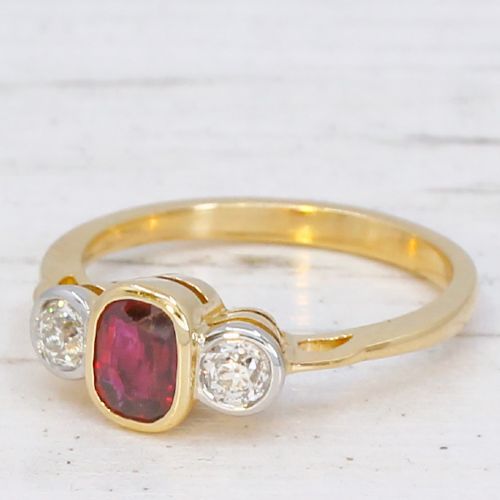


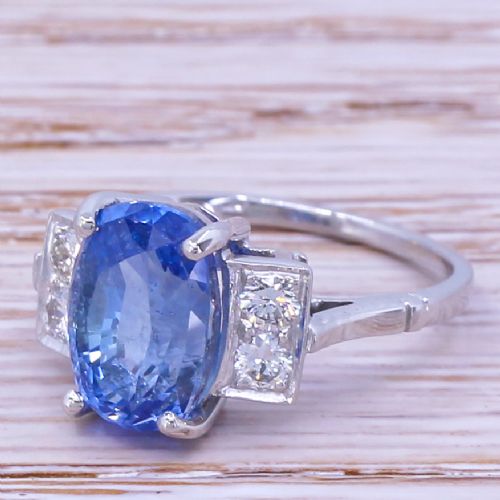


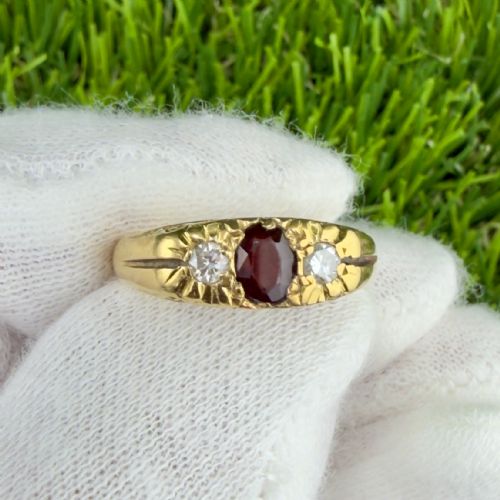
Mid Century Trilogy Ring
A mid century trilogy ring brings together three stones representing past, present, and future in platinum and gold settings.
Mid Century Trilogy Ring
A mid century trilogy ring gathers three distinct gemstones onto a single band, forming a silhouette that dominated the decades around the middle of the twentieth century. These pieces appear most frequently with a central diamond or sapphire flanked by smaller stones, often spanning the 1940s, 1950s, and 1960s.
The materials span platinum, 18ct gold, and 9ct yellow gold, holding diamonds alongside rubies, sapphires, garnets, teal tourmalines, fire opals, and emeralds. Stones display traditional cuts such as old cut, transitional cut, brilliant cut, and rose cut.
How they were made
Goldsmiths of the period utilised durable platinum and substantial gold alloys to secure stones in claw or flush settings. Platinum provided the strength needed to mount larger diamond carats securely without heavy metal bulk.
Gemstones were cut by hand or through early industrial machinery, resulting in characteristic old European, transitional, and brilliant facets that catch light differently from modern stones.
Mid Century Trilogy Ring Retail Price Guide 2026
Typical asking prices for mid century trilogy ring among the pieces listed under this phrase on Sellingantiques today, from the lower quarter to the upper quarter. They describe what is for sale here now, not the wider market.
Some mid-century designs tucked tiny rubies beside diamonds, hiding secret flashes of red beneath the primary stones.
What varies in quality
The calibre of the central gemstone relative to its side stones dictates the visual balance of the piece. Matching the colour saturation of sapphires or rubies with the clarity of accompanying diamonds separates standard workshop output from finer examples.
Metalwork execution distinguishes these rings, visible in the precision of the claw work and the robustness of the shank. Heavier platinum and 18ct gold bands maintain their structural integrity better over decades of wear than lighter 9ct alternatives.
The Mid Century Trilogy Ring Glossary
- Trilogy ring
- A ring set with three stones, traditionally signifying the past, present, and future. This layout is common in mid-century jewellery.
- Old cut diamond
- A diamond cut by hand before modern brilliant-cut standards, featuring a smaller table and larger culet. These stones project a softer glow under candlelight.
- Transitional cut
- A diamond cut between the 1930s and 1950s, bridging older antique facets and modern brilliant symmetry. It retains chunky facets while adopting a rounder outline.
- Platinum
- A dense, white precious metal used extensively for mid-century ring mounts. Its strength allows for minimal metal visibility around stones.
Mid Century Trilogy Ring: Frequently Asked Questions
How do I wear a trilogy ring daily?
These rings suit everyday wear provided the setting metal remains thick and secure around the stones. Platinum and 18ct gold bands withstand regular use well.
Avoid wearing them during heavy manual tasks to protect older diamond cuts and softer coloured stones like emeralds from impact.
What do three stones represent?
The three stones traditionally symbolise the past, the present, and the future of a relationship. This design choice gained immense popularity during the mid-twentieth century.
Jewellers arranged diamonds or coloured gems like sapphires and rubies in graduating or matching sizes across the finger.
How do I date a mid century ring?
Dating relies on hallmark stamps, metal purity marks, and the specific cutting style of the gemstones. Transitional and old cut diamonds point towards the 1940s and 1950s.
Changes in gold carat standards and stylistic shifts from Art Deco geometry to softer mid-century curves help narrow the decade.
Are coloured gemstones common in these rings?
Natural Ceylon sapphires, rubies, garnets, and emeralds frequently appear alongside diamonds in these pieces. Coloured stones were often selected as vibrant central elements.
Pairs of diamond shoulders then frame the primary gem to enhance its visual impact on the hand.