

Mid-century Paper Artwork
These mid-century paper artwork pieces capture the visual experiments and quiet domestic scenes of the twentieth century.
Mid-century Paper Artwork
When you examine mid-century paper artwork on this page, you find paintings, drawings, and prints executed primarily during the 1940s, 1950s, and 1960s. The selection spans landscape watercolours, modernist gouaches, ink sketches, and lithographs from British and European hands.
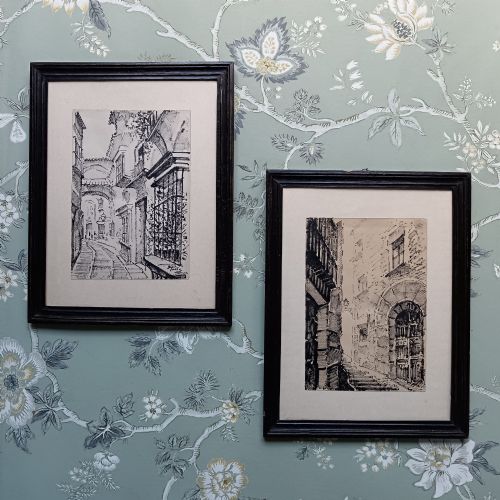
The most common formats include framed landscape watercolours and ink drawings on paper, often showing regional British scenery, continental views, or figure studies. These works reflect the mid-century shift toward accessible, expressive media that could be framed for domestic interiors.
Materials and Techniques
Artists relied on watercolour, gouache, ink, pastel, and graphite applied directly to various paper supports, occasionally combining media as seen in mixed-drawing works. Lithography also appears, capturing drawn imagery through plate-printing techniques.
The physical support ranges from standard drawing paper to coloured and textured sheets, framed behind glass to protect the delicate media from atmospheric moisture and handling.
Mid-century Paper Artwork Retail Price Guide 2026
Typical asking prices for mid-century paper artwork among the pieces listed under this phrase on Sellingantiques today, from the lower quarter to the upper quarter. They describe what is for sale here now, not the wider market.
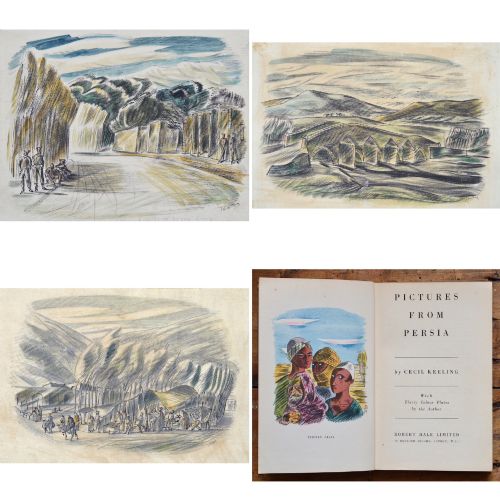
Several wartime drawings recorded quiet moments of Persian life while inks and watercolours quietly captured everything from ballet dancers to stray garden birds.
Assessing Quality in Paper Works
Quality rests on the confidence of the hand and the clarity of the composition, distinguishing hurried student exercises from the deliberate marks of established painters and illustrators. Stronger pieces demonstrate tonal balance and assured use of the chosen medium.
Condition and presentation further differentiate the pieces, with well-preserved sheets maintaining their original paper tone and pigment vibrancy inside period frames.
Alessandro Cittadini·Cecil Keeling·Richard Principal Leitch·John R Prentice·Robert Leslie Howey·Marc Chagall·Maurice Brianchon·Frank Dobson·Samuel Rabin·Shiro Katamatsu·Ralston Gudgeon·James Tower·Edward Seago·John Hobson Nicholson·Michael Lyne·Sir Peter Blake
The Mid-century Paper Artwork Glossary
- Gouache
- An opaque water-based paint that dries to a matte finish. It allows artists to layer light colours over dark washes for solid blocks of tone.
- Lithograph
- A print produced from a flat stone or metal plate treated to retain ink in designated image areas. It enables precise reproduction of original graphic drawings.
- Provenance
- The documented history of ownership or creation for an artwork. It helps establish authenticity and connection to a specific maker.
- Watercolour
- A transparent paint made from pigments suspended in a water-soluble vehicle. Washes are built up in thin layers to let the white of the paper illuminate the colour.
Mid-century Paper Artwork: Frequently Asked Questions
Are these works original or printed reproductions?
The majority listed here are unique original paintings and drawings created by hand using watercolour, ink, gouache, or pastel. Each brushstroke or pencil mark is physically present on the paper surface.
A small portion consists of original mid-century lithographs and prints produced as part of limited artistic editions rather than modern commercial reproductions.
How do I identify mid-century styles on paper?
Mid-century pieces often embrace simplified forms, expressive brushwork, and a departure from strict academic realism toward modern British or continental abstraction. Landscapes and figure studies from this era frequently employ a restricted, moody palette or vibrant gouache tones.
Signatures, framing styles, and subject matter relating to the 1940s through the 1960s further help anchor the piece to the period.
What subjects are most common in these collections?
British and European landscapes dominate the selections, ranging from Cumbrian lakes and Scottish hills to Mediterranean scenes and maritime views. Figure studies, botanical still lifes, and architectural sketches also appear frequently across the decades.
These subjects reflect the mid-century artist's engagement with both local topography and intimate domestic settings.