

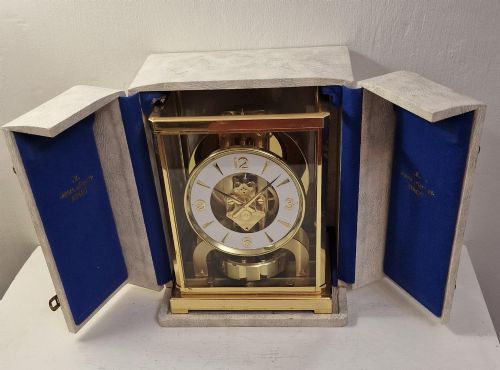


Mid Century Motion Clock
These mid century motion clock examples are ingenious perpetual timepieces driven by thermal expansion, offering silent movement and striking modernist desk presence.
Mid Century Motion Clock
When you search for a mid century motion clock, you encounter sophisticated mantel timepieces operating without batteries or manual winding. The most common versions on this page are Swiss-made Jaeger-LeCoultre Atmos clocks produced across the 1940s, 1950s and 1960s, alongside older 19th-century interpretations.
These pieces primarily take the form of mantel clocks featuring distinctive square or round dials. Many examples are housed within glass bell-jar cases that reveal the intricate mechanical inner workings completely.
The aesthetic aligns closely with mid-century modern design principles, pairing clean geometric lines with minimalist dial layouts. You will also find specialised variants like the Marina model and the Elysee version among the selections.
Materials and construction
The construction relies heavily on brass and gilt brass frameworks, often finished with polished rhodium-plated metal or gold gilt. Transparent glass forms the protective enclosures, particularly in the bell-jar models that showcase the perpetual motion mechanism.
Movement quality is underpinned by precision Swiss engineering, including 15-jewel movements and specific calibres such as the 519 and 540. Lucite and metal elements occasionally complement the primary metallic structures to achieve distinct visual finishes.
Mid Century Motion Clock Retail Price Guide 2026
Typical asking prices for mid century motion clock among the pieces listed under this phrase on Sellingantiques today, from the lower quarter to the upper quarter. They describe what is for sale here now, not the wider market.
Listings feature items spanning the 1940s, 1950s, 1960s, and 19th Century, constructed from brass, glass, lucite, and rhodium.
Assessing quality
Quality differences rest largely upon the precision of the specific calibre and the complexity of the housing. Standard classic models differ significantly from specialised bell-jar configurations or the decorative black Marina variants.
The integrity of surface platings, such as rhodium or gold gilt, distinguishes finer examples. Original packaging, documentation, and the overall condition of the delicate glass enclosures further elevate certain specimens above standard production.
Jaeger LeCoultre·Le Coultre
The Mid Century Motion Clock Glossary
- Atmos clock
- A mechanical mantel timepiece driven by changes in temperature and atmospheric pressure rather than a mainspring. This ingenious mechanism winds itself continuously.
- Bell-jar model
- A clock enclosed within a dome-shaped or cylindrical glass cover. This transparent housing protects the movement while allowing unobstructed view of the interior components.
- Calibre
- The specific manufacturer's designation for a particular watch or clock movement design. Different calibres indicate varying mechanical layouts and production eras.
- Rhodium-plated
- Coated with a hard, reflective, silver-coloured precious metal from the platinum group. This finish provides high durability and resistance to tarnish.
- Marina
- A distinctive style of clock featuring decorated panels, often with transparent or dark backgrounds. These models showcase artistic motifs within the casing.
Mid Century Motion Clock: Frequently Asked Questions
How do these clocks wind themselves?
A sealed chamber inside contains a gas that expands and contracts with minute temperature fluctuations. This movement continuously winds the mainspring without human intervention.
Because the mechanism reacts to normal room temperature changes, it operates indefinitely without batteries or external power sources.
Where should I place an Atmos clock?
Position the clock on a stable, level surface away from direct sunlight and strong drafts. Mantelpieces, desks and sturdy sideboards provide ideal settings.
A stable foundation ensures the delicate perpetual motion mechanism maintains accurate timekeeping without external physical interference.
How do I identify a 1950s model?
Examine the dial design, case materials and movement calibre specifications noted in the documentation. Rhodium-plated bell-jar variants frequently date to this decade.
Comparing the specific movement calibre numbers, such as the 519, helps confirm the exact production period alongside stylistic cues.
What is a bell-jar case?
A bell-jar case is a transparent glass cover shaped to sit over the entire clock movement. It protects the sensitive internal components from dust while offering complete visibility.
This design highlights the brass and rhodium mechanics from every angle, serving both a functional and an aesthetic purpose.