
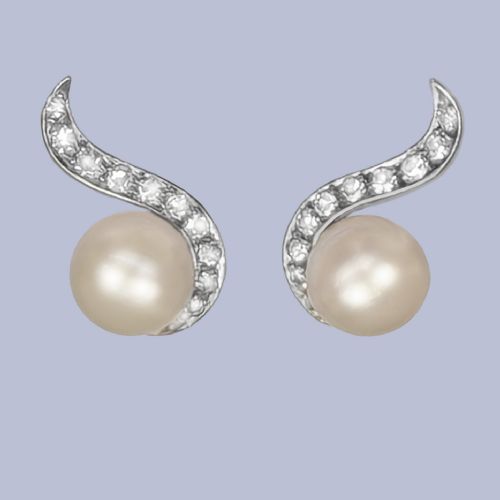
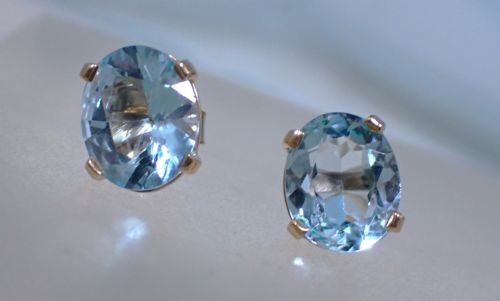


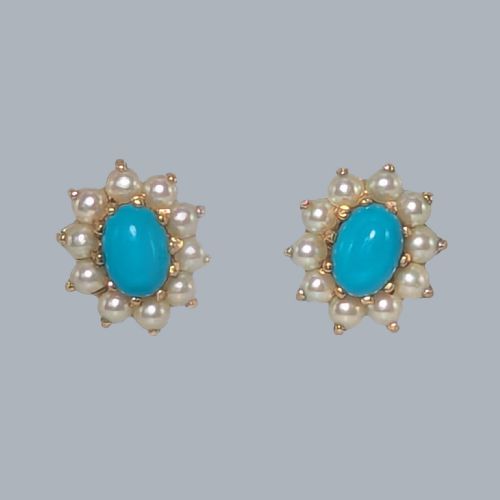


Mid Century Gold Stud Earrings
Mid century gold stud earrings bring distinct geometric form and vibrant gemstones to the ear, offering wearable modernist design for daily use.
Mid Century Gold Stud Earrings
Mid century gold stud earrings comprise items from the 1940s, 1950s, and 1960s, appearing in styles designated as mid-century, mid-century modern, modernist, and retro. These pieces take the form of earrings, featuring both cluster designs and simpler configurations.
The selections available here rely heavily upon yellow and white gold alloys, alongside silver gilt, pairing the metalwork with a variety of precious and semi-precious stones. Buyers encounter stones such as aquamarine, jade, pearl, turquoise, sapphire, emerald, rose quartz, lapis lazuli, amethyst, and mabe pearl alongside diamonds.
Cluster formations and fan motifs feature prominently among the recorded items, reflecting the aesthetic priorities of the mid-century decades. Pieces range from straightforward nine-carat and eighteen-carat gold settings to complex multi-stone arrangements involving white gold.
Materials and construction
The construction of these pieces centres on gold fabrication, utilising nine-carat, fourteen-carat, and eighteen-carat gold in both yellow and white varieties, supplemented by silver gilt. Metal components are shaped to hold stones securely, employing techniques suited to cluster designs and fan shapes.
Gems and organic materials are integrated into the precious metal frames, including diamonds, pearls, turquoise, aquamarine, jade, and lapis lazuli. Hallmarking, such as London marks from the mid-nineteen-sixties, records the official testing of the metal purity for specific items.
Quality factors
Quality differences stem from the weight of the gold used in the mount and the selection of the primary stones, such as the size and clarity of the diamonds or the saturation of the turquoise and aquamarine. Maker attribution, seen in examples like the work associated with Andrew Grima, also separates standard production items from distinguished studio pieces.
The complexity of the design work, from simple single-stone settings to intricate cluster arrangements with multiple brilliant or eight-cut diamonds, influences the character of each pair. Original packaging and specific hallmarks add documentary weight to surviving examples.
Andrew Grima
The Mid Century Gold Stud Earrings Glossary
- Cluster earrings
- A style featuring a central gemstone surrounded by a border of smaller stones, typically diamonds.
- Eight-cut diamond
- A simple diamond cut with eight facets on the crown, common in mid-century jewellery production.
- Hallmark
- An official stamp applied to precious metals indicating purity and origin, such as London assay marks.
- Mabe pearl
- A cultured blister pearl grown against the inside shell of an oyster, producing a dome shape with a flat back.
- Silver gilt
- Silver that has been coated with a thin layer of gold on its exterior surface.
Mid Century Gold Stud Earrings: Frequently Asked Questions
What periods do these earrings cover?
The pieces span the decades from the 1940s through to the 1960s, encompassing styles identified as retro and mid-century modern.
Most items originate from the 1950s and 1960s, reflecting the dominant design aesthetics of those years.
What metals are used in these pieces?
Makers utilised nine-carat gold, fourteen-carat gold, and eighteen-carat gold in both yellow and white variations, alongside silver gilt.
White gold frequently serves as a setting for diamonds, while yellow gold pairs with coloured stones like turquoise and jade.
Which gemstones appear most often?
Diamonds and pearls occur frequently, often combined in cluster designs or drop configurations.
Coloured stones such as aquamarine, turquoise, jade, and lapis lazuli also feature prominently across the selection.
How do I care for vintage gold earrings?
Store them individually in lined boxes or soft pouches to prevent scratching between pieces.
Clean the metal and stones gently with a soft cloth, avoiding harsh chemical dips that might harm softer gems like pearls or turquoise.