
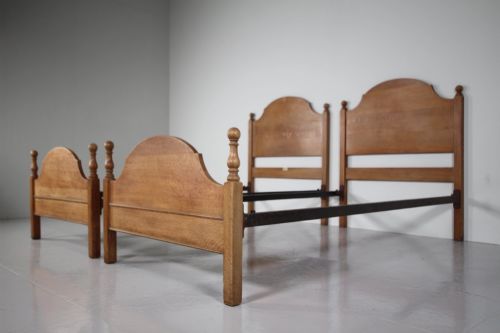


Matching Pair Single Beds
These matching pair single beds bring balanced proportion to a bedroom, offering twin sleeping frames designed to complement each other.

Understanding matching pair single beds
When you search for matching pair single beds, you encounter twin frames designed to sit together in a shared room or guest space with balanced symmetry. The evidence shows these items spanning periods from the nineteenth century through the Victorian era into the nineteen-thirties, including specific styles like Art Deco, French Rococo Revival, Queen Anne style, and Arts and Crafts. You are most likely to meet walnut and painted wood versions on this page, alongside satinwood, cane, leather, and gilt highlights.
The objects range from platform beds and carved wooden frames to caned and upholstered designs. Makers such as Heal & Son appear in the records alongside French Directoire and classic Victorian interpretations. Each pair provides two corresponding beds rather than a single standalone piece, maintaining a unified visual theme across the room.
Materials and construction
Makers utilised solid timbers and veneers, predominantly walnut, oak, and satinwood, to build these frames. Surface decoration involved carved details, painted finishes, and embossed leather panels.
Certain examples incorporate cane work and textile upholstery alongside gilt accents, reflecting the cabinetmaker skills of the nineteenth and early twentieth centuries.
Retail Price Guide 2026
Typical UK retail prices for matching pair single beds, calculated from the Sellingantiques database of over a million retail prices indexed since 2003. This retail price guide relies exclusively on Sellingantiques data; no external sources or auction records are used, so the figures do not describe the wider market.
Every successful guest room starts with two beds that actually agree on their finish.
Distinctions in quality
The distinction between standard examples and superior pieces rests on the choice of timber and the execution of carved or veneered surfaces. Rich walnut and figured satinwood display finer grain patterns than plain painted wood.
Design integration separates ordinary production from works associated with known makers like Heal & Son. Cohesion in the matching pair, from balanced wood grain to precise carving, determines the overall standing of the set.
Heal & Son
The Matching Pair Single Beds Glossary
- Art Deco
- A design style from the nineteen-thirties characterised by sleek geometric lines and streamlined forms. It appears frequently in the walnut and satinwood listings on this page.
- Satinwood
- A durable timber with a golden sheen used for fine cabinetmaking. It yields a bright finish prized in twentieth-century bedroom suites.
- Caning
- Woven rattan material stretched across a wooden frame for headboards or footboards. It introduces lightness and texture to French-influenced designs.
- Queen Anne Style
- A traditional British furniture style distinguished by curved lines and restrained ornamentation. Pieces in this style often feature embossed leather details.
- Directoire Style
- A transitional French design period bridging neoclassical severity and nineteenth-century revivalism. It employs painted wood and classical symmetry.
Frequently Asked Questions
How do I use a matching pair?
These beds are positioned symmetrically in a guest room or twin bedroom to create a unified appearance. They hold standard single mattresses for everyday sleeping arrangements.
Their coordinated design ensures the furniture complements the surrounding interior scheme without mismatched wood tones.
What periods do these beds represent?
The available selection covers the nineteenth century, Victorian era, and nineteen-thirties. You will find distinct stylistic movements such as Art Deco, Arts and Crafts, and French revival designs.
Each period brings specific material choices, from dark carved walnut to geometric satinwood veneers.
Are slats included with the frames?
Some listings specify included bed bases or platforms to support the mattress. Construction details vary between nineteenth-century timber frames and twentieth-century designs.
It is sensible to check the listing specifics regarding internal supports before arranging mattresses.
How do I care for wooden frames?
Polishing walnut and satinwood surfaces with appropriate wax maintains the timber grain. Avoid placing antique wood in direct sunlight or damp conditions to protect the finish.
Painted and upholstered sections require gentle cleaning suited to their specific textile or pigment composition.