
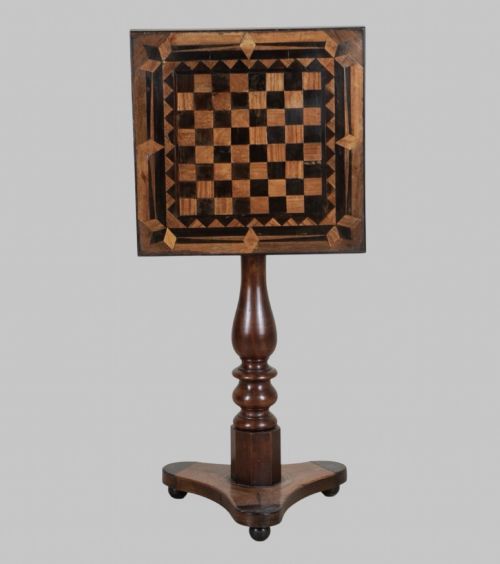
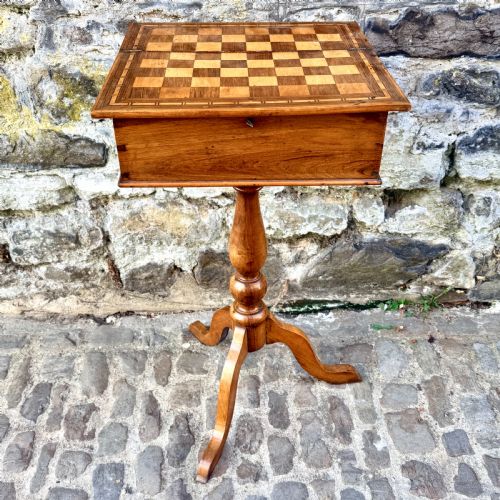


Marquetry Games Board
A marquetry games board offers intricate wood inlay and dual-purpose utility, bringing tactile historical pastimes straight into a modern interior.
Marquetry Games Board
When you search for a marquetry games board, you encounter intricately patterned surfaces designed for historical pastimes such as chess, backgammon, and cribbage. These items bridge decorative arts and functional furniture, serving as both visual centerpieces and usable boards for traditional games.
The versions most commonly met on this page date from the Georgian and Victorian eras, alongside 19th-century French Provincial and Swedish Biedermeier examples. They appear in diverse formats ranging from folding travel boxes to tripod occasional tables and specialised cribbage boxes.
How they were made
Maker workshops utilised contrasting timbers such as walnut, mahogany, rosewood, boxwood, satinwood, and birch to build up the intricate pictorial and geometric marquetry patterns. These woods were carefully selected for their natural colour variations and grain characteristics to create depth and definition on the playing surface.
Detailing often integrated materials like bone and mother-of-pearl to highlight scoring tracks, cribbage boards, or specific decorative motifs within the wood veneer. Fine cutting and fitting of these delicate elements required specialist woodworking skills passed down through traditional cabinet-making guilds.
What varies in quality
The standard of a marquetry games board rests upon the precision of the veneer work and the harmonious selection of timber tones. Superior examples demonstrate seamless joints between contrasting woods, whereas lesser pieces show wider gaps or hurried assembly in the patterned borders.
Structural integrity also separates standard items from exceptional ones, particularly in how well folding hinges align or how stably tripod bases support the playing surface. The complexity of the chosen design, from simple chequered squares to elaborate pictorial scenes, reflects the original maker's investment of time and skill.
The Marquetry Games Board Glossary
- Marquetry
- Decorative veneer work applied to a wooden structure to form geometric patterns or pictorial designs. Craftsmen cut thin slices of various coloured woods and fitted them together meticulously.
- Veneer
- A thin layer of fine wood applied to a base timber to provide a superior decorative exterior. This technique allowed makers to utilise costly and exotic woods efficiently.
- Cribbage board
- A specialised board featuring tracked holes used for scoring the card game cribbage. They frequently appear as standalone boxes or integrated into folding table designs.
- Tripod table
- A small freestanding table supported by a central pillar and three spreading feet. This form allows the top to tilt or remain fixed depending on the intended use for games.
- Boxwood
- A dense, pale yellow wood frequently utilised for contrasting squares and inlay work. Its fine grain permits sharp cutting for intricate board details.
Marquetry Games Board: Frequently Asked Questions
What games were played on these boards?
These boards were primarily designed for traditional pastimes including chess, backgammon, and cribbage. Many incorporated multi-functional surfaces or internal storage compartments to accommodate multiple games within a single piece of furniture.
Travellers also utilised compact folding versions for entertainment during long journeys. The inclusion of cribbage tracks or backgammon points reflects the widespread popularity of board gaming in domestic settings during the Georgian and Victorian periods.
How do I date a marquetry board?
Dating relies on examining the timber species, construction techniques, and stylistic markers visible in the piece. Georgian examples often feature simpler mahogany or walnut frames, while Victorian iterations frequently incorporate walnut, Tunbridge ware elements, or exotic specimen woods.
Hardware such as hinges and locks also provides chronological clues, alongside the overall form of the supporting table or box. Comparing the veneer patterns to established period designs helps narrow down the decade of manufacture.
Are these boards suitable for daily use?
Most antique games boards remain structurally sound for gentle use during modern game sessions. However, the delicate nature of historic veneer and inlay work requires careful handling to prevent scratching or moisture damage.
Placing them away from direct sunlight and extreme temperature fluctuations preserves the natural wood tones and prevents veneer shrinkage. Regular maintenance involves gentle dusting rather than liquid polish applications.
What is the difference between marquetry and inlay?
Marquetry involves assembling an entire picture or pattern from various wood veneers before applying it as a single sheet to the carcase. This technique covers the entire surface with a mosaic of contrasting grains and colours.
Inlay traditionally involves cutting recesses into a solid wood base and inserting contrasting materials directly into those cavities. Both methods appear frequently across 19th-century gaming furniture to delineate playing fields.