

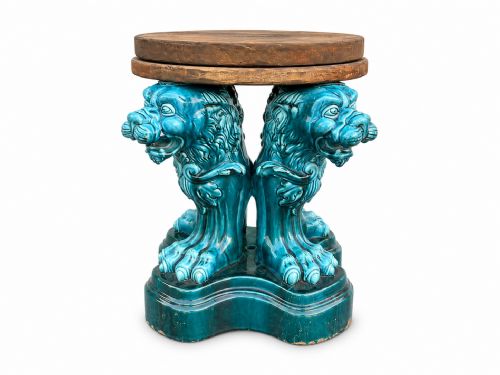
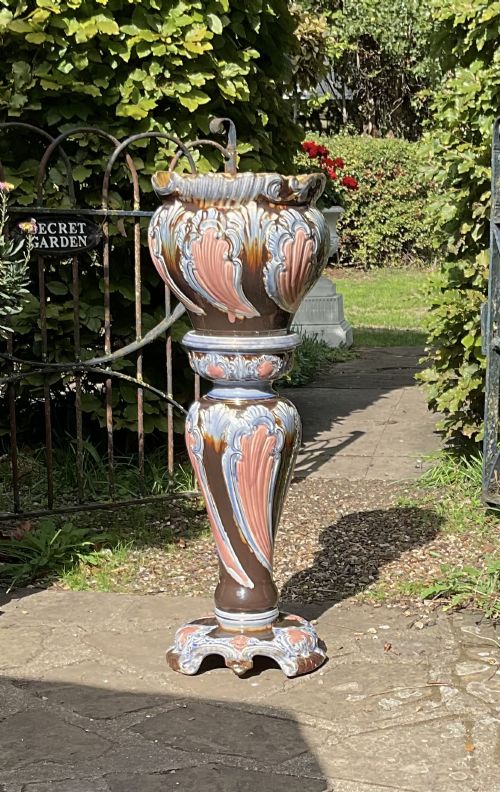


Majolica Plant Pedestal
A majolica plant pedestal carries a heavy potted fern or flowering jardiniere, bringing rich colourful glazes and raised botanical forms into nineteenth and early twentieth century rooms.
Majolica Plant Pedestal
When you search for a majolica plant pedestal, you find ceramic columns, stands and matching jardiniere sets designed to elevate greenery within Victorian and Edwardian interiors. These glazed earthenware pieces range from tall single-column supports to complete two-piece stands paired with matching jardinieres.
The versions you meet most frequently on this page date from the nineteenth century through to the Edwardian period and nineteen-ten. They appear in styles including Victorian naturalism, rustic Victorian designs, Arts and Crafts, and Art Nouveau.
Makers and potteries represented in these forms include Burmantofts, Clement Massier, Minton, Julius Dressler and Woodlesford. Alongside tall stands, the selections incorporate conservatory seats and naturalistic planters.
Materials and construction
Makers formed these pieces from terracotta, earthenware and pottery, shaping them into cylindrical columns or tapering pedestals to support heavy planting vessels. The bodies receive complex modelling with naturalistic motifs such as leaves, branches, swans and griffins.
Potters applied vibrant coloured glazes over the earthenware bodies, sometimes utilising specialised lustre glaze techniques to create metallic sheens and iridescent surfaces. This glossy coating defines the majolica appearance and protects the porous clay beneath.
Majolica Plant Pedestal Retail Price Guide 2026
Typical asking prices for majolica plant pedestal among the pieces listed under this phrase on Sellingantiques today, from the lower quarter to the upper quarter. They describe what is for sale here now, not the wider market.
Listings feature earthenware, terracotta and glazed ceramic materials across nineteenth-century and Edwardian periods.
Quality differences
Quality rests upon the crispness of the moulded detail and the complexity of the glaze application. Pieces modelled with sharp naturalistic relief and rich, even colour distribution sit at the upper end of the range, while softer moulding and flat glazes belong further down.
The presence of a recognised pottery mark or the attribution to a known maker elevates a piece. Complete matching sets of both the jardiniere and its original pedestal command greater interest than solitary stands separated from their bowls.
Clement Massier·Minton·Julius Dressler·Woodlesford
The Majolica Plant Pedestal Glossary
- Majolica
- A type of pottery covered with an opaque tin-lead glaze or colourful lead glazes fired over an earthenware body. It produces bright greens, blues, browns and yellows with a high gloss finish.
- Jardiniere
- A large ornamental pot or container designed to hold growing plants or flowers. They frequently accompany matching pedestals to form tall display stands.
- Pedestal
- A structural support column or base used to elevate a jardiniere or planter above floor level. They feature cylindrical or fluted profiles.
- Lustre glaze
- A metallic film applied to pottery that creates an iridescent, shimmering surface effect when fired in a reduced oxygen kiln. Clement Massier utilised this technique.
- Faience
- Tin-glazed earthenware produced in Europe, often sharing stylistic traits with majolica and Victorian art pottery. Woodlesford pieces fall into this category.
Majolica Plant Pedestal: Frequently Asked Questions
How were majolica plant pedestals used?
These tall stands occupied entrance halls, drawing rooms and conservatories to display large ferns and flowering plants at eye level. By lifting greenery off the floor, they protected carpets and showcased heavy ceramic vessels.
Complete sets combined a deep planter bowl with a matching columnar base to create an imposing architectural feature within domestic interiors. Conservatory seats also served similar decorative functions in glazed ceramic settings.
Are jardiniere stands stable?
Ceramic plant pedestals possess considerable weight due to their dense earthenware construction, which helps anchor heavy potted plants safely. Their broad base footprints provide a secure foundation against accidental knocks in busy rooms.
Because they consist of heavy fired clay, users must place them on level flooring to prevent tipping. Two-piece sets rely on gravity and precise fitting between the top bowl and lower column.
How do I date a majolica pedestal?
Dating relies upon stylistic markers, impressed factory marks and the specific character of the coloured glazes. Victorian naturalistic pieces often feature rustic branch and leaf motifs, whereas Edwardian and later examples show smoother lines or Art Nouveau styling.
Maker signatures stamped into the clay base provide the most reliable chronological anchor. Comparative glaze palettes from potteries like Burmantofts or Minton further narrow the period of manufacture.
What is the difference between earthenware and majolica?
Earthenware is the underlying porous clay body fired at lower temperatures before glazing is applied. Majolica refers specifically to the decorative surface treatment of coloured lead glazes fired onto that earthenware.
Every majolica pedestal uses an earthenware or terracotta base beneath its glossy coloured coating. The term defines the decorative finish rather than the structural clay itself.