

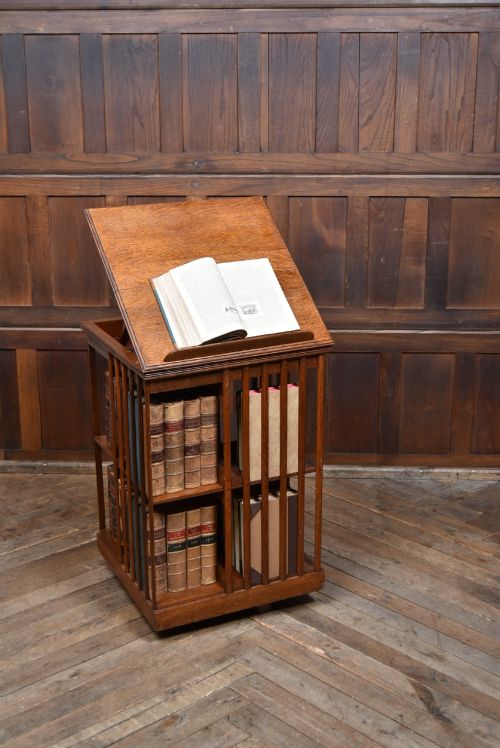


Mahogany Table Top Bookcase
These mahogany table top bookcase pieces offer compact desktop storage, combining rich timbers and revolving mechanics to organise your volumes in style.
Mahogany Table Top Bookcase
A mahogany table top bookcase provides a practical surface or desktop solution for holding working libraries without taking up floor space. You will find examples ranging from Edwardian revolving designs to Regency open formats.
The selection on this page centres heavily upon compact desk accessories and revolving bookcase variations. These forms allow easy access to books from a seated position at a writing table.
Origins span several distinct eras, with Edwardian and Regency pieces forming the core of the selection. Makers from the Georgian period onward utilised durable timbers to construct these desktop containers.
Materials and construction
Makers built these pieces primarily from solid mahogany, often complemented by secondary timbers like oak and rosewood. Brass inlays and cast iron fittings frequently appear on finer examples to strengthen and decorate the framework.
Glass panels protect the contents in certain cabinet formats, while leather surfaces add texture to related writing tables. Skilled cabinet makers shaped the wood to form smooth cylinders, tambour doors, and rotating tier platforms.
Mahogany Table Top Bookcase Retail Price Guide 2026
Typical asking prices for mahogany table top bookcase among the pieces listed under this phrase on Sellingantiques today, from the lower quarter to the upper quarter. They describe what is for sale here now, not the wider market.
Listings feature mahogany, oak, rosewood, brass, and marble across Edwardian, Regency, and Georgian periods.
Judging quality
Quality rests upon the crispness of the mahogany grain and the precision of any brass inlay work. Pieces featuring smooth revolving mechanisms and carefully fitted tambour panels stand above simpler constructions.
The choice of secondary materials, such as marble tops or fine leather inserts, distinguishes exceptional items from standard utility pieces. Superior proportion and balanced styling across the Edwardian and Regency periods indicate higher workshop standards.
The Mahogany Table Top Bookcase Glossary
- Tambour
- A flexible shutter door formed of narrow strips of wood glued to canvas, allowing smooth movement around curved desk fronts.
- Revolving bookcase
- A rotating desktop tier system designed to hold multiple volumes within arm's reach.
- Regency
- An architectural and decorative style period dating from the early nineteenth century, noted for classical restraint and elegant proportions.
- Edwardian
- The period spanning the early twentieth century up to the First World War, characterised by lighter furniture designs and revival styles.
Mahogany Table Top Bookcase: Frequently Asked Questions
What is a mahogany table top bookcase?
It is a small desktop shelving unit or rotating stand designed to keep reference volumes close at hand. These pieces sit neatly upon larger desks, side tables, or cabinets.
They combine practical storage with decorative timberwork, reflecting the aesthetic preferences of periods ranging from the Georgian era through to the early twentieth century.
How do revolving versions work?
Revolving bookcases utilise a concealed central pivot mechanism beneath the tiered shelves. This allows the user to spin the entire book storage block smoothly to select a volume.
Such mechanics require careful engineering so the timber tiers remain balanced and stable during rotation.
Where were these pieces used?
Owners placed them upon library writing desks, study tables, or drawing room surfaces where space for large floor-standing bookcases was limited. They served scholars, writers, and readers needing immediate access to specific texts.
Today, they function well in similar desktop or tabletop roles within domestic studies.
How do I distinguish Edwardian from Regency examples?
Edwardian pieces often feature delicate inlaid decoration and lighter structural framing typical of the early twentieth century. Regency items tend to display classical restraint, richer dark mahogany tones, and heavier architectural lines.
Examining the construction methods and secondary timbers helps clarify the manufacturing era.