

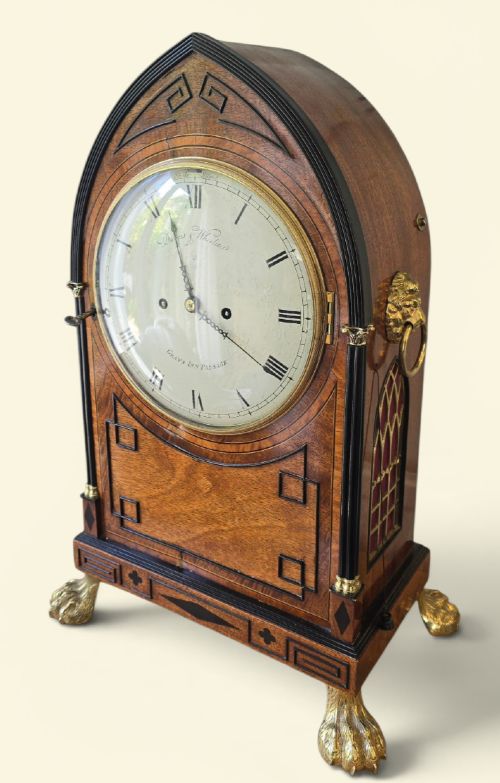


Mahogany Lancet Clock
A mahogany lancet clock combines architectural Gothic lines with warm timber, serving as a striking timepiece for a mantelpiece or bracket shelf.
Mahogany Lancet Clock
When you search for a mahogany lancet clock, you are looking at mantel and bracket clocks defined by their distinctive pointed, arched top resembling a Gothic lancet window. These upright wooden timepieces appear frequently from the Georgian, Regency, Victorian, and Edwardian periods.
The most common examples on this page are compact mantel clocks and bracket clocks housed in polished mahogany cases. Alongside these table clocks, occasional longcase clocks also adopt the characteristic lancet top shape in burr mahogany.
Makers from London and provincial towns produced these cases to sit neatly on tabletops, frequently incorporating brass feet, side handles, or delicate stringing. They function both as dependable timekeepers and as sculptural decorative objects for the room.
What varies in quality
The distinction between ordinary and superior examples lies in the selection of the timber and the crispness of the case architecture. Finer pieces display carefully matched mahogany grain across the curved lancet top and precise execution of stringing.
Internal mechanical complexity and the reputation of the maker elevate a piece significantly. Clocks bearing signatures from established London workshops command greater attention than anonymous provincial items of the same period.
Mahogany Lancet Clock Retail Price Guide 2026
Typical asking prices for mahogany lancet clock among the pieces listed under this phrase on Sellingantiques today, from the lower quarter to the upper quarter. They describe what is for sale here now, not the wider market.
One notable timepiece carries railway provenance, proving that even Victorian commuters appreciated the dignity of a sharp Gothic arch.
Desbois & Wheeler·Cording of London·W. Burton·W&H·Wilkinson Leicester·Ganthony of London·James McCabe·Parkinson & Frodsham
The Mahogany Lancet Clock Glossary
- Lancet top
- An architectural clock case shape featuring a pointed, gothic arch at the crown. This silhouette resembles the narrow windows seen in medieval ecclesiastical architecture.
- Fusee
- A conical pulley mechanism inside a clock that equalises the declining power of the mainspring as it unwinds. This device helps the clock maintain a consistent rate of timekeeping.
- Bracket clock
- A portable clock originally designed to sit upon a matching wall bracket or table. Over time, the term came to describe large mantel clocks housed in wooden cases with carrying handles.
- Stringing
- A narrow strip of contrasting light or dark wood inlaid into the surface of a mahogany case. It creates delicate geometric borders around the door and plinth.
- Ting tang
- A striking train mechanism that sounds two different notes on the quarters or hours using multiple hammers and bells or gongs. It provides a distinctive chime distinct from standard hour striking.
Mahogany Lancet Clock: Frequently Asked Questions
What is a lancet clock?
A lancet clock is a mantel or bracket clock housed in a wooden case distinguished by a pointed, arched top. The silhouette mimics the gothic lancet architectural form popular during the nineteenth and early twentieth centuries.
Cabinet makers utilised mahogany for these cases, often embellishing the upright panels with brass inlay or contrasting stringing. They served primarily as functional timepieces for the principal rooms of a home.
How do I wind my clock?
Most mechanical clocks require a specialised key inserted into small winding holes on the enamel or metal dial. Turning the key clockwise tensions the internal springs.
Care must be taken not to overwind the movement, as this can strain the mainspring. Refer to the specific instructions for fusee or striking movements to ensure proper handling.
Where should I place it?
These clocks are designed to sit securely on level surfaces such as mantelpieces, sideboards, or dedicated bracket shelves. A stable foundation is essential for the pendulum or balance wheel to beat evenly.
Keep the wooden case away from direct sunlight, radiators, and damp environments to protect the polished mahogany finish and internal brass work from deterioration.
How can I tell the period?
Dating a piece involves examining the timber selection, dial construction, and internal movement style. Georgian and Regency examples often feature heavier brass mounts and simpler dial layouts, while Edwardian models may incorporate refined stringing and different chime types.
Signatures on the dial or movement backplate often provide a direct link to known makers working in specific eras.