


Mahogany Hearth Screen
These mahogany hearth screen pieces offer adjustable wooden protection and needlework panels, bringing period warmth and decorative craft to a sitting room.
Mahogany Hearth Screen
A mahogany hearth screen stands near a fireplace to shield occupants from radiant heat while displaying decorative needlework or prints. These pieces date across Georgian, Regency, William IV, and Victorian periods, reflecting shifting tastes in interior comfort.
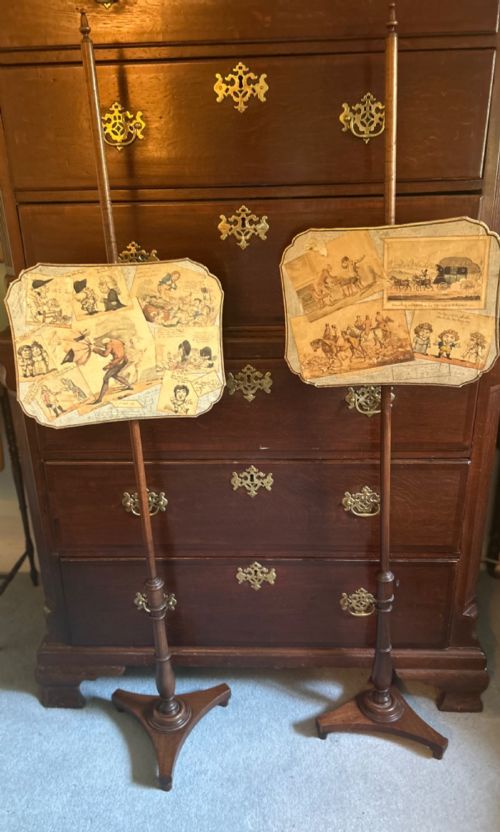
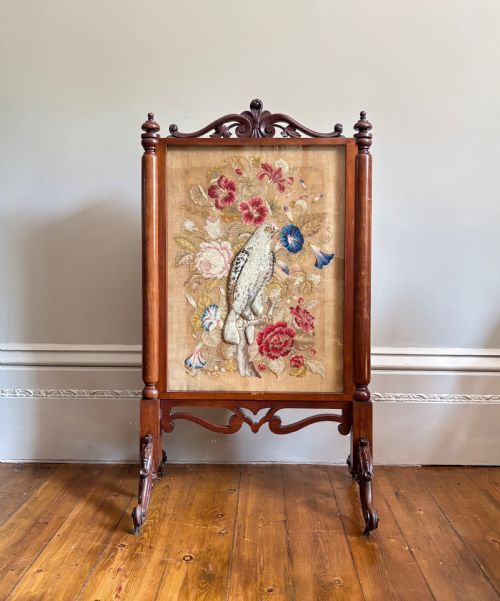
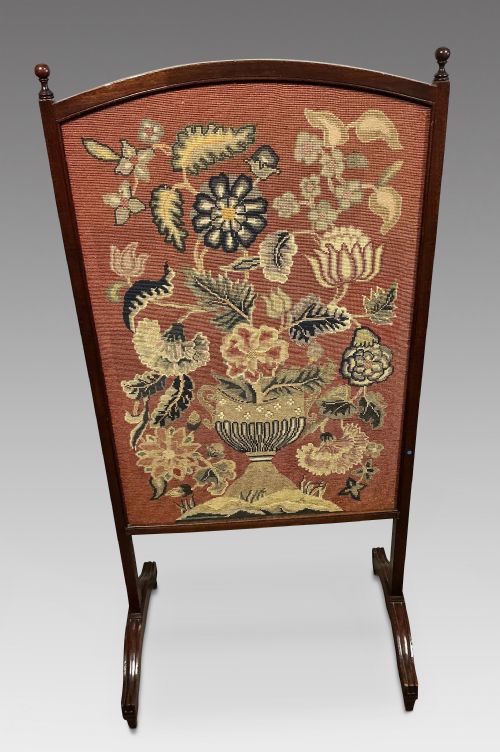
The most common form on this page is the pole screen, featuring a vertical wooden shaft on a carved base with an adjustable sliding panel. Other variations include folding leaf screens and fixed glass or tapestry designs.
Examples utilise mahogany timbers combined with brass fittings and textiles such as wool, silk, and tapestry. The panels display embroidered needlepoint, Berlin work, satirical prints, or hand-painted details.
What varies in quality
The sophistication of the timber turning and the carving on the base distinguish standard examples from finer pieces. Bases featuring robust tripod legs with detailed carving demonstrate superior cabinet-making.
The complexity and condition of the central panel elevate a piece, particularly finely worked needlepoint tapestry, heraldic depictions, or satirical prints. Original adjustable brass fittings that retain smooth movement also indicate higher standard production.
One surviving Georgian screen depicts the Clan Maclellan coat of arms alongside witty satirical prints.
The Mahogany Hearth Screen Glossary
- Berlin work
- A style of counted-thread embroidery popular in the nineteenth century using wool on canvas. It often produced colourful, highly detailed pictorial panels for screens.
- Needlepoint
- Embroidery stitched onto a canvas mesh ground to form dense pictorial designs. This technique accounts for many of the textile panels found within these frames.
- Poker work
- A decorative technique using heated metal tools to burn designs into wood or leather. Examples appear on panels as an alternative to textile embroidery.
Mahogany Hearth Screen: Frequently Asked Questions
How do you adjust the panel height?
Most pole screens utilise a brass collar or thumb screw at the back of the panel. Loosening this mechanism allows the frame to slide up and down the vertical mahogany shaft to the desired position.
Tightening the fitting secures the panel in place against the radiant heat of the fireplace.
What rooms suit a hearth screen today?
These screens fit comfortably beside modern fireplaces or wood-burning stoves where radiant heat control remains useful. They also serve as decorative partitions in sitting rooms or studies.
The slim profile of a pole screen allows it to occupy corners without taking up substantial floor space.
How do I identify a Regency period screen?
Regency pieces often display restrained classical lines, sometimes incorporating brass inlay or specific carved motifs upon the base. The proportions tend to balance slender turned poles with stable tripod supports.
Needlework panels from this era frequently utilise specific botanical or geometric motifs characteristic of the early nineteenth century.
Are the textile panels original?
Many screens retain their period needlework, tapestry, or Berlin work panels mounted within the mahogany frame. The age of the textiles generally aligns with the manufacturing period of the woodwork.
Examining the back of the panel reveals the mounting technique and the retention of older lining materials.