

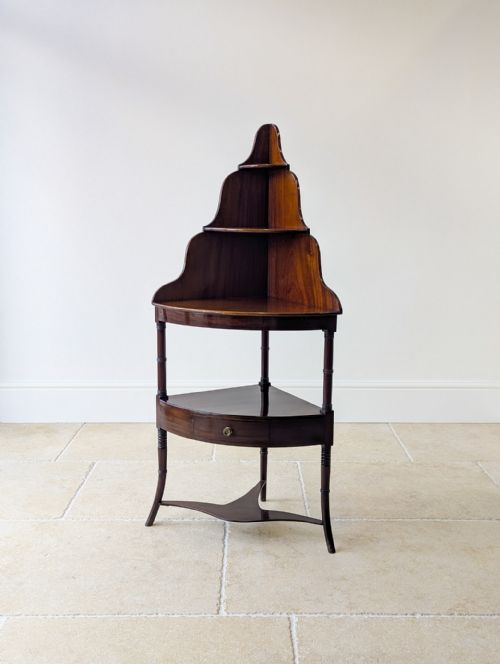


Mahogany Corner Shelving
Mahogany corner shelving solves awkward angles with tiers of warm timber designed to hold books, ceramics and ornaments.
Mahogany Corner Shelving
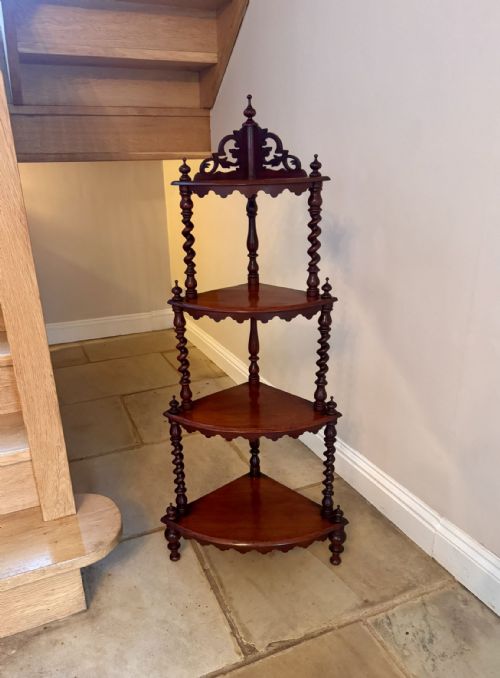
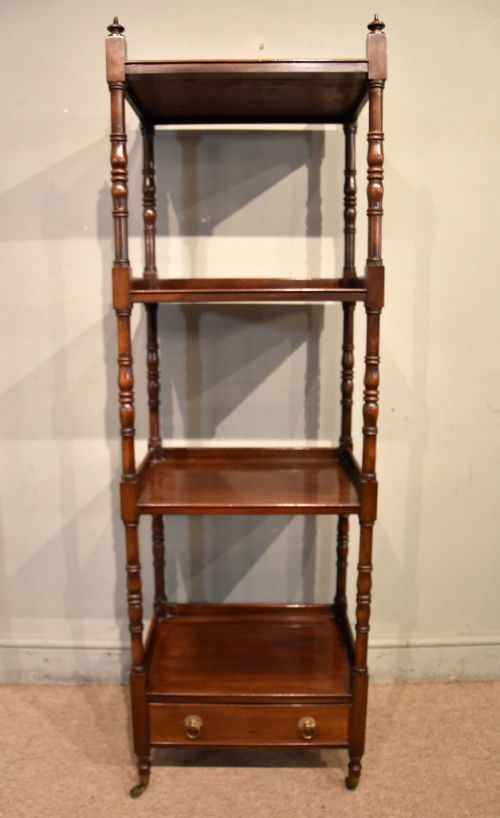
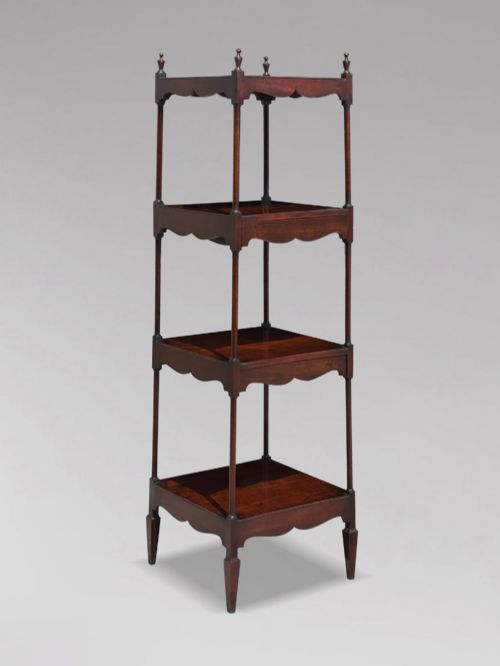
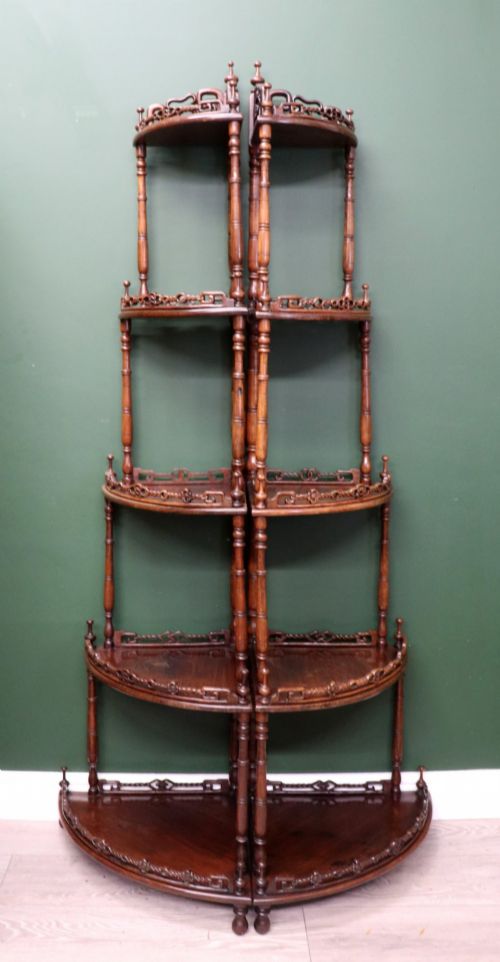
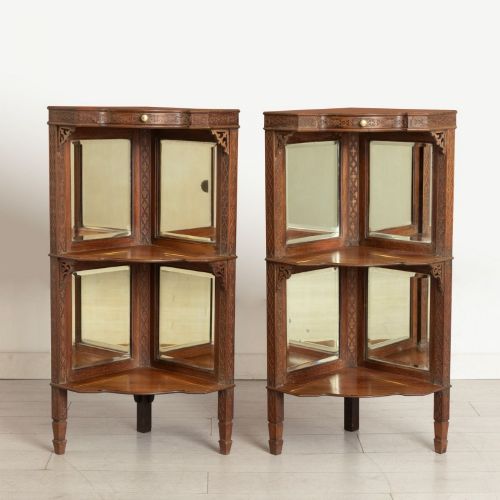
Mahogany corner shelving appears across multiple periods including Georgian, Regency and Victorian eras, taking forms such as tiered whatnots, etageres, corner cabinets and open bookcases. These pieces utilise unused wall angles to provide vertical display and storage without dominating a room.
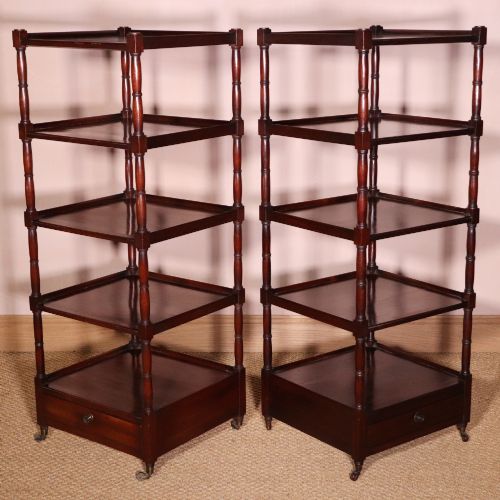
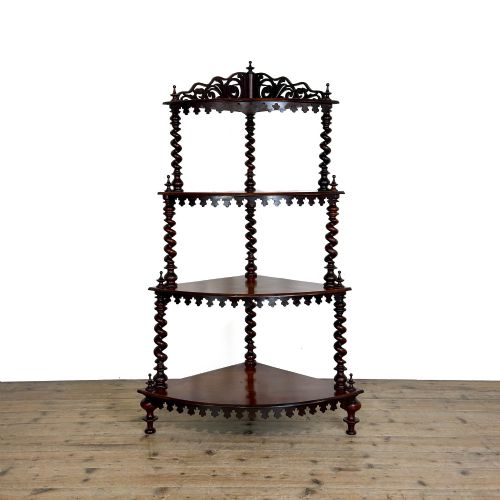
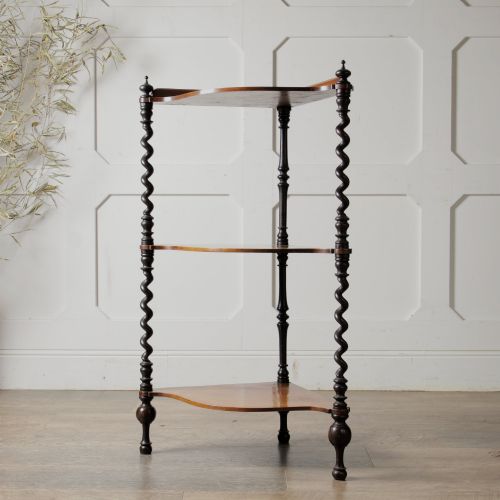
The pieces on this page lean heavily towards nineteenth-century examples, with Victorian and Regency versions dominating alongside eighteenth-century Georgian designs. Buyers encounter everything from simple three-tier open shelves to elaborate four-tier units with barley twist supports, mirrors and enclosed cupboards.
Materials and construction methods
Cabinet makers relied primarily on solid mahogany and mahogany veneers, often enhanced with fruitwood inlay, glass panels and brass fittings. Structural integrity in multi-tiered pieces relied on precisely turned supports, columns or barley twist uprights that bore the weight of each shelf.
Back panels and secondary timbers occasionally incorporate oak, while specific workshop pieces display fine carving, ebonised details and mirrored backs. Construction methods range from freestanding multi-tier frames to hanging cupboards and wall-mounted brackets designed to fit tight internal angles.
Materials appearing across the inventory include solid mahogany, glass, mirror glass, brass, fruitwood inlay, paint, walnut and oak.
Quality factors in mahogany corner pieces
Quality rests on the selection of the mahogany timber itself, where rich grain patterns and deep natural colour elevate a piece above plain or heavily repaired stock. The crispness of hand-carving on uprights, mouldings and brackets distinguishes superior workshop output from standard production.
Structural joinery dictates longevity, particularly in multi-tiered whatnots where uprights meet shelves without wobble or misalignment. Thoughtful details such as inlaid fruitwood, original brass hardware and well-fitted cupboard doors separate ordinary utility furniture from finer examples.
Gillows·Edwards and Roberts·Goodhall Lamb and Heighway
The Mahogany Corner Shelving Glossary
- Whatnot
- A movable set of open shelves used for displaying ornaments and books, popular from the late eighteenth century onwards.
- Etagere
- A piece of furniture consisting of a number of tiers for holding ornaments, closely related in form to the whatnot.
- Barley twist
- A type of turned column resembling a spiralling rope, frequently found on nineteenth-century supports and uprights.
- Bow front
- A convex, curved front section of a cabinet or set of shelves that softens the sharp geometry of a corner unit.
- Inlay
- A decorative technique where contrasting materials such as fruitwood are inserted into recesses within the mahogany surface.
Mahogany Corner Shelving: Frequently Asked Questions
What is a corner whatnot?
A corner whatnot is a tiered open shelving unit designed specifically to fit into the right-angle corner of a room. It provides vertical display space for books, ceramics and decorative objects.
These pieces became popular in the Georgian period and remained staples through the Victorian era. Their triangular footprint allows them to utilise dead space effectively.
How do I spot a Regency piece?
Regency pieces often display clean architectural lines, tapering supports and restrained use of brass inlay or mounts. The mahogany selected during this era usually has a warm, deep tone.
Look for proportion and simplicity compared to the heavier carved decoration seen on later Victorian items. Maker signatures or distinctive turnings can also point towards this period.
Can these shelves hold heavy books?
Most corner whatnots and etageres were built to display decorative ornaments, ceramics and lighter volumes rather than heavy reference libraries. The weight capacity depends entirely on the stability of the upright supports and the fixing of the shelves.
Free-standing five-tier models offer robust timber construction, but wall-mounted brackets require careful inspection of fixings before loading them with heavy objects.
Are these pieces stable on uneven floors?
Multi-tiered corner units can rock slightly on older uneven floors, particularly taller four or five-tier examples. Small adjustments or discreet leveling may be needed to ensure total stability.
Because they fit tightly into a corner, wall proximity often provides additional points for secure placement if necessary.