
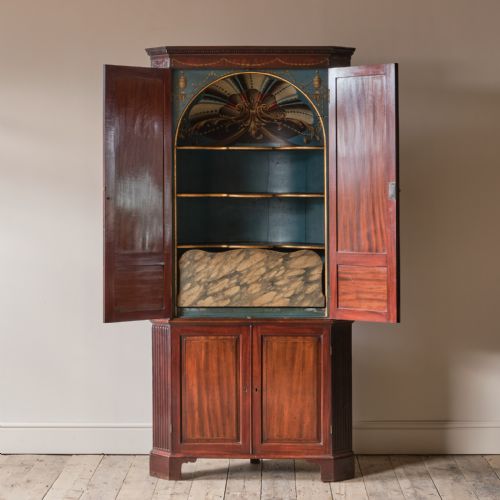
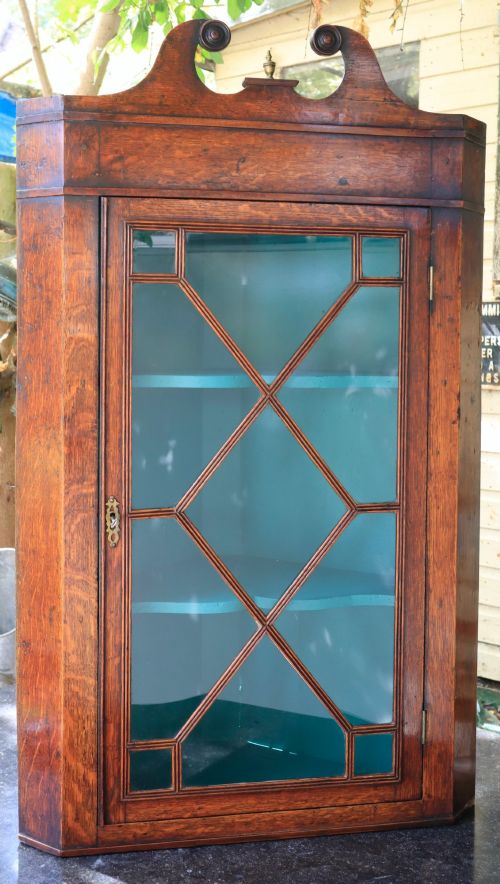


Mahogany Corner Display Case
Mahogany corner display cases are space-saving glazed units designed to house treasured objects, and collectors prize them for their rich timber figures and clever geometry.
Mahogany Corner Display Case
A mahogany corner display case serves to utilise awkward room angles while framing collection pieces behind glass. The selection ranges from wall-hanging cupboards to substantial standing double-height units and standing bookcases.
Georgian examples often display simple architectural glazing bars, whereas Edwardian and Sheraton Revival iterations introduce delicate satinwood inlay and serpentine fronts. Hanging variants frequently include internal shelving and lower drawers.
Materials and construction
Cabinet makers utilised dense tropical mahogany for structural stability, often selecting figured veneers for door panels and cornices. Satinwood inlay provides contrasting stringing and classical motifs across Edwardian and revival pieces.
Glazing relies on timber muntins dividing glass panes, while brass hardware secures doors and internal drawers. Fabric linings occasionally back the interior display space behind the glass doors.
Several cabinets include locking doors with working keys, essential for keeping curious hands away from delicate displays.
Judgments of quality
Quality rests in timber selection and the precision of the cabinet work, particularly around curved bow fronts and serpentine doors. Finely cut inlay and original brass fittings elevate the standing of a piece.
Proportion and scale distinguish superior items, such as double-height standing cupboards with harmonious upper and lower sections. Finer Georgian and Edwards and Roberts pieces demonstrate sharper carving and more meticulous joinery.
John Stow Ltd·Edwards And Roberts
The Mahogany Corner Display Case Glossary
- Serpentine front
- A curved shape that undulates with a convex centre flanked by concave wings. This complex joinery requires considerable skill to construct in solid mahogany.
- Bow front
- A cabinet door or front curved in a simple outward arc. It softens the severe angles inherent to room corners.
- Satinwood inlay
- Decorative contrasting wood veneers set flush into the mahogany surface. It is typical of Sheraton Revival and Edwardian craftsmanship.
- Glazing bars
- The wooden strips that hold individual panes of glass within a door. Earlier examples tend to feature heavier profiles than later Victorian or Edwardian equivalents.
Mahogany Corner Display Case: Frequently Asked Questions
How do I hang a wall corner cabinet safely?
Wall-hanging mahogany corner units require secure fixing to solid masonry or properly located wall studs using heavy-duty brackets. The substantial weight of the timber and glass demands robust hardware to bear the load.
Distribute the weight of any displayed ceramics or glassware evenly across the internal shelves once the cabinet is fixed. Check the stability of the hanging loops or internal fixing points before loading the case.
Are these cabinets suitable for small rooms?
Corner display cases are specifically designed to fit into unused room angles, making them ideal for compact spaces. Their triangular footprint maximises display area without encroaching into the main floor plan.
Tall standing versions draw the eye upward, creating an impression of height while occupying minimal floor space. Wall-hanging variants free up the floor entirely while still providing enclosed storage.
How do I distinguish Georgian from Edwardian pieces?
Georgian mahogany corner cabinets typically exhibit heavier structural timbers, simpler architectural lines, and hand-cut glazing bars. They date from the eighteenth or early nineteenth century and rely on proportion rather than surface decoration.
Edwardian and Sheraton Revival pieces from around nineteen hundred often feature lighter construction, satinwood inlay, and bowed glass doors. They reflect a revival of eighteenth-century neoclassical aesthetics combined with Edwardian manufacturing techniques.
Can I adjust the shelves inside?
Most antique corner cabinets feature fixed wooden shelving grooved into the interior sides of the carcass. Altering shelf heights is rarely straightforward due to the original construction methods.
Plan the scale of your collection pieces to fit the fixed shelf clearances before purchasing. Shorter cabinet sections suit small glassware, while double-height standing units accommodate taller volumes and ceramics.