


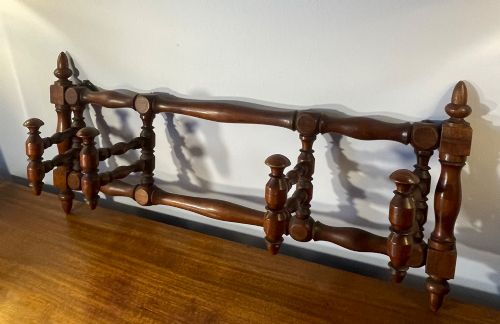
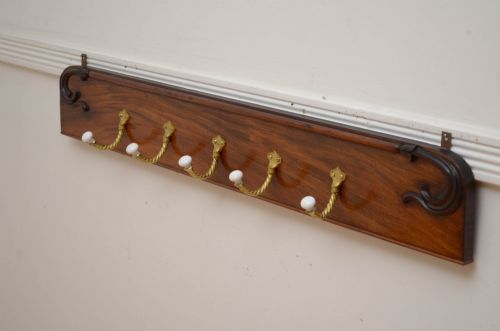
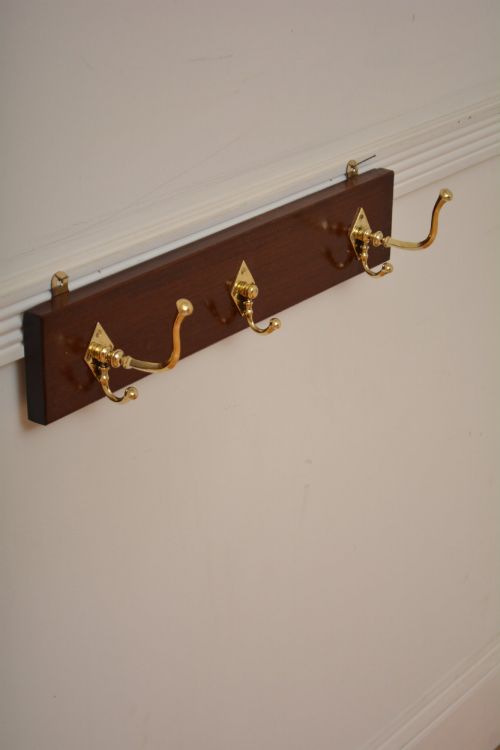


Mahogany Coat Rail
These mahogany coat rail examples offer practical entrance storage in traditional wood, bringing period utility to hallways.
Mahogany Coat Rail
A mahogany coat rail provides a sturdy wooden batten mounted with metal or ceramic hooks for hanging garments in a hallway or cloakroom. These functional fixtures appear across several nineteenth and early twentieth century periods including Victorian and Edwardian eras.
The assortment on this page includes wall-mounted hat and coat racks alongside larger hall stands and portmanteau designs. Most examples combine rich mahogany timbers with brass or ceramic fittings, creating a reliable hallway accessory.
How they were made
Makers shaped dense mahogany planks to form the foundational mounting boards, often utilising solid timber to support the weight of heavy garments. Metal hooks made from brass or iron fasten securely to the wood, frequently complemented by ceramic or glass details.
Construction techniques span simple wall rails fixed via cast mounting plates to more elaborate bentwood or turned wooden frames. Artisans during the Victorian and Edwardian periods applied hand-finished details to the timber and metalwork.
Mahogany Coat Rail Retail Price Guide 2026
Typical asking prices for mahogany coat rail among the pieces listed under this phrase on Sellingantiques today, from the lower quarter to the upper quarter. They describe what is for sale here now, not the wider market.
Listings feature mahogany, brass, glass, ceramic, iron, bentwood, and beech across Victorian, Edwardian, and William IV styles.
What varies in quality
Quality rests in the weight of the timber and the standard of the cast mounting plates rather than decorative excess alone. Thicker mahogany boards and heavily cast brass elements distinguish the superior examples from standard utility pieces.
The choice of hook materials and the finesse of the metal casting separate standard hat racks from finer Aesthetic Movement or William IV pieces. Well-executed twisted rope carvings or integrated ceramic inserts denote superior craftsmanship.
The Mahogany Coat Rail Glossary
- Mahogany
- A durable reddish-brown tropical hardwood utilised extensively for furniture and wall fixtures throughout the nineteenth century. Its strength makes it ideal for supporting heavy coats and hats.
- Bentwood
- Wood softened by steam and bent into curved structural forms, seen in certain hat and coat hooks. This technique creates graceful rounded shapes without relying on complex joinery.
- Portmanteau
- A term applied to wall-mounted or freestanding hallway fixtures designed for hanging garments and storing accessories. These pieces serve a similar organisational purpose to standard coat rails.
- Aesthetic Movement
- A nineteenth-century design style focusing on artistic visual qualities and refined craftsmanship. Pieces from this period often incorporate distinctive brass and mahogany arrangements.
Mahogany Coat Rail: Frequently Asked Questions
How do I hang a heavy mahogany coat rail?
Secure the wooden mounting board directly into wall studs using appropriate fixings through the pre-cast holes or mounting plates. Solid timber rails require robust support to safely bear the weight of winter garments.
Ensure the wall material can handle the load before mounting older Victorian or Edwardian fixtures, as dense mahogany timber and cast metal hooks add considerable weight.
What is the difference between a coat rail and a hall stand?
A coat rail is a linear wooden batten fixed directly to the wall with mounted hooks, designed primarily for hanging garments in confined spaces. A hall stand is typically a larger freestanding piece that may include mirror panels, umbrella holders, and seating.
Both forms utilise materials like mahogany and brass, but hall stands offer multi-functional furniture for a reception hall rather than simple wall storage.
How do I clean nineteenth-century mahogany and brass?
Dust the timber gently with a dry, soft cloth and apply a quality beeswax periodically to maintain the rich lustre of the mahogany. Avoid harsh chemical cleaners that might strip the historic finish.
Clean brass hooks with a mild metal polish if required, taking care not to let abrasive substances touch the surrounding wooden backplate.
Can I date a coat rail by its hooks?
Hook design provides strong clues to the period, with early examples featuring heavy brass castings, ceramic inserts, or distinctive Aesthetic Movement styling. William IV pieces often display carved details like twisted rope motifs.
Simpler iron or bentwood hooks frequently point towards later nineteenth or early twentieth-century utility production.