
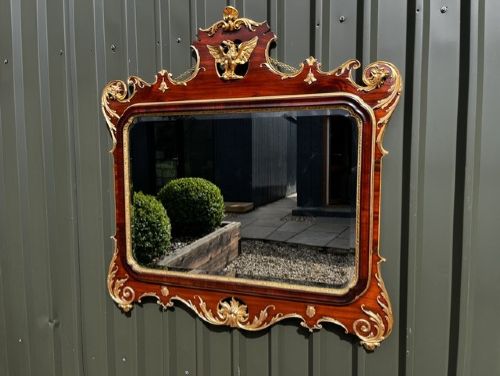
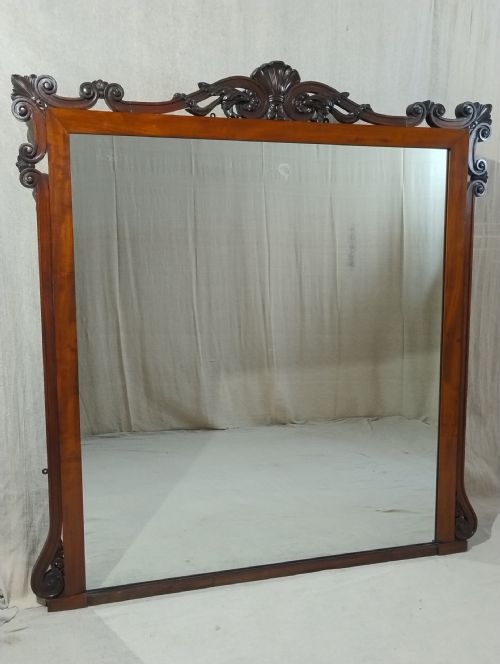


Mahogany Chimney Mirror
These mahogany chimney mirror examples bring deep timber frames and period glass to a fireplace, offering a functional centrepiece for the room.
Mahogany Chimney Mirror
A mahogany chimney mirror is a substantial looking glass designed to sit above a fireplace, often taking the form of an overmantel mirror. These furnishings span several distinct eras, including the 18th century, Regency period, Victorian era, and Edwardian times.
The selections encountered here range from large antique wall mirrors to smaller overmantel variants and fretted triptych designs. Makers utilised rich timbers such as mahogany and rosewood, frequently incorporating parcel gilt highlights or marquetry details.
How they were made
Joiners constructed these frames using solid hardwoods like mahogany, frequently applying giltwood accents or parcel gilt to catch the light of a room. Marquetry and wood inlay decorated the surfaces of later Edwardian pieces, adding geometric or floral motifs to the timber.
Glaziers set original or bevelled glass into the timber rebates, supporting the large weight of the plates within sturdy wooden structures. Carved elements adorned the crests and borders of Chippendale style and Victorian examples, showing traditional hand-working techniques.
Some Victorian mirrors feature triptych frames, ideal for checking your hair from three angles before greeting unexpected visitors.
What varies in quality
The sophistication of the carved ornamentation and the depth of the timber moulding define the upper tier of these mirrors. Superior examples display crisp joinery and well-preserved parcel gilt, whereas simpler pieces rely on plain mahogany framing without carving.
The proportion between the glass plate and the surrounding woodwork dictates the visual balance of the object. Finer items integrate marquetry or triptych panel layouts with precision, while more utilitarian domestic pieces keep the wooden framing straightforward.
The Mahogany Chimney Mirror Glossary
- Overmantel mirror
- A large looking glass specifically proportioned to hang on the wall directly above a fireplace mantelpiece. These fixtures often span a considerable horizontal width to reflect the hearth below.
- Parcel gilt
- A decorative technique where small sections of a wooden frame are partially covered in gold leaf. This method highlights specific carved details against the dark mahogany background.
- Marquetry
- The art of applying thin veneers of different coloured woods to form decorative patterns on a surface. Edwardian makers utilised this method to create intricate designs across the timber frame.
- Bevelled glass
- A mirror plate with edges cut and polished at an angle to create a framed border effect. This treatment catches light distinctively and indicates refined glass production.
- Triptych mirror
- A three-panel looking glass where a larger central section is flanked by two smaller hinged or fixed panes. This configuration adds architectural complexity to the overall frame.
Mahogany Chimney Mirror: Frequently Asked Questions
What is a mahogany chimney mirror?
A mahogany chimney mirror is a large looking glass built to mount directly over a fireplace opening. These objects serve as prominent architectural focal points within a room.
They appear in various period styles ranging from Georgian and Regency to Victorian and Edwardian interpretations. The timber frames often feature carved details, parcel gilt, or decorative wood inlay.
Where should I hang an overmantel mirror?
These mirrors traditionally hang on the chimney breast directly above the fireplace mantelpiece. Their horizontal proportions suit the width of a standard hearth.
Placing them in this position allows the glass to reflect light from windows across the room. They can also be mounted on large drawing room walls as standalone decorative art pieces.
How do I identify the period of a mirror?
Dating relies on observing the combination of timber selection, framing style, and mirror glass construction. Georgian and Regency pieces often show clean architectural lines or Chippendale carving influences.
Victorian and Edwardian examples frequently introduce heavier proportions, rosewood veneers, or marquetry detailing. Examining the backboards and fixings also helps determine the age of the construction.
Are these mirrors heavy to hang?
These pieces possess substantial weight due to the combination of dense hardwood frames and thick glass plates. Proper wall fixings are essential to secure them safely to masonry or studwork.
Professional installation is recommended for large overmantel variants to ensure the weight distributes evenly. The hanging brackets must anchor securely into solid support structures.