



Louis XV Walnut Settee
A louis xv walnut settee brings fluid Rococo lines and warm timber tones to a room, offering both generous seating and distinct decorative presence.
Louis XV Walnut Settee
A louis xv walnut settee represents a French seating form defined by curved frames, cabriole legs, and organic floral carving. When searching for this phrase, buyers encounter pieces spanning the nineteenth century alongside revival interpretations from the early twentieth century.
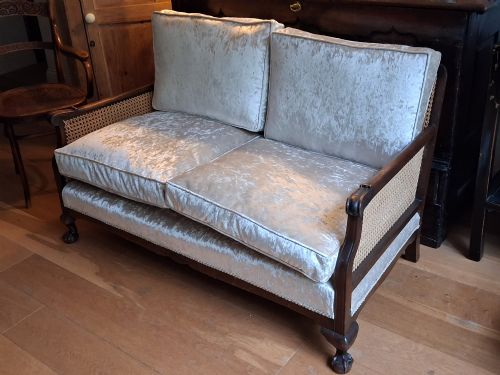
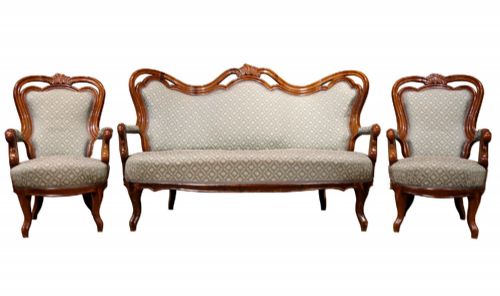
The variations on this page include two and three-seater couches, canapés, and salon suites paired with matching armchairs. Many examples utilise cane work panels within the back and sides, while others employ traditional textile upholstery.
Origins cluster around French provincial workshops and later revival makers who adopted the classic Louis XV style. The timber is predominantly walnut, sometimes bleached or finished with a pale tone to highlight the carved details.
Materials and construction
The structural framework of these settees relies on solid walnut, chosen for its strength and suitability for intricate hand carving. Craftsmen shaped the wood into flowing cabriole legs and serpentine rails without relying on straight lines.
Panel inserts on many pieces utilise woven cane work, requiring skilled manual labour to thread natural materials tightly through the frame. Alternatively, traditional upholstery techniques deploy textile, linen, and velvet over sprung or stuffed foundations.
Louis XV Walnut Settee Retail Price Guide 2026
Typical asking prices for louis xv walnut settee among the pieces listed under this phrase on Sellingantiques today, from the lower quarter to the upper quarter. They describe what is for sale here now, not the wider market.
The selection includes individual sofas alongside three-piece salon suites comprising a small sofa and matching armchairs.
Judging quality and craftsmanship
Depth and crispness of the hand carving separate standard production from finer work, as skilled carvers render naturalistic foliage and scrolls directly into the solid walnut. The flow of the timber grain along the curved rails also indicates careful material selection.
Integration of the cane work or upholstery defines the finish of the piece, with tightly woven panels and well-balanced proportions marking superior examples. The structural stability of the frame joints ensures the settee remains solid during daily use.
The Louis XV Walnut Settee Glossary
- Canapé
- A traditional French term for a long settee or sofa designed for multiple occupants. These pieces often share proportions with salon chairs of the same period.
- Bergère
- An enclosed upholstered armchair or sofa featuring solid wooden sides and a padded back. The style provides a deep and comfortable seat.
- Cabriole leg
- A furniture leg that curves outward and then tapers inward, finishing in a scroll or pad foot. This form mimics the natural shape of animal limbs and defines Rococo design.
- Salon suite
- A matching set of seating furniture comprising a settee and complementary armchairs. These groupings furnished formal entertaining rooms.
- Rococo revival
- A nineteenth-century design movement that re-interpreted the asymmetrical curves and shell motifs of the eighteenth-century French style. Makers utilised walnut to recreate historic forms with contemporary tools.
Louis XV Walnut Settee: Frequently Asked Questions
How do I clean cane work?
Dust cane panels gently with a soft brush and wipe occasionally with a damp cloth to maintain moisture in the natural fibres. Avoid harsh chemical cleaners that can dry out and snap the woven strands.
Allow the material to dry completely before use. Keeping the room at a moderate humidity level prevents the cane from becoming brittle over time.
Where should I place my settee?
A settee suits a living room, a large hallway, or the foot of a bed where its decorative wooden frame remains visible. Positioning the piece away from direct sunlight protects the walnut timber and any fabric upholstery from fading.
Leave sufficient space around the curved legs and arms to appreciate the carved details. Pairing the settee with complementary armchairs creates a cohesive seating area.
Are these settees comfortable for daily use?
Many pieces offer supportive seating through upholstered or caned backs combined with padded seat cushions. Revival and nineteenth-century examples often incorporate sprung interiors designed for relaxation.
Support varies depending on whether the piece relies on a rigid caned base or a soft textile cushion. Adding scatter cushions can adjust the seat depth to suit individual preference.
How do I date a walnut settee?
Examine the colour and grain of the walnut timber alongside the tool marks left on the underside of the frame. Nineteenth-century revival pieces often display machine-assisted construction combined with hand finishing.
Compare the style of the carving and the proportions of the cabriole legs to known periods. Eighteenth-century originals feature different joinery techniques compared to nineteenth-century interpretations.