


Louis XV Couch
A louis xv couch brings serpentine curves and grand salon seating into a room, offering low-slung comfort with carved floral motifs.
Louis XV Couch
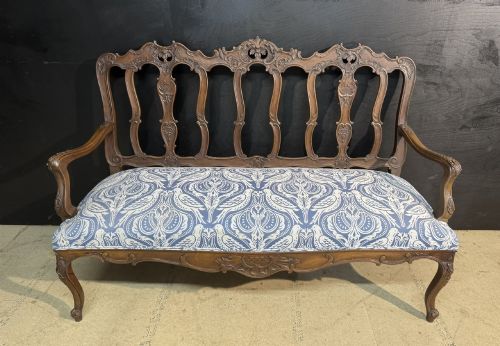
When you search for a louis xv couch, you enter a world of asymmetric scrolls, cabriole legs, and sweeping wooden frames designed for formal reception rooms. These seating forms span various decades from the nineteenth century into the early twentieth century, reflecting revivals of eighteenth-century French taste.
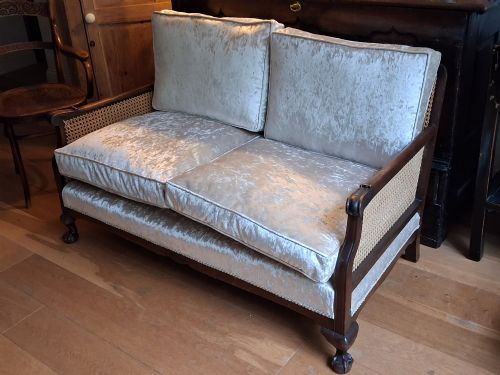
You will most frequently encounter walnut frames, giltwood surfaces, and caned panels taking the shape of settees, two-seater sofas, and larger salon seating. The French provincial and Rococo revival styles dominate these pieces, bringing ornate carvings and curved silhouettes to domestic spaces.
Forms range from compact caned bergères to large gilded sofas upholstered in velvet, silk, linen, or tapestry textiles. Each iteration shares a low profile and flowing structural lines that define the classic French seating tradition.
What varies in quality
Depth and crispness of the hand-carved woodwork distinguish finer frames from simpler production, separating deep relief floral motifs from shallow moulding. The quality of the underlying timber, whether richly figured walnut or finely applied gilding over gesso, dictates the visual weight of the piece.
Upholstery execution and the tightness of cane weaving alter the tactile experience, alongside the structural integrity of the serpentine frame and cabriole legs.
Several pieces are specifically noted as boudoir seating, suggesting they served for private gossip rather than formal entertaining.
The Louis XV Couch Glossary
- Cabriole leg
- An S-shaped furniture leg curving outward at the knee and tapering inward to a modest foot, characteristic of the style.
- Bergère
- An enclosed upholstered armchair or small sofa featuring exposed wooden framing and upholstered sides.
- Canape
- An antique French term for a decorative sofa or settee designed for multiple occupants in a salon setting.
- Giltwood
- Timber coated with a thin layer of gold leaf or gilt paint, imparting a luminous metallic finish to the carved frame.
- Rococo revival
- A nineteenth-century design movement that reinterpreted the curving, asymmetrical ornamentation of the mid-eighteenth-century French court.
Louis XV Couch: Frequently Asked Questions
Where did these sofas originate?
These seating forms draw inspiration from eighteenth-century French court furniture commissioned during the reign of Louis the Fifteenth, later reinterpreted by nineteenth and early twentieth-century makers.
The revival pieces seen today reflect European fascination with historic French design traditions adapted for Victorian and Edwardian drawing rooms.
How are two-seater and three-seater models different?
Two-seater models, often termed settees, loveseats, or small couches, provide intimate proportions suited to boudoirs and smaller reception spaces.
Three-seater and large salon sofas offer extended length and additional carved support struts, designed to anchor larger drawing rooms.
Can I use cane-backed couches daily?
Caned panels provide resilient and breathable seating surfaces that withstand regular domestic use when handled with reasonable care.
Placing cushions on the seat helps protect the woven cane from direct heavy wear over time.
What distinguishes giltwood from painted finishes?
Giltwood involves the application of thin gold leaf over a prepared surface, creating a reflective metallic sheen that catches natural light.
Painted or gold-painted finishes utilise liquid pigments to achieve a decorative metallic or coloured effect without leaf application.