





Long Pine Pew
A long pine pew offers robust, honest seating born from institutional and domestic utility.
Long Pine Pew
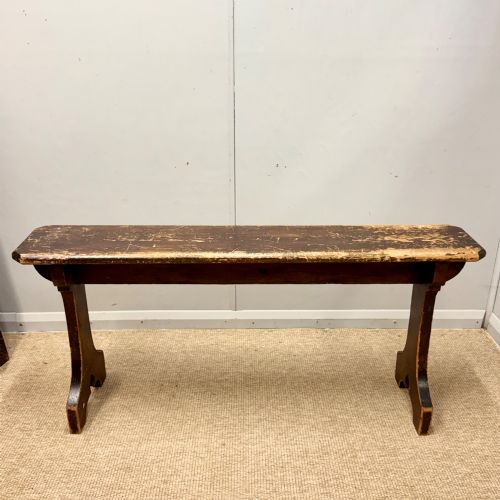
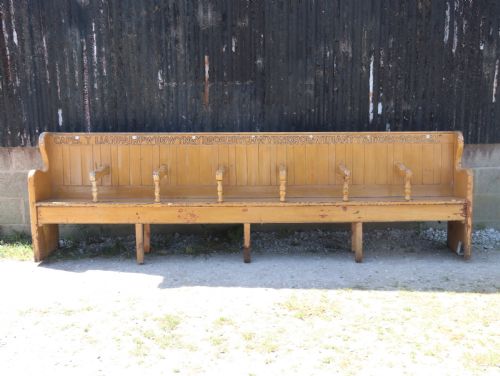
A long pine pew is a sturdy timber bench designed for communal seating in churches, schools, and domestic spaces. Buyers searching for a long pine pew will encounter items spanning the Victorian era through the early twentieth century.
These pieces encompass various forms including church pews, school benches, railway benches, and long dining benches. Origins range from English workshops to French provincial and Scandinavian traditions.
The aesthetic leans heavily toward rustic country, farmhouse, and industrial vernacular styles. Many examples feature simple linear forms constructed for utilitarian endurance rather than ostentatious display.
How they were made
Construction relies primarily on pine and softwood timber, occasionally supplemented by pitch pine or ash components. Iron fixings provide structural reinforcement where joints endure daily stress.
Surfaces frequently display historic paint finishes or bare timber showing the natural grain of the softwood. Selected pieces incorporate fabric elements or specialised mechanisms like flip-over seating arrangements.
Long Pine Pew Retail Price Guide 2026
Typical asking prices for long pine pew among the pieces listed under this phrase on Sellingantiques today, from the lower quarter to the upper quarter. They describe what is for sale here now, not the wider market.
Listings span the nineteenth century, the Victorian period, and early twentieth-century dates up to nineteen-ten, utilising pine, softwood, iron, and fabric.
What varies in quality
Quality rests upon the integrity of the timber selection and the honesty of the construction. Pieces originating from specific institutional contexts, such as marked chapel benches, carry greater historical specificity.
Proportion and length dictate utility, with longer runs maintaining structural soundness without sagging. The character of the surface patina, whether through weathered softwood or aged paint, separates everyday utility from finer examples.
The Long Pine Pew Glossary
- Pine
- A softwood commonly utilised for utilitarian furniture throughout the nineteenth and early twentieth centuries. It provides a light-grained surface that accepts paint readily.
- Pitch pine
- A harder, resinous variety of pine known for its durability and prominent grain patterns. It frequently appears in heavy ecclesiastical seating.
- Settle
- A wooden bench featuring a high back and solid sides designed to block draughts in domestic interiors. Some country examples share construction traits with church pews.
- Vernacular
- Everyday objects built by local craftspeople for practical use rather than following high-style academic designs. These pieces reflect regional needs and available materials.
Long Pine Pew: Frequently Asked Questions
Where did these long benches originate?
The listings include examples originating from English, French, and Scandinavian contexts. Many served in institutional settings like churches, chapels, and schools.
Others were built for domestic dining rooms or hallways in rural farmhouses and country houses.
How long are these pine pews typically?
Lengths vary considerably across the selection, ranging from compact five-foot variants to substantial ten-foot runs. Several pieces exceed two metres in width.
Buyers should measure their intended space carefully to accommodate these extended proportions.
Can I use a church pew for dining?
Long pine pews function effectively alongside large rustic or farmhouse dining tables. Their linear forms provide ample communal seating for family meals.
Consider the seat height and depth relative to your table clearance before placement.
How do I identify a Victorian pine pew?
Victorian examples display construction methods characteristic of the nineteenth century, utilising solid pine and softwood timbers. Evidence of age appears in the surface wear and timber patination.
Certain pieces bear specific institutional markings pointing to their original chapel or school context.