

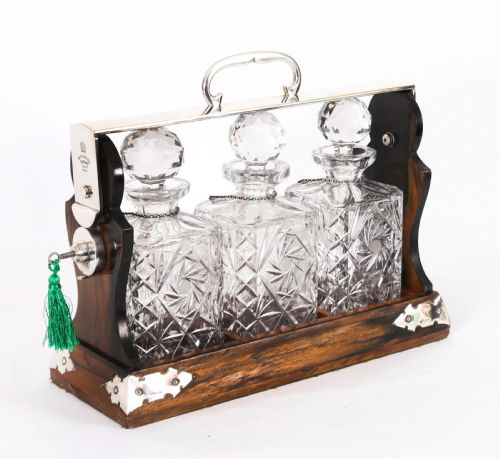


Locked Spirit Decanter
A locked spirit decanter secures choice bottles under a metal bar or within a fitted box, keeping expensive drinks safe from uninvited guests.
Locked Spirit Decanter
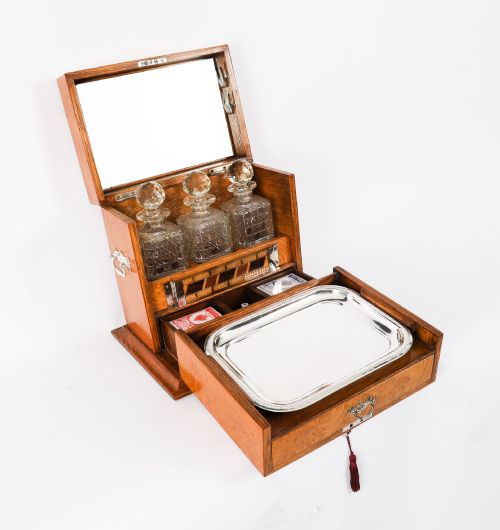
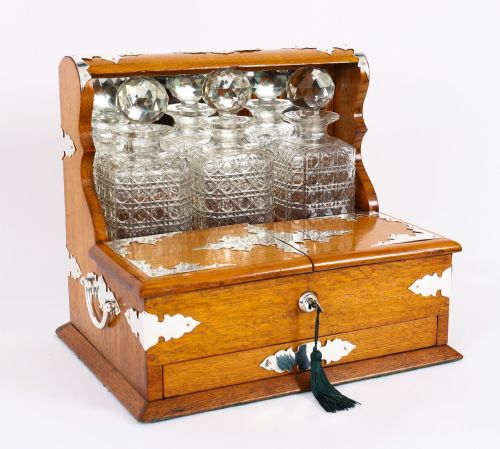
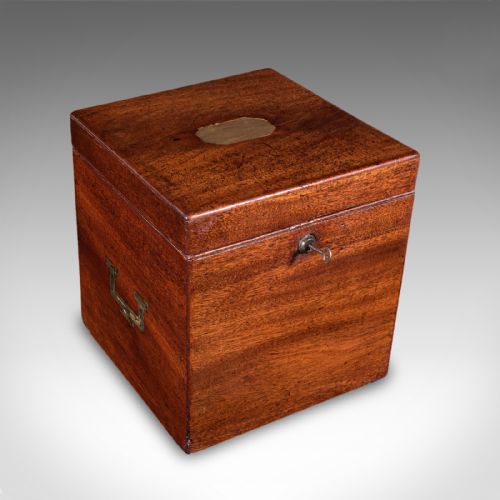
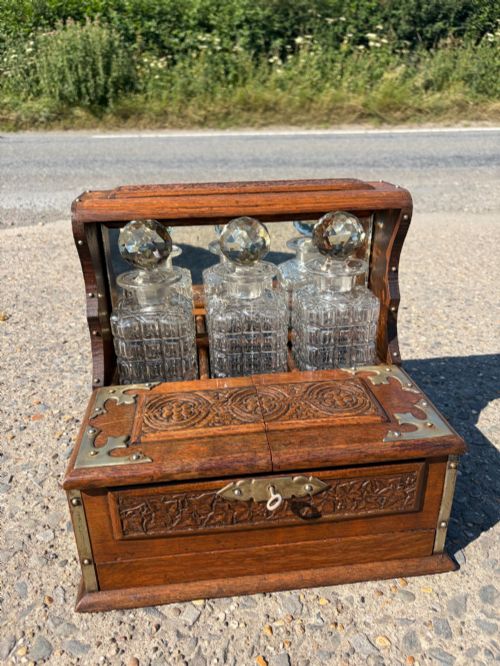
When you search for a locked spirit decanter, you are looking at sophisticated drinking apparatus designed to restrict access to liquor, most commonly encountered as a tantalus or a locking bottle case.
The pieces on this page span the Georgian, Victorian, Edwardian, and Art Deco periods, with oak and coromandel wood frames holding cut crystal or glass bottles.
You will most frequently meet Victorian and Edwardian oak three-bottle tantalus units, alongside fitted storage boxes and single-bottle locking decanters.
How they were made
Cabinetmakers constructed the frames and boxes from dense hardwoods such as oak, walnut, and coromandel wood, frequently mounting them with brass corners, handles, and lock mechanisms.
The storage vessels utilise heavy cut crystal or glass, often paired with silver-plated or sterling silver collars, mounts, and lockable retaining bars.
Locked Spirit Decanter Retail Price Guide 2026
Typical asking prices for locked spirit decanter among the pieces listed under this phrase on Sellingantiques today, from the lower quarter to the upper quarter. They describe what is for sale here now, not the wider market.
Victorian hosts used a tantalus to subtly signal to household staff that the brandy was strictly for family use.
What varies in quality
Quality rests on the integrity of the locking mechanism and the craftsmanship of the timber frame, where secret drawers, integrated games compendiums, and fully operational locks with original keys elevate a piece.
The clarity and depth of the cut crystal bottles, together with the weight of the brass mounts and the precision of the silver hallmarks, distinguish standard production from exceptional examples.
Hukin and Heath·Betjemann
The Locked Spirit Decanter Glossary
- Tantalus
- A locking drink stand that holds decanters securely within a wooden frame so they cannot be removed without a key. The name derives from the mythological figure of Tantalus, who was kept just out of reach of water and food.
- Coromandel wood
- A dense, heavily figured exotic timber from Southeast Asia with dark brown and black streaks. It was frequently utilised for luxury Victorian games boxes and tantalus frames.
- Bramah lock
- A patented high-security cylindrical lock invented by Joseph Bramah in the eighteenth century. These locks are prized by collectors for their complex internal mechanisms.
- Cut crystal
- High-clarity glass containing lead oxide, cut with deep geometric patterns to catch the light. It forms the standard material for nineteenth-century decanters.
Locked Spirit Decanter: Frequently Asked Questions
How do tantalus locks work?
A tantalus secures decanters by means of a metal retaining bar that traps the stoppers beneath a locked crossbar. Turning the key releases the bar so the bottles can be lifted free from the frame.
Most mechanisms rely on a turn of the key to lift or slide the restraining bracket, though earlier storage boxes enclose the bottles entirely behind locking wooden doors.
Are keys usually included?
Many antique locking decanters retain their original working keys, though some are sold with replacement keys or without functional locks due to their age.
A skilled locksmith can often fit a working key to nineteenth-century lever locks if the mechanism remains intact.
What is a games compendium?
Certain luxury tantalus cabinets incorporate pull-out drawers or compartments beneath the bottles containing items for card games, cribbage, or chess. These multi-functional pieces served as complete social stationers for Victorian drawing rooms.
The inclusion of games gear alongside a liquor dispenser indicates high-status manufacture, often by premium retailers.
How should I clean crystal decanters?
Crystal decanters benefit from gentle hand washing with warm water and mild detergent rather than immersion in hot water, which can stress old glass. Wooden frames require only a dry cloth and occasional wax conditioning.
Abrasive cleaners or harsh scrubbing will scratch the crystal surface and damage silver-plated mounts.