

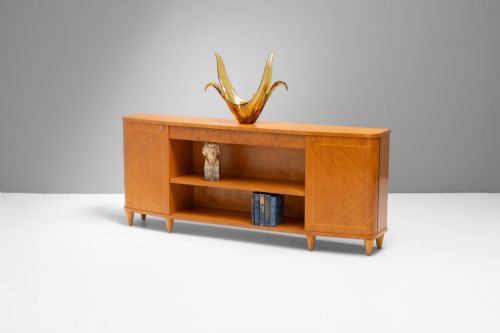



Light Wood Sideboard
A light wood sideboard brings warmth and pale grain to a room, offering generous storage through fitted cupboards and drawers.
Light Wood Sideboard
A light wood sideboard encompasses server units, dresser bases, potboard dressers and cabinets originating from the eighteenth, nineteenth and twentieth centuries. These items serve as functional storage pieces in dining rooms, living spaces and hallways while introducing pale timber tones to an interior.
The selections span international origins including Swedish Grace, Spanish traditional, Breton folk art, Qing Dynasty and English country styles. You will encounter pieces rendered in bleached oak, birch, satinwood, ash and blonde walnut across these varied periods.
Forms range from compact Edwardian pine chiffoniers with three drawers to substantial nineteenth-century cabinets and 1930s blonde bedroom units. Each example demonstrates how different eras handled pale timbers for domestic storage.
How they were made
Cabinet makers utilised solid timbers such as oak, ash, birch and walnut, frequently employing bleaching techniques to achieve a lighter surface tone. Traditional joinery methods secure the frames, panels and drawers, ensuring structural stability across centuries of domestic use.
Surface details incorporate carved elements, notably seen in regional Breton folk art and Spanish servers, alongside clean-lined Art Deco geometries. Brass hardware frequently appears on doors and drawers as operational fittings and decorative accents.
Light Wood Sideboard Retail Price Guide 2026
Typical asking prices for light wood sideboard among the pieces listed under this phrase on Sellingantiques today, from the lower quarter to the upper quarter. They describe what is for sale here now, not the wider market.
Geographic origins represented in the selection range from Britain and France to Sweden, Spain, Italy and China.
What varies in quality
Quality rests upon the selection of timber, the crispness of hand-carved details and the integrity of the original construction. Pieces exhibiting thoughtful grain matching and refined proportions command greater attention than utilitarian workshop examples.
The preservation of original surface treatments, whether naturally aged bleached finishes or polished blonde walnut, distinguishes superior survivals. Hardware integrity and smooth drawer operation further indicate the standard of craftsmanship applied to the piece.
The Light Wood Sideboard Glossary
- Bleached oak
- Oak timber treated to lighten its natural dark brown tone. This process reveals the open grain pattern in a paler shade suitable for lighter interior schemes.
- Potboard dresser
- A traditional storage unit featuring an open lower shelf beneath upper drawers or cupboards. Historically used for displaying and storing heavy kitchen pottery.
- Chiffonier
- A compact nineteenth-century sideboard or low cabinet equipped with drawers and enclosed shelving. It provides convenient storage where a full-scale dining room sideboard proves too large.
- Server
- A low table or cabinet designed for holding dishes and serving food in a dining area. It generally lacks the superstructure found on larger dressers.
- Swedish Grace
- A refined architectural and decorative style popular in Sweden during the 1920s and 1930s. It blends classical proportions with stripped-down modern elegance and light wood finishes.
Light Wood Sideboard: Frequently Asked Questions
Where should I place a sideboard?
A light wood sideboard suits dining rooms, hallways and living areas where surface space and concealed storage are required. Their pale tones integrate easily with both contemporary and traditional room schemes.
Ensure adequate clearance for doors and drawers to open fully without obstruction from surrounding furniture.
How do I clean pale wood surfaces?
Dust regularly with a soft, dry cloth to prevent dirt accumulation in the grain. Avoid harsh chemical cleaners that can strip or alter the pale timber finish.
Apply a suitable natural wax periodically if the surface requires nourishment, following the direction of the grain.
What is the difference between a dresser base and a sideboard?
A dresser base typically originates from the lower section of a two-part kitchen or dining dresser, often featuring a potboard shelf below. A sideboard is designed primarily as a standalone dining room storage unit.
Both forms offer generous surface tops and under-counter storage compartments for household items.
How do I identify Art Deco cabinets?
Art Deco cabinets from the 1930s feature geometric lines, blonde or exotic wood veneers, and streamlined silhouettes free from heavy historical ornamentation. They emphasise clean forms and the natural beauty of the timber grain.
Hardware is often minimal, utilising streamlined brass or chromium fixtures to complement the modern aesthetic.