



Library Desk Clock
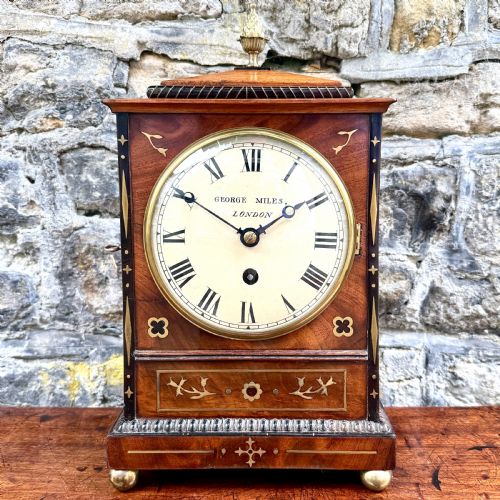
A library desk clock sits quietly among heavy volumes, offering precise timekeeping in a compact, architectural brass and mahogany case.

Library Desk Clock
A library desk clock combines the portable reliability of a mantel clock with the intimate scale required for a study, reading room, or private office. These pieces emerge across the Georgian, Regency, and Victorian periods, manifesting in distinct architectural forms and heavy wooden housings.
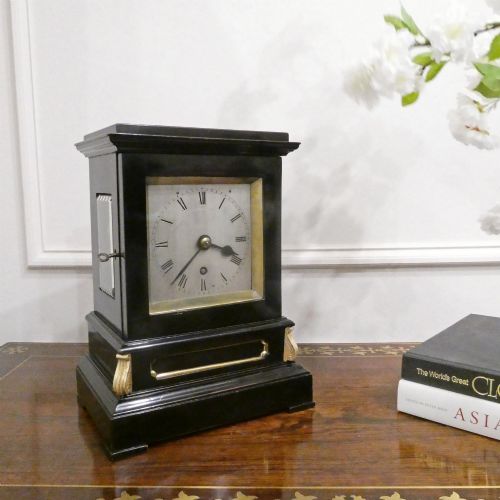
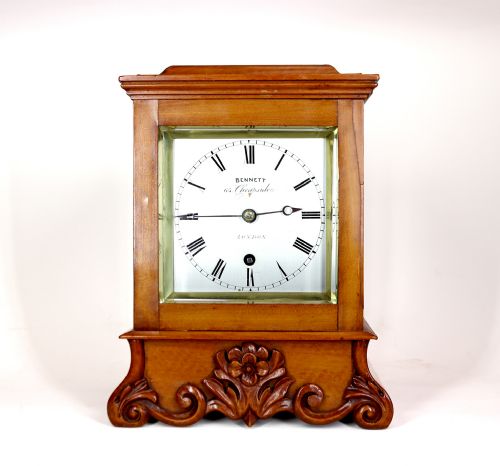
The version most commonly met on this page is the English five-glass library clock, often featuring a fusee movement enclosed within a brass-framed glass case. Mahogany and rosewood predominate, frequently accented with satinwood or ebonised details to complement traditional desk furniture.
Beyond standard timepieces, variants encompass striking mechanisms, skeleton movements, and unusual industrial novelty designs. Collectors encounter everything from austere Georgian wood-cased designs to ornate mid-Victorian brass and bevelled glass constructions.
Materials and Construction
Heavy timber such as mahogany, rosewood, and satinwood forms the primary housing for many examples, shaped into rectangular or architectural desk cases. Selected pieces utilise ebonised finishes or delicate stringing to define the edges of the timber frames.
Brass provides the structural framework for glass-sided models and the intricate internal gear trains of fusee movements. Silvered metal dials offer high contrast against the dark timber and polished brass components, carrying engraved numerals and maker signatures.
Mechanical construction relies on fusee movements driven by chains or gut lines, ensuring steady power delivery as the mainspring unwinds. Platform escapements and heavy glass panels allow clear visibility of the oscillating balance wheel and working gears.
Some nineteenth-century makers concealed tiny spirit levels inside the brass bases to ensure the desk clock sat perfectly true.
Distinctions in Quality
The refinement of the mechanical movement largely determines the standing of a library desk clock. Fusee movements with chain drives and engraved backplates represent higher standards of watchmaking than simpler spring-driven alternatives.
The integration of the case materials dictates overall visual harmony. Finely figured mahogany or rosewood, coupled with heavy bevelled glass and fire-gilded brass mounts, separates superior workshop production from standard utilitarian pieces.
Signatures from established London makers add documented provenance and precision engineering. The clarity of the silvered dial engraving and the crisp execution of the case mouldings complete the distinction between ordinary and exceptional examples.
Bush of London·Sir John Bennett·Walker·McCabe London·Andre Guilmet·Plumbly and Tupman·John Massey
The Library Desk Clock Glossary
- Fusee
- A conical pulley used in a clock movement to equalize the torque of the mainspring as it runs down. This mechanism ensures consistent timekeeping accuracy from a fully wound state to near empty.
- Platform escapement
- A self-contained escapement unit fitted on a small platform within the clock. It frees the movement from strict pendulum dependence, allowing portable desk clocks to operate reliably.
- Five-glass clock
- A timepiece housed in a brass-framed case featuring glass panels on the top and all four sides. This construction showcases the internal mechanical movement from multiple angles.
- Skeleton clock
- A timepiece designed with an open framework that exposes the entire gear train. It emphasises the intricate motion of the wheels and pinions.
- Timepiece
- A clock that indicates the hours and minutes without a striking mechanism. Such models maintain a simpler internal layout dedicated solely to tracking time.
Library Desk Clock: Frequently Asked Questions
How do I wind a library desk clock?
Most fusee models require a small winding key inserted directly into the dial face or the backplate. Turn the key gently until resistance signals the mainspring is fully tensioned.
Avoid overwinding the mechanism, as this places undue stress on the chain or gut line. Regular, gentle winding preserves the historical components.
Where should I place a library desk clock?
Position the clock on a stable, level surface away from direct sunlight and fluctuating heat sources like radiators. A sturdy desk, bookshelf, or mantel provides the ideal environment for stable operation.
Ensure the location protects the glass panels from accidental knocks. A level platform prevents the escapement from binding.
How do I identify a Victorian library clock?
Victorian examples often feature heavy brass and bevelled glass cases, ebonised timber finishes, or robust single fusee movements. Design influences range from Gothic Revival details to industrial novelty forms.
Maker signatures engraved on the silvered dial or backplate help confirm the Victorian date range. Comparing the timber grain and brass casting style further clarifies the era.
What is the difference between a timepiece and a striking clock?
A timepiece focuses exclusively on measuring and displaying the hours and minutes. It contains no internal gear train or bell for sounding the hour.
Striking clocks include an additional train of gears and a hammer mechanism to chime on the hour or half-hour. This requires a separate winding port on the dial.