





Library Armchairs Set
Library armchairs set selections bring matched seating of historic pedigree into study spaces, offering deep comfort paired with traditional British craftsmanship.
Library Armchairs Set
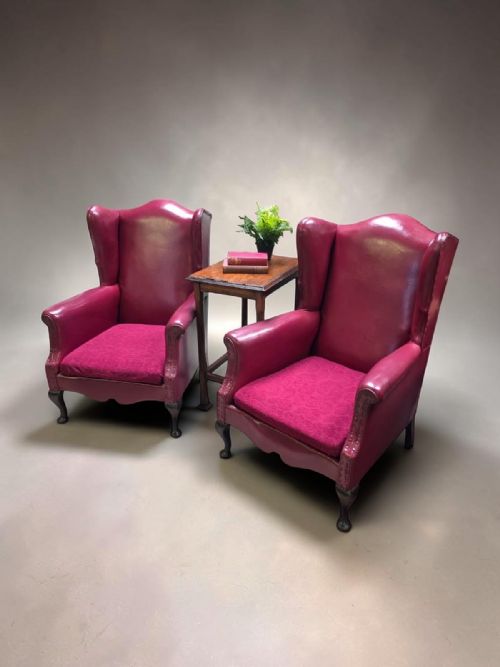
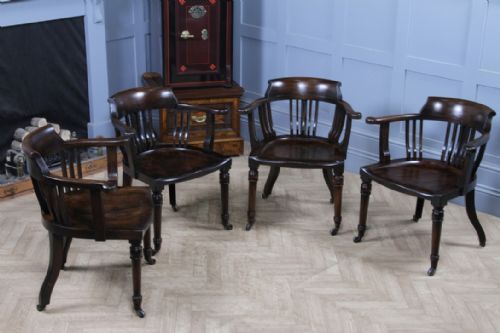
A library armchairs set comprises multiple coordinated seats designed for reading rooms, studies, and formal parlours. The pieces found here range from substantial wingback and club models to captains chairs and smokers bows.
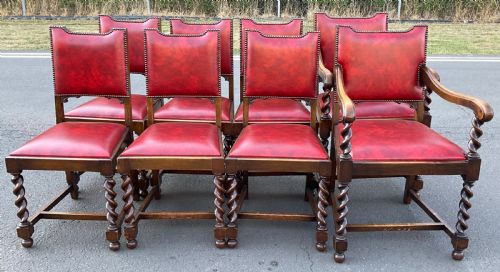
The most frequent versions encountered on this page span the Victorian and Edwardian eras, alongside earlier Georgian revivals. These seating groups often appear in groupings of two, four, six, or more matched chairs, sometimes accompanied by matching footstools.
Makers historically produced these seating sets in various configurations, including desk armchairs, cross-frame armchairs, and matching his and her pairs. Their forms reflect the functional requirements of nineteenth and early twentieth century libraries and writing rooms.
Materials and Construction
Makers utilised sturdy hardwoods including oak, mahogany, elm, and walnut for the structural frames of these seating groups. These timbers provided the necessary strength for heavy daily use in domestic and institutional libraries.
Upholstery techniques involved traditional stuffing methods combined with leather, fabric, or velvet coverings. Hand-dyed leather and brass nail detailing frequently finish the surface work on nineteenth century library and club chairs.
Library Armchairs Set Retail Price Guide 2026
Typical asking prices for library armchairs set among the pieces listed under this phrase on Sellingantiques today, from the lower quarter to the upper quarter. They describe what is for sale here now, not the wider market.
Several sturdy smokers bow chairs on offer spent their earlier decades accommodating gentlemen smoking pipes in Victorian libraries.
Distinguishing Quality Levels
The tier of a library armchairs set depends largely upon the selection of timber and the precision of the carved details. Superior examples display dense, well-figured mahogany or oak, alongside deeply carved arm supports and legs.
Frame integrity and upholstery execution separate standard seating from exceptional examples. Chairs retaining their original patinated leather and tight, rigid joints represent the upper echelon of surviving sets.
The Library Armchairs Set Glossary
- Smokers Bow
- A sturdy type of nineteenth century wooden armchair with a rounded spindle back, often used at desks or in smoking rooms.
- Wingback
- An armchair featuring side panels or wings attached to the arm rests, originally designed to shield the sitter from draughts.
- Gainsborough Chair
- A wide, upholstered armchair with open arms, standing on four legs, popular during the Georgian period.
- Captain's Chair
- A low-backed wooden armchair designed for swivel desks or office use, featuring a curved top rail supported by spindles.
Library Armchairs Set: Frequently Asked Questions
What periods do these sets cover?
The available sets span from the Georgian period through the Victorian and Edwardian eras up to the 1930s. Mid nineteenth century designs appear frequently alongside early twentieth century interpretations.
Buyers will find both authentic period seating and revival styles representing traditional British cabinet making traditions.
How many chairs come in a set?
Listings vary widely, offering pairs, groups of four, six, or larger collections numbering up to ten pieces. Some seating groups also include matching footstools or separate his and her chairs.
Review individual descriptions to confirm the exact count and composition of each matched group.
Which woods were used most often?
Oak and mahogany dominate the wooden frames across the available seating options. Elm and walnut also appear in specific nineteenth century captain chairs and coronation chairs.
These dense hardwoods ensured longevity and structural stability in busy library environments.
Are these chairs suitable for modern desks?
Many desk armchairs, captains chairs, and smokers bows function effectively with contemporary study spaces. Their ergonomic wooden backs and arm heights were originally scaled for writing and reading.
Buyers should verify seat heights and clearance dimensions before pairing historic chairs with modern tables.