
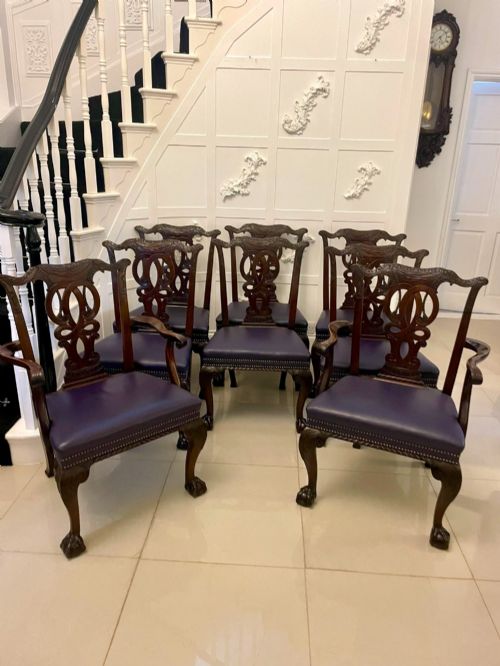
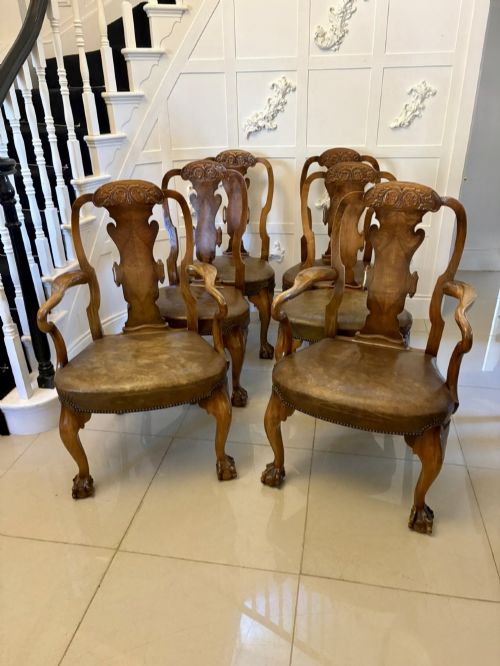
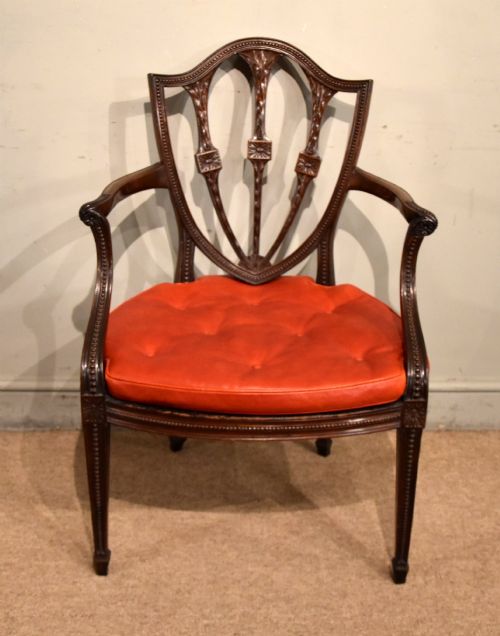
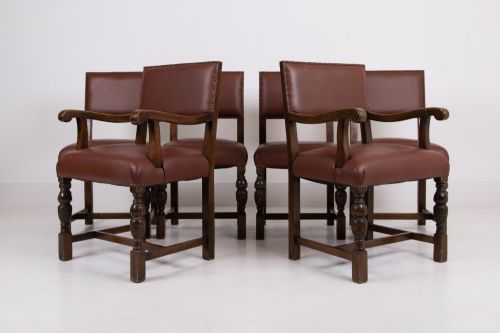
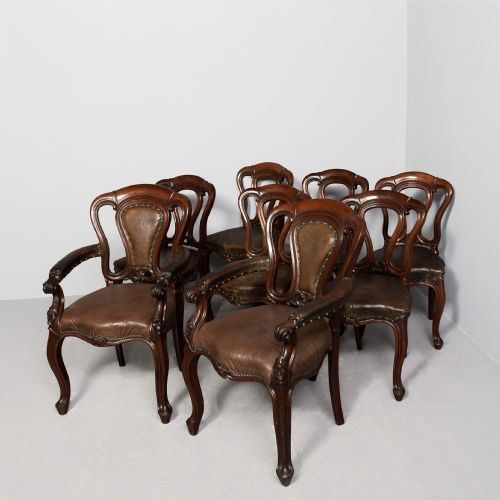


Leather Upholstered Carver Chairs
Leather upholstered carver chairs are sturdy seated timber forms combining open arms with hide pads, offering steady support for desks and dining rooms.
Leather Upholstered Carver Chairs
Leather upholstered carver chairs appear across multiple centuries and stylistic revivals, taking the form of dining carvers, desk chairs, and standalone armchairs. The pieces on this page span the eighteenth century through to the mid-twentieth century, capturing designs from George III and Regency periods alongside Victorian walnut examples and later Art Deco interpretations.
Buyers seeking leather upholstered carver chairs will most frequently encounter nineteenth century mahogany and walnut iterations, often found as pairs or within larger dining sets. These often feature carved woodwork, open arms, and hide seats or backrests secured with brass studs.
How they were made
Cabinet makers constructed these carver chairs using robust hardwoods such as mahogany, walnut, oak, and burr walnut, shaping frames through joinery and carving. Timber components were frequently turned or sculpted into styles reflecting prevailing tastes from Jacobean Revival to Chippendale.
Upholstery involved stretching leather across padded seats and backrests, occasionally fastened with decorative brass nails. Makers incorporated supportive understructures, employing sturdy legs, stretchers, and barley twist supports to ensure longevity.
The listings span eight distinct periods, reaching from the 18th Century through to the 1940s, utilising mahogany, walnut, oak, burr walnut, and brass.
What varies in quality
The distinction between standard examples and the finest work lies in the depth of timber carving and the selection of figured wood grains. Superior pieces demonstrate crisp execution in scrollwork, foliage, and frame joints.
Material selection dictates the upper tier of the range, where dense mahogany, rich burr walnut, and high-grade leather upholstery remain intact. Construction integrity and the preservation of original framing components further elevate the status of individual pieces.
The Leather Upholstered Carver Chairs Glossary
- Carver chair
- An armchair designed with open sides to accommodate wider clothing styles, traditionally used at the head of a dining table or at a desk. These pieces feature prominent armrests attached to the main seat frame.
- Studded
- A method of securing leather upholstery to timber frames using decorative metal tacks, often in brass. This technique provides a neat border along the edge of the hide.
- Barley twist
- A carved wooden furniture leg or stretcher shaped to resemble a spiral twist resembling coiled barley. This decorative turning technique appears frequently on oak and walnut frames.
- Spoon back
- A chair backrest shaped with a concave oval contour resembling the bowl of a spoon, designed to fit the human spine. This form is characteristic of Victorian seating.
- Chippendale style
- A decorative design vocabulary inspired by eighteenth century furniture maker Thomas Chippendale, featuring ornate carving, cabriole legs, and interlaced splats.
Leather Upholstered Carver Chairs: Frequently Asked Questions
What is a carver chair?
A carver chair is an armchair with open wooden sides, traditionally placed at the head of a dining table or utilised as a desk chair. These pieces provide additional arm support while matching the surrounding single chairs in a set.
They share the stylistic motifs of their period, ranging from plain oak frames to intricately carved mahogany and walnut structures.
How do I date these chairs?
Dating relies on examining the timber species, construction methods, and stylistic indicators such as carved motifs and leg shapes. Pieces reflect distinct eras from the eighteenth century up to the 1940s.
Reference points include Regency curves, Victorian walnut spoon backs, and later Art Deco geometric lines.
Are these chairs suitable for daily use?
These timber chairs are built from durable hardwoods like mahogany, oak, and walnut, making them structurally sound for everyday seating. Leather upholstery offers a practical, wipe-clean surface for dining and desk work.
Maintenance involves treating the wooden frames and conditioning the leather hide periodically to preserve flexibility.
What styles are available?
The selection encompasses several historical periods and revivals, including George III, Regency, Victorian, Edwardian, and Art Deco. Craftsmanship styles span Chippendale influence, Jacobean Revival, and Arts and Crafts.
Wood types vary correspondingly from dark mahogany and walnut to lighter oak and burr walnut finishes.