





Leather Fender Seat
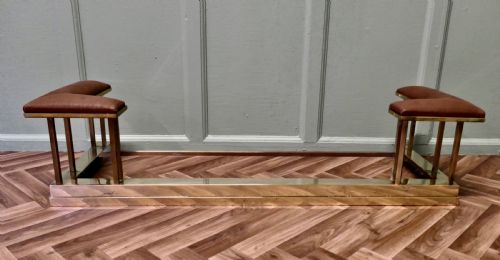
A leather fender seat bridges the gap between hearth and room, offering padded comfort around the fire.
Leather Fender Seat
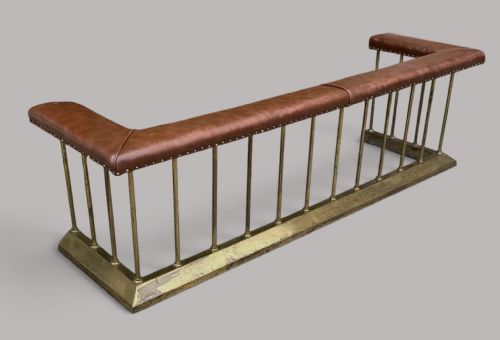
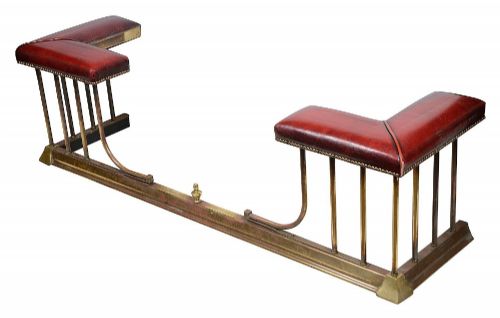
A leather fender seat functions as a fireside bench, wrapping around the hearth to provide low seating for warming cold feet. These pieces combine a rigid metal frame with cushioned leather top rails, originating mainly in the nineteenth and early twentieth centuries.
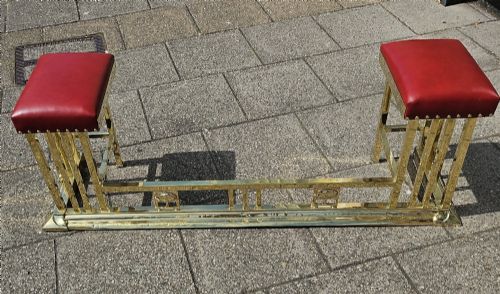
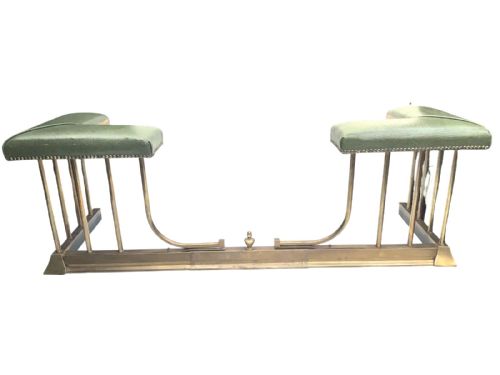
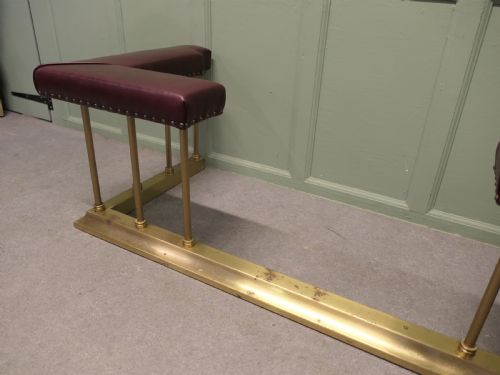
The most common version met on this page is the club fender, constructed from polished brass or steel with buttoned leather top cushions. They range from compact Victorian examples to wide Edwardian and Art Deco configurations designed for country house inglenooks.
How they were made
Frames rely on heavy metalwork, utilising cast brass, polished steel, wrought iron, and occasionally copper or oak for the structural base. Smiths joined these metals to form rigid corner assemblies, sometimes incorporating adjustable mechanisms for length.
Upholstery involves durable cattle hide stretched over padded seats, often secured with brass studs and finished in tan, green, red, or black tones. Craftsmen paired the supportive metal frameworks with deep buttoning or smooth leather pads built to withstand direct hearth heat.
Periods represented reach from the late nineteenth century through Victorian, Edwardian, Art Deco, and 1940s eras.
What varies in quality
Substantial weight and gauge of the metal separate robust hearth furniture from lighter utilitarian versions, with heavier brass and cast steel frames offering superior rigidity. The intricacy of the corner balustrades and the presence of solid rivets rather than hollow tubing dictate the grade of construction.
Upholstery execution defines the finish, seen in the depth of buttoning, the grade of the leather hide, and the precision of the stud work. Pieces featuring adjustable extension mechanisms or specialised materials like copper and oak demonstrate higher levels of workshop ambition.
William Birch
The Leather Fender Seat Glossary
- Club Fender
- A fireside seat built around an open hearth that allows people to sit directly over the fireplace surround. These structures emerged in gentlemen's clubs and country houses during the Victorian period.
- Chesterfield Seat
- An upholstered top rail characterised by deep button tufting across the leather surface. This padded style provides resilient support for extended periods of sitting near the fire.
- Extending Fender
- A design incorporating a sliding mechanism that allows the overall width of the metal frame to adjust. This adjustment helps fit the bench precisely to different hearth dimensions.
- Balustrade
- The upright metal spindles or columns forming the open framework between the floor base and the seat. They appear in simple straight bars or decorative turned brass configurations.
Leather Fender Seat: Frequently Asked Questions
How do you use a leather fender seat?
These benches sit directly on the floor around the hearth, framing the fireplace opening while providing low seating close to the warmth.
Occupants sit on the padded leather top rails facing inward toward the fire, utilising the integrated structure as both a physical barrier against stray embers and a practical bench.
What periods do these fender seats come from?
The pieces span the nineteenth and twentieth centuries, encompassing Victorian, Edwardian, and Art Deco eras from roughly 1880 through the 1940s.
Victorian and Edwardian examples make up the majority of the selection, reflecting traditional English domestic metalwork and upholstery styles.
Are club fenders adjustable in size?
Many examples feature extending frames that allow the metal sections to slide inward or outward to match specific hearth widths.
This mechanical flexibility was built into numerous nineteenth and early twentieth-century designs to accommodate varying fireplace dimensions in different rooms.
What metals are used in the frames?
Polished and cast brass form the primary material for the structural frames and balustrades across most surviving examples.
Alternative constructions utilise steel, wrought iron, cast steel, copper, or occasionally wood combinations to achieve different weights and appearances.