



Late Victorian Partner Desk
A late victorian partner desk provides dual-sided workspace and storage, offering substantial timber presence and period character for a study.
Late Victorian Partner Desk
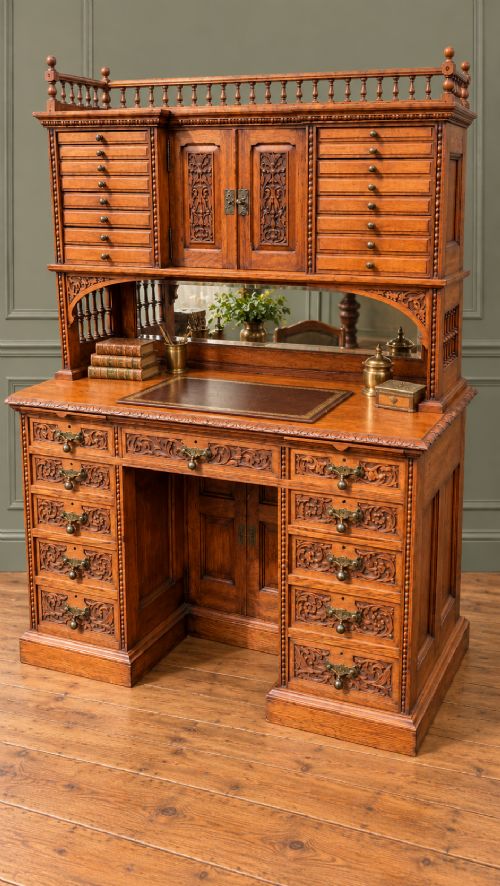
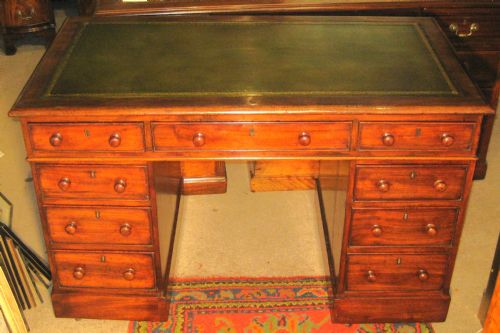
A late victorian partner desk is a substantial pedestal-based workspace designed for simultaneous use from opposite sides, featuring drawers and cupboards facing in both directions. You are most likely to meet mahogany and oak examples dating from the late nineteenth century, often retaining their original inset writing surfaces.
The form developed to accommodate two people working face-to-face, typically solicitors, bankers or senior partners in commerce. These pieces combine utilitarian drawer configurations with formal timber exteriors suited to grand nineteenth-century interiors.
How they were made
Cabinet makers utilised dense hardwoods such as mahogany, oak and walnut for the primary structure and drawer construction, often pairing solid timbers with matching veneers. Drawer interiors commonly employ secondary woods like ash, joined with traditional techniques to withstand heavy daily use.
Writing surfaces were traditionally inset with tooled leather, whilst hardware components incorporate cast brass handles and locks. Structural stability relied on heavy pedestal carcases designed to support large quantities of papers and ledgers.
Late Victorian Partner Desk Retail Price Guide 2026
Typical asking prices for late victorian partner desk among the pieces listed under this phrase on Sellingantiques today, from the lower quarter to the upper quarter. They describe what is for sale here now, not the wider market.
Some models feature up to eighteen ash-lined drawers, ensuring nobody ever loses a paper clip again.
What varies in quality
Quality in a late victorian partner desk is determined by the selection of timber figures, such as burr walnut or figured mahogany, and the depth of the carving on the mouldings and panels. Superior examples display meticulous attention to internal construction, including solid wood drawer linings rather than cheaper alternatives.
Proportion and scale also separate standard utility pieces from exhibition-grade commissions. Desks finished on all sides with fully panelled pedestals and identical drawer arrangements front and back represent the higher tier of production.
GILLOWS Lancaster·Edwards & Roberts·Merryweather & Son·Maple & Co
The Late Victorian Partner Desk Glossary
- Pedestal desk
- A freestanding office desk comprising two independent drawer units or pedestals supporting a central top section.
- Partners desk
- A double-sided variant of the pedestal desk designed for two people to work opposite one another, featuring dual storage accessible from both faces.
- Kneehole
- The central recessed space beneath the desktop designed to accommodate the user's legs.
- Ebonised
- Timber treated with a chemical stain or paint finish to imitate expensive ebony.
- Inlaid
- The technique of embedding contrasting woods or materials into the surface of the primary timber to create decorative patterns.
Late Victorian Partner Desk: Frequently Asked Questions
How do I care for the leather top?
The leather writing surface benefits from occasional treatment with neutral wax balms to prevent cracking and maintain its supple texture. Avoid using harsh chemical cleaners or excess moisture near the gilt tooling.
Keep the desk away from direct heat sources and strong sunlight to protect both the leather insert and the surrounding timber finish from fading and drying out.
Can a partner desk be used against a wall?
These desks are engineered as freestanding items with finished panels on all sides, meaning they look appropriate positioned in the middle of a room. Placing one against a wall conceals half of the functional drawers and ruins the symmetry of the design.
To appreciate the double-sided nature of the piece, position it centrally where both users can access the opposing banks of drawers simultaneously.
What woods were used?
The evidence shows these desks were constructed primarily from mahogany, oak and walnut, occasionally utilising burr walnut, ash, pitch pine or satinwood. Solid timbers were frequently combined with decorative veneers on the primary display surfaces.
Secondary woods like ash were commonly employed for internal drawer construction to ensure durability under heavy loads.
How do I identify the period?
Late nineteenth-century pieces display stylistic markers associated with the Victorian era, aesthetic movement or revival designs. Construction methods such as hand-cut dovetails and timber choices help confirm the manufacturing timeframe between eighteen-seventy and nineteen-hundred.
Maker stamps or stamps within the drawer linings occasionally provide definitive documentary evidence of the production date and workshop origin.