

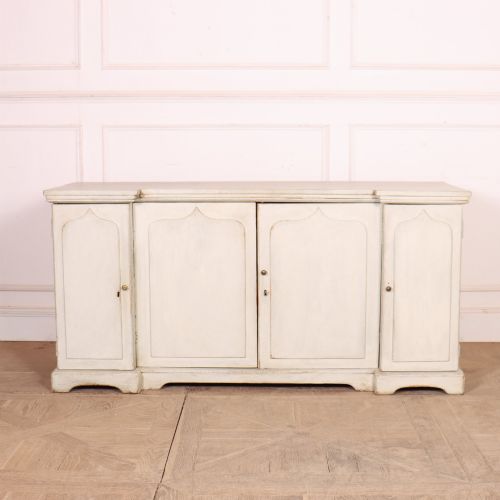
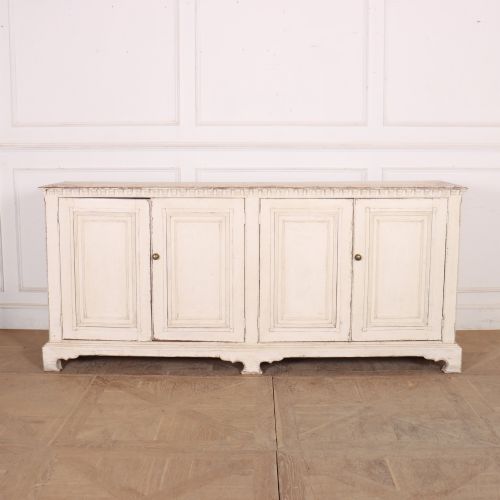


Large White Cupboard
A large white cupboard brings architectural presence and robust storage to a room, offering practical utility wrapped in period character.
Large White Cupboard
A large white cupboard encompasses substantial storage forms from the eighteenth, nineteenth, and early twentieth centuries, including housekeepers cupboards, linen cupboards, and glazed cabinets. These pieces anchor a room with their scale while brightening interiors through painted surfaces.
The selections span English country pieces, Swedish country designs, and Italian neoclassical enfilades alongside industrial medical cabinets and Gothic revival wardrobes. Housekeepers cupboards and dresser bases dominate the offerings, built originally for utilitarian storage in country houses and sculleries.
Victorian and Georgian periods provide the bulk of the domestic examples, executed primarily in pine and painted timber. Every piece carries the functional heritage of domestic service and rural practicality, adapted now for modern living spaces.
Construction and materials
Construction relies heavily on pine and painted timber, built by hand with traditional joinery to endure heavy daily use in domestic and institutional settings. Paint and painted wood form the primary surface treatments, often applied over decades to seal and refresh the timber.
Large White Cupboard Retail Price Guide 2026
Typical asking prices for large white cupboard among the pieces listed under this phrase on Sellingantiques today, from the lower quarter to the upper quarter. They describe what is for sale here now, not the wider market.
The listings span the eighteenth century through to nineteen thirty, uniting pine, painted timber, brass, iron, and glass across English, Swedish, and Italian origins.
Assessing quality and proportion
Quality rests in the integrity of the original timber and the depth of the painted surface, where authentic ageing reveals layers of history rather than modern intervention. Proportions matter significantly on a large scale, separating balanced vernacular pieces from awkward proportions.
The sophistication of the joinery and the preservation of original hardware distinguish utilitarian storage from finer cabinet work. Pieces that retain their structural soundness while showing honest patination command greater appreciation among collectors.
The Large White Cupboard Glossary
- Housekeepers cupboard
- A large storage piece traditionally used for storing household linen and dry goods, featuring panelled doors and internal shelving. These pieces often form the focal point of a large country kitchen or utility space.
- Enfilade
- A suite of rooms formally aligned, or in this context, a long sideboard or cabinet designed to stand against an extended wall. Italian examples often display neoclassical proportions and refined painted finishes.
- Breakfront
- A piece of furniture where the central section projects forward from the flanking outer sections. This architectural arrangement creates shadow and visual depth on large cupboards and dresser bases.
- Scullery cupboard
- A utilitarian storage unit built for heavy domestic tasks in the service quarters of a country house. These pieces prioritize robust pine construction and simple lines over decorative flourishes.
Large White Cupboard: Frequently Asked Questions
Where should I place a large white cupboard?
These substantial pieces demand a generous wall space, making them ideal for kitchens, dining rooms, or wide hallways where their scale can be fully appreciated without overwhelming the room.
Ensure you measure both floor space and ceiling height carefully before placement, as the proportions of eighteenth and nineteenth-century furniture often exceed modern standard dimensions.
What is the difference between an 18th and 19th-century cupboard?
Eighteenth-century pieces typically display heavier framing, hand- forged iron or brass hardware, and construction methods characteristic of earlier vernacular cabinet making. The timber often shows deeper patination acquired through centuries of domestic use.
Nineteenth-century examples introduce greater regional stylistic variety, encompassing Gothic revival details, Swedish country lightness, and industrial medical forms alongside traditional housekeepers designs.
Can these cupboards hold modern kitchen items?
The deep shelving and robust construction of housekeepers cupboards and dresser bases make them exceptionally well-suited for storing contemporary crockery, glassware, and kitchen equipment. The internal depth easily accommodates oversized serving platters and heavy cookware.
Checking the weight capacity of older shelves ensures they safely support dense modern tableware without sagging.