

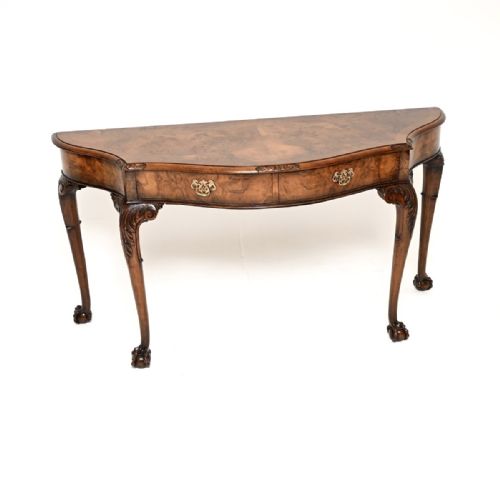


Large Walnut Hall Table
A large walnut hall table brings commanding presence and rich timber grain to an entranceway, offering a practical surface for everyday use.
Large Walnut Hall Table
A large walnut hall table provides a substantial surface for an entranceway, drawing the eye with rich timber figures and deep brown tones. These items span console tables, centre tables, lowboys, and side tables, originating across the eighteenth and nineteenth centuries.
The most common examples on this page are console tables and centre tables from the nineteenth century, often reflecting French, Italian, or Queen Anne design influences. These forms balance utility with decorative presence, suiting both traditional and eclectic interiors.
Makers utilised walnut for its warmth and varied grain patterns, frequently pairing the primary timber with contrasting inlays like fruitwood, boxwood, and marquetry. Some pieces incorporate striking marble tops or brass hardware to elevate their formal character.
Construction and materials
Cabinet makers constructed these tables using solid walnut and figured veneers over supportive secondary woods, ensuring both stability and visual depth. The timber was carefully selected for its rich grain, which often forms symmetrical patterns across large surface areas.
Surface decoration frequently involves intricate marquetry and fruitwood or boxwood inlay, requiring precise hand-cutting and fitting. Tables with marble tops rely on robust subframes to support heavy stone inserts safely.
Joinery techniques varied by period, from eighteenth-century dovetailed drawer construction to nineteenth-century framing methods. Brass mounts and handles were cast and finished by hand, adding metallic contrast to the dark wood.
Large Walnut Hall Table Retail Price Guide 2026
Typical asking prices for large walnut hall table among the pieces listed under this phrase on Sellingantiques today, from the lower quarter to the upper quarter. They describe what is for sale here now, not the wider market.
Some nineteenth-century tables cleverly hide secret compartments behind deceptively deep frieze drawers for storing private correspondence.
Judging quality in walnut furniture
Quality rests primarily on the choice of timber and the execution of surface embellishments, such as fine marquetry or crisp fruitwood inlay. Superior examples display carefully matched veneer grains and thoughtful composition across the entire table top.
The sophistication of the carved or turned supports separates standard production from finer workshop output, particularly in revival styles like Queen Anne or Rococo. Integration of premium materials, such as heavy purple or white marble slabs, also indicates a higher tier of manufacture.
The Large Walnut Hall Table Glossary
- Console table
- A table designed to stand against a wall, frequently secured to it with brackets for additional stability. These pieces often feature decorative front legs while the rear relies on the wall for support.
- Lowboy
- A small table with one or more rows of drawers, originating in the late seventeenth century. This form serves well for storage while maintaining a low profile.
- Marquetry
- Decorative veneer work forming pictorial or geometric patterns using various coloured woods. Artisans cut thin slices of timber and fit them together precisely before gluing them to the carcase.
- Fruitwood inlay
- The practice of inserting contrasting light woods, often from fruit-bearing trees, into recesses carved into the walnut surface. This technique creates delicate borders and floral motifs.
- Centre table
- A freestanding piece finished on all sides, intended to sit in the middle of a room rather than against a wall. These tables often take circular or oval forms.
Large Walnut Hall Table: Frequently Asked Questions
Where should I place a large hall table?
These tables find a natural home in entrance halls, corridors, and large living spaces where their length can be appreciated without obstructing movement. They provide an immediate surface for keys, lighting, and decorative objects upon entering the home.
Positioning them against a blank wall allows the walnut grain and any accompanying mirror or artwork above to take visual precedence. Ensure the chosen walkway has sufficient clearance for the table depth.
How do I care for antique walnut wood?
Maintenance requires keeping walnut surfaces away from direct sunlight and excessive heat sources to prevent the wood from drying out or fading. Regular dusting with a soft, dry cloth preserves the finish without building up heavy wax residues.
Applying a quality furniture wax periodically helps nourish the timber and maintain its natural lustre. Avoid placing damp items directly onto unsealed wood or marble surfaces to prevent permanent staining.
What is the difference between a console and a centre table?
A console table is designed specifically to stand flush against a wall, often featuring elaborately decorated front legs and simpler rear supports. These are ideal for narrow spaces where floor area is at a premium.
By contrast, a centre table is finished on all sides and intended to stand independently in the middle of a room. Centre tables often feature circular tops and accessible storage or display space underneath.
How can I identify Queen Anne style features?
Queen Anne style furniture typically exhibits cabriole legs that curve outward at the knee and taper inward to pad or hoof feet. This design emphasises smooth, flowing lines rather than heavy carving.
Walnut became the primary timber of choice during this period, prized for its rich grain and ability to hold elegant proportions. Tables in this style often display restrained ornamentation, letting the natural warmth of the wood speak for itself.