

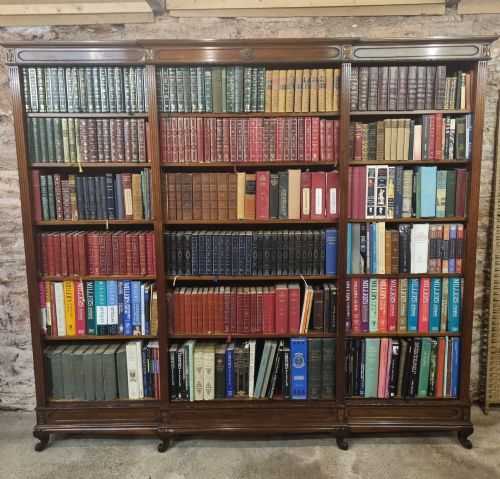
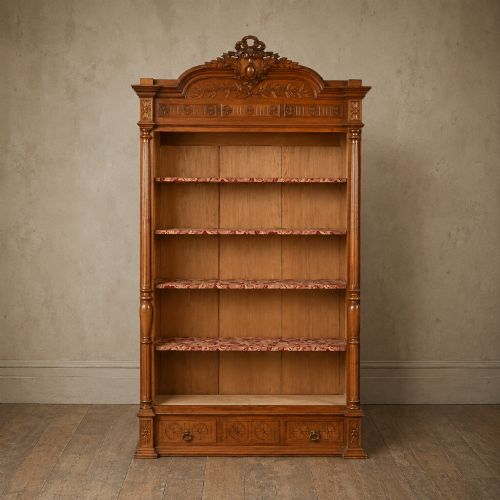
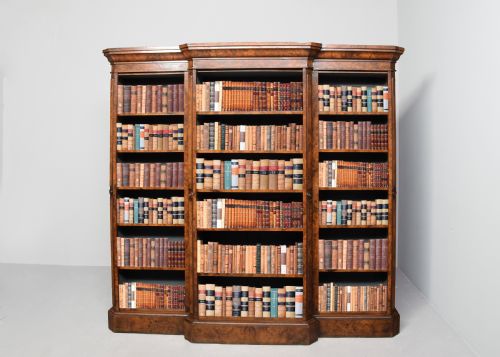
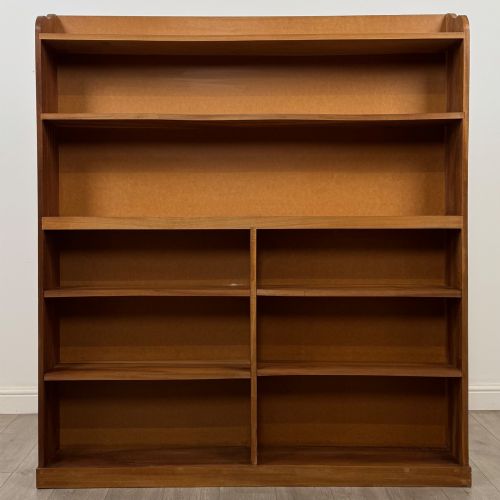
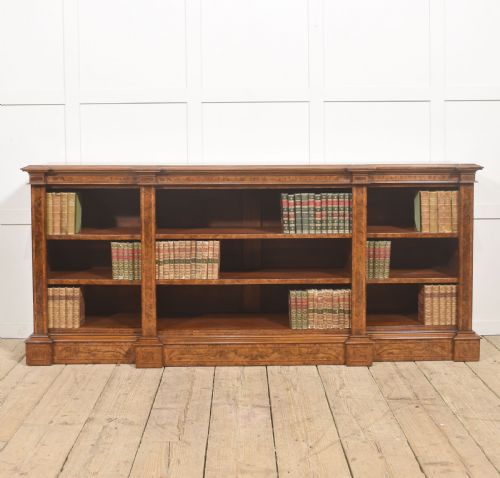

Large Walnut Bookshelf
A large walnut bookshelf brings rich grain and warmth to a room while holding a substantial library.
Large Walnut Bookshelf
A large walnut bookshelf serves as a primary storage piece for substantial libraries and collections of volumes. When you search for a large walnut bookshelf, you encounter pieces designed to anchor a room through scale and presence. The examples available here span the Victorian, Edwardian, and nineteenth-century periods, presenting robust furniture built to house heavy rows of books.
Most pieces on this page appear as open bookcases or breakfront designs that allow easy access to volumes. You will find variations including three-section breakfronts, open shelves, and wall-mounted cabinets incorporating timber and brass. These forms reflect the functional demands of nineteenth-century and early twentieth-century libraries.
Makers and cabinetmakers of these periods utilised both solid wood and walnut veneer over supportive timber carcasses. Styles range from Victorian and Edwardian traditionalism to Arts and Crafts simplicity and Jacobean Revival motifs. The resulting furniture balances structural utility with decorative grain patterns.
How they were made
Cabinetmakers constructed these bookcases using walnut timber and decorative burr walnut veneer applied to stable secondary woods. The natural figuring of the grain dictated how veneers were matched across large surfaces like doors and friezes. Solid wood was reserved for structural elements, carcase frames, and load-bearing shelving.
Decorative detailing on these pieces involves hand-carved friezes, barley twist columns, and cast or gilt ormolu mounts. Brass fittings frequently secure adjustable shelving systems within the larger breakfront and open compartments. These techniques combined structural integrity with the opulent surface textures favoured during the Victorian and Edwardian eras.
Large Walnut Bookshelf Retail Price Guide 2026
Typical asking prices for large walnut bookshelf among the pieces listed under this phrase on Sellingantiques today, from the lower quarter to the upper quarter. They describe what is for sale here now, not the wider market.
Some shelves are deep enough to hide a very small dog behind the folios.
What varies in quality
The choice of veneer significantly influences the visual distinction of a piece, with figured burr walnut commanding greater aesthetic complexity than plain walnut timber. Cabinetmakers who carefully book-matched grain patterns across wide breakfront facades produced a more harmonious visual rhythm. The depth and crispness of hand-carved friezes and applied columns also separate standard production from superior craftsmanship.
Structural complexity, such as three-section breakfront construction and integrated brass hardware, marks the higher tiers of these bookcases. The inclusion of adjustable shelving mechanisms demonstrates thoughtful utility alongside decorative ambition. Pieces that retain their original surfaces and mountings offer a more complete historical integrity.
The Large Walnut Bookshelf Glossary
- Burr walnut
- A highly figured veneer taken from the warted growths of walnut trees. It displays swirling, organic patterns that catch the light.
- Breakfront
- A piece of furniture whose central section projects forward from the flanking wings. This configuration adds architectural depth to large bookcases.
- Ormolu
- Gilded bronze or brass mounts applied for decorative effect. It provides metallic contrast against dark timber surfaces.
- Barley twist
- A decorative turning technique resembling a spiralling rope. It appears on columns and uprights of nineteenth-century furniture.
- Frieze
- The flat or carved horizontal band situated just below the cornice. It often carries decorative carving or moulding.
Large Walnut Bookshelf: Frequently Asked Questions
How do I style a large walnut bookshelf?
A large walnut bookshelf works best against a neutral wall where its dark grain and varied figuring can command attention. Balance heavy rows of books with decorative objects or empty space to maintain a light visual rhythm.
Position the piece away from direct sunlight to protect the walnut timber and veneer from fading over time. Ensure the floor is level so that large breakfront or multi-section bookcases remain stable.
Are the shelves adjustable?
Many of the larger nineteenth-century and Edwardian bookcases feature adjustable shelving supported by wooden racks or brass pins. This allows you to alter shelf heights to accommodate folio volumes and smaller books alike.
Check individual descriptions to confirm the shelving mechanism used in a specific piece.
What is burr walnut?
Burr walnut is a decorative veneer harvested from the knotty outgrowths of a walnut tree. It yields intricate, swirling grain patterns highly prized by cabinetmakers.
Because of its striking appearance, burr walnut was frequently used on the main display surfaces of Victorian and Edwardian furniture.
How do I tell Victorian from Edwardian?
Victorian bookcases generally feature heavier proportions, richer ornamentation such as ormolu mounts, and darker finishes. They often incorporate architectural elements like carved friezes and barley twist columns.
Edwardian pieces tend to display lighter construction, simpler lines, and influences from the Arts and Crafts movement while maintaining traditional walnut materials.