
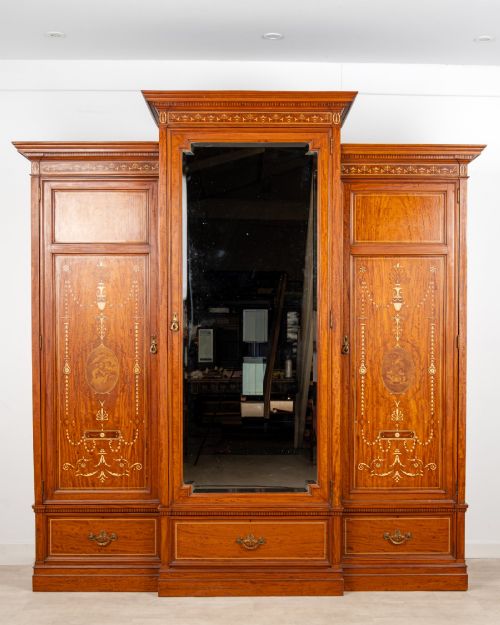
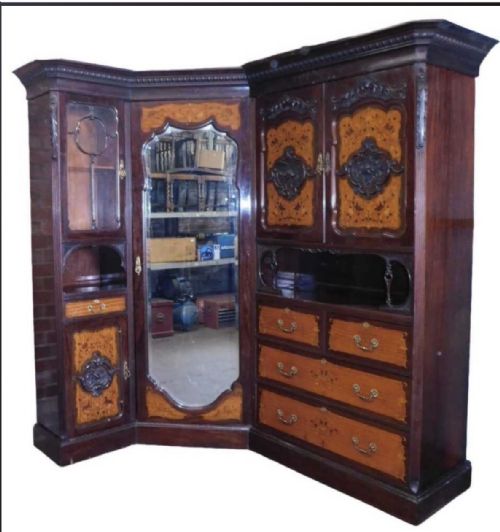


Large Satinwood Wardrobe
A large satinwood wardrobe is a grand bedroom piece defined by shimmering timber and generous proportions, offering both timeless presence and substantial storage.
Large Satinwood Wardrobe
When you search for a large satinwood wardrobe, you encounter substantial bedroom furniture dating from the late nineteenth and early twentieth centuries. These pieces predominantly span the Victorian and Edwardian periods, often adhering to the Sheraton Revival style.
The most common formats on this page are expansive triple wardrobes, breakfront configurations, and complex compactum units. Many examples incorporate fitted interiors alongside mirrored doors and detailed inlay work.
Originating during an era of lavish domestic appointments, these large wardrobes served as central storage fixtures in substantial residences. Today, they remain practical for modern bedrooms while anchoring a room with period character.
Assessing quality and craftsmanship
Quality in these wardrobes rests upon the precision of the cabinetwork and the intricacy of the timber selection. Superior pieces display book-matched satinwood veneers and complex marquetry, whereas simpler examples rely solely on basic linear stringing.
The architectural ambition of the piece dictates its standing, with breakfront and compactum layouts requiring advanced joinery compared to standard flat-front triple wardrobes. Maker attribution, such as work originating from noted cabinet makers, further elevates the status of an individual piece.
Makers hid intricate sliding shirt drawers behind mirrored doors, ensuring linen remained protected from the daily Victorian soot.
Edwards & Roberts·Maples & Co·Gillows
The Large Satinwood Wardrobe Glossary
- Satinwood
- A hard, durable tropical timber known for its lustrous, light yellow appearance and satin-like sheen. It forms the primary visible surface on these wardrobes.
- Compactum
- A multi-section wardrobe designed to combine hanging space, drawers, and linen shelves within a single integrated unit. This form maximises storage efficiency.
- Breakfront
- A cabinet design where the central section projects forward from the flanking wings, creating visual depth and architectural presence. This configuration is typical of larger wardrobe forms.
- Marquetry
- The art of applying pieces of veneer to a structure to form decorative patterns and pictures. Makers utilised various contrasting timbers to achieve this ornamentation.
- Sheraton Revival
- A late nineteenth-century design movement inspired by the neoclassical furniture of Thomas Sheraton. Pieces in this style often feature delicate inlay and classical proportions.
Large Satinwood Wardrobe: Frequently Asked Questions
How do I date a satinwood wardrobe?
Dating relies on stylistic markers and construction methods associated with the Victorian and Edwardian eras. Pieces from this period frequently display Sheraton Revival motifs or specific inlay patterns.
Archival records and maker signatures also assist in establishing a precise timeframe between the late nineteenth and early twentieth centuries.
What is a compactum wardrobe?
A compactum is a specialised multi-section wardrobe designed to consolidate various storage requirements. It integrates hanging compartments, sliding drawers, and shelving into one cohesive piece of furniture.
This form provides exceptional internal organisation compared to standard hanging wardrobes.
Will a triple wardrobe fit my room?
Triple wardrobes possess significant width and height, requiring careful measurement of both floor space and ceiling clearance. Because many large wardrobes are designed to dismantle into sections, transportation into a room is generally manageable.
Professional assembly is often recommended to ensure proper alignment of the heavy doors and mirrored panels.
How do I care for satinwood?
Satinwood benefits from placement away from direct sunlight and excessive temperature fluctuations to protect the veneer and polished finish. Regular dusting with a soft, dry cloth maintains the timber's natural lustre.
Avoid using silicone-based polishes, opting instead for traditional wax formulated for antique furniture.