

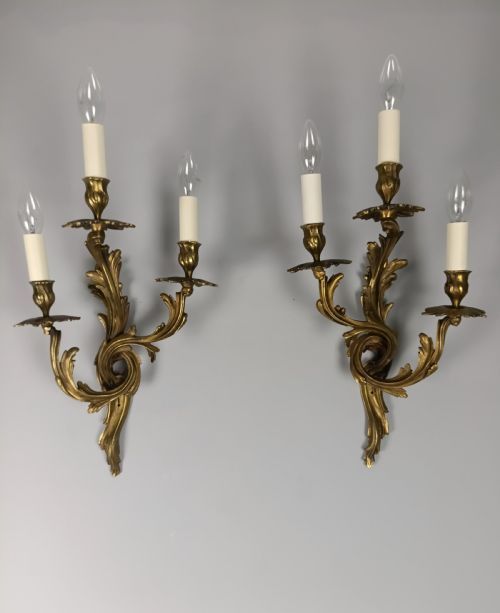


Large Gilt Wall Lights
Large gilt wall lights bring warmth and architectural presence to a room, projecting light across gilded surfaces.
Large Gilt Wall Lights
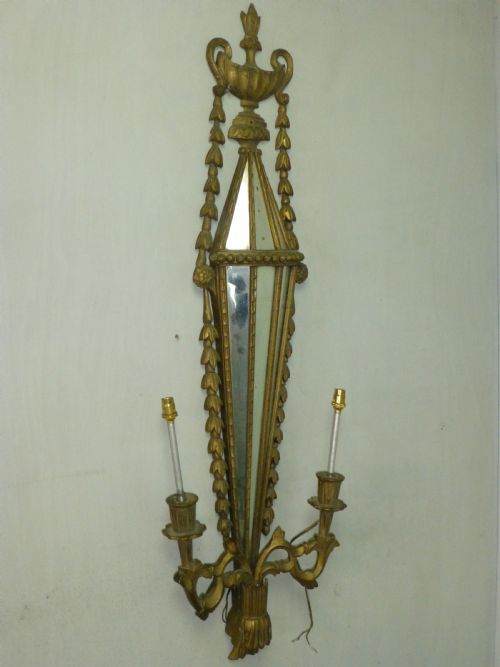
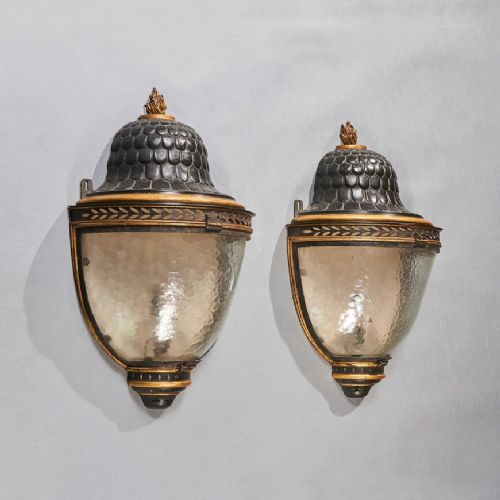
Large gilt wall lights take many forms, including multi-branched sconces, girandoles, overmantel mirrors with integrated arms, and wall lanterns. When searching for large gilt wall lights, buyers encounter substantial fixtures designed to dominate a wall space and amplify candlelight or early electric illumination.
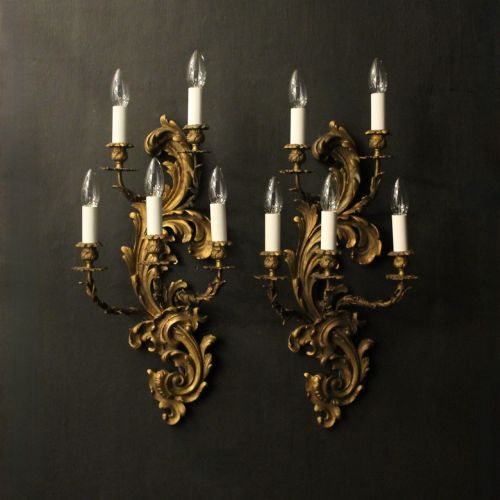
The pieces listed here originate predominantly from France, spanning the nineteenth century through the 1930s. Workshops produced pairs and sets of twin, triple, or five-arm fixtures suited to high ceilings and grand domestic interiors.
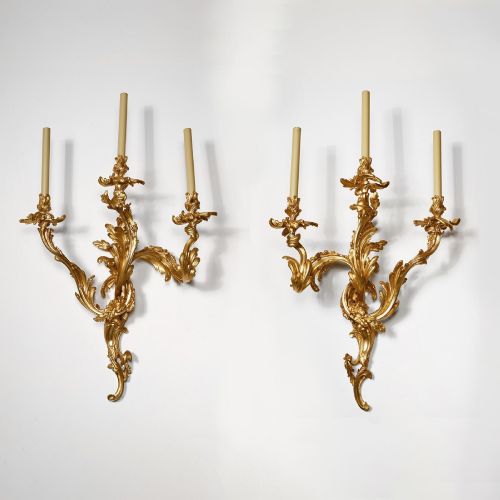
Styles heavily reflect French decorative movements, showing Louis XVI, Napoleon III, and Rococo Revival influences. Alongside purely metal sconces, hybrid formats appear, such as carved giltwood mirrors fitted with branching candle arms.
Materials and construction methods
Foundational structures rely on cast metals such as bronze, ormolu, brass, and tole peinte, alongside carved timber for giltwood examples. Gesso and gold leaf provide the luminous surface finishes that define the appearance of these fixtures under light.
Foundries and workshops employed casting techniques for metal arms and backplates, whilst woodcarvers shaped elaborate scrollwork and floral motifs before applying gilding. Glass elements occasionally integrate into lanterns and mirrored backplates to reflect the glow.
Large Gilt Wall Lights Retail Price Guide 2026
Typical asking prices for large gilt wall lights among the pieces listed under this phrase on Sellingantiques today, from the lower quarter to the upper quarter. They describe what is for sale here now, not the wider market.
Several heavy bronze pairs feature watchful carved cherubs peering down from the backplates, guarding the flame since the nineteenth century.
Assessing quality in period lighting
Quality rests in the crispness of the metal casting and the depth of the hand-carved detail in wood or gesso. Superior examples display sharp relief in acanthus leaves, cherubs, and rococo scrolls, whereas lesser pieces show softened edges from worn moulds.
The weight and gauge of the bronze, brass, or giltwood provide an immediate indication of substance. Heavier, more substantial framing supports multi-branched arms securely without structural distortion over decades of use.
The Large Gilt Wall Lights Glossary
- Ormolu
- Gilding technique involving finely ground high-carat gold applied to a bronze base. This finish produces a deep, warm metallic lustre that resists tarnishing.
- Girandole
- An ornamental wall mirror fitted with branching candle sconces attached to the frame. The glass surface multiplies the reflected illumination in the room.
- Appliqué
- A French term used interchangeably with wall sconce. It denotes a light fixture mounted directly to a vertical surface.
- Tole peinte
- Painted sheet metal used in decorative lanterns and fixtures. It frequently appears alongside parcel gilt elements for textural contrast.
Large Gilt Wall Lights: Frequently Asked Questions
How were large gilt wall lights used?
These fixtures were mounted in principal reception rooms, grand hallways, and salons to provide ambient illumination alongside central chandeliers. Their reflective gilt surfaces maximised the reach of candlelight before the widespread adoption of electricity.
Over time, many surviving examples have been rewired to accommodate modern electrical standards while retaining their historic metalwork and candle-form tubes.
How do I identify French Rococo Revival pieces?
Rococo Revival pieces display asymmetrical scrollwork, C-scrolls, naturalistic floral motifs, and shell forms. The bronze or giltwood frames curve dynamically without rigid symmetry.
In contrast, Louis XVI style pieces incorporate neoclassical straight lines, urns, swags, and architectural symmetry.
Are these wall lights suitable for modern electrical wiring?
Many period fixtures arrive updated with modern wiring housed discreetly within the arms and backplates. Professional installation ensures that heavy bronze or giltwood assemblies secure safely to wall studs.
Buyers should consult qualified electricians to confirm compatibility with local household circuits and wall anchor requirements.
What is the difference between gilt bronze and brass?
Gilt bronze, or ormolu, consists of a copper and tin alloy treated with gold leaf or mercury gilding to achieve a rich, enduring golden sheen. Brass is an alloy of copper and zinc that tends toward a brighter, yellower metallic tone.
Bronze generally permits sharper, deeper casting definition, which allows for intricate detailing on high-end nineteenth-century sconces.