




Large Edwardian Banquet Table
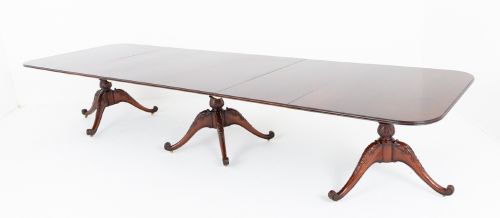
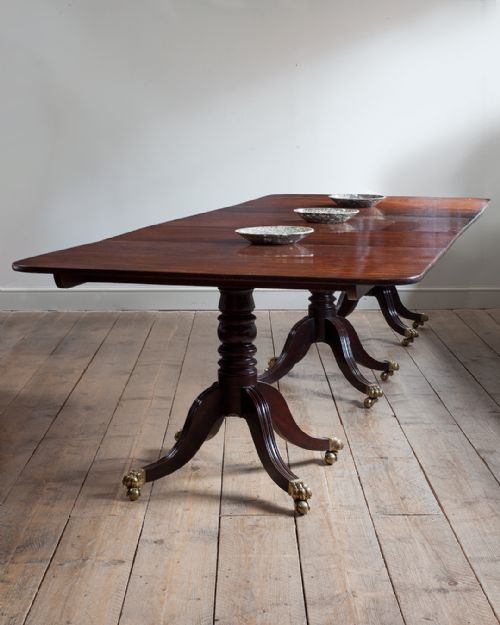
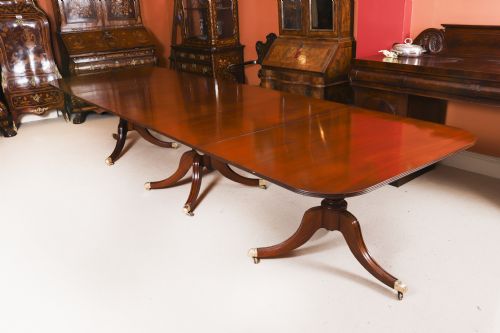
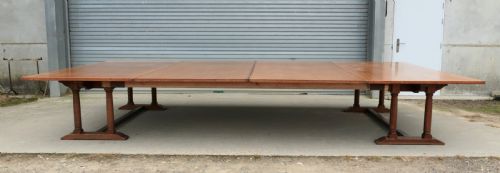
A large edwardian banquet table offers substantial seating for formal dining, anchored by rich mahogany and solid oak timbers.
Large Edwardian Banquet Table
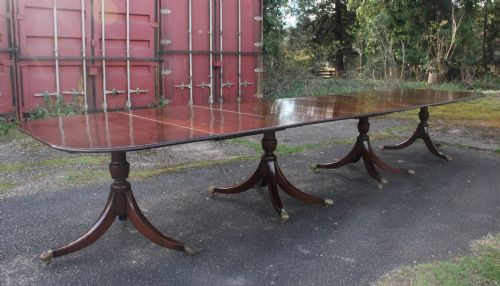
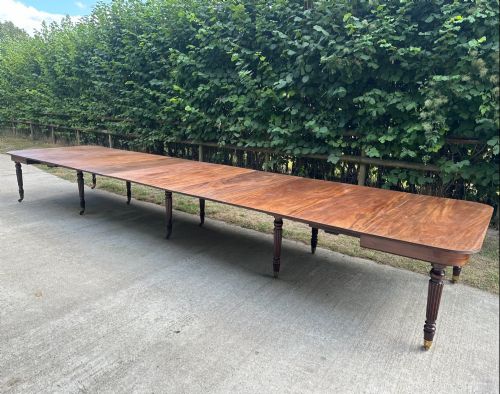
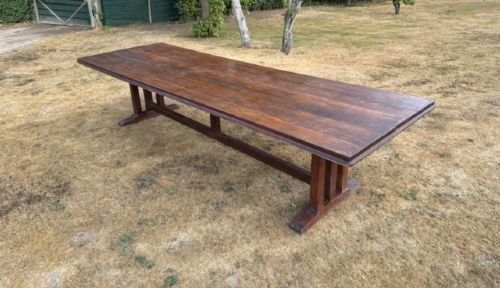
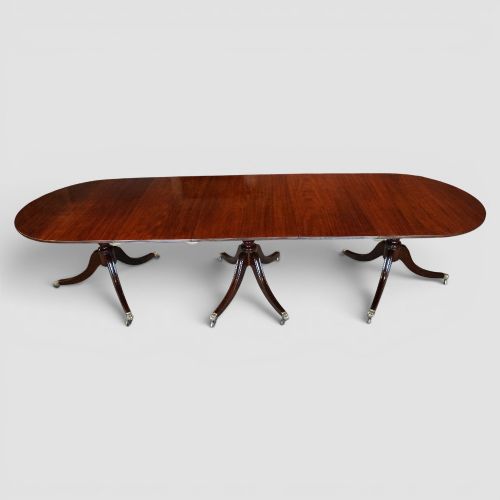
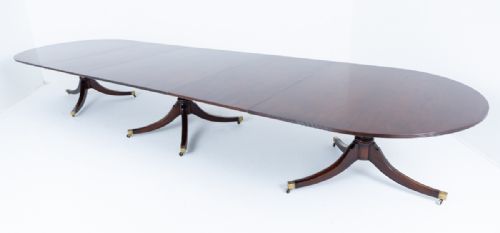
Makers and workshops of the period drew upon earlier Georgian and Regency precedents, producing revival pieces alongside contemporary Edwardian designs. Buyers encounter both mahogany and oak constructions, ranging from triple and quadruple pedestal arrangements to long refectory boards.
What Varies In Quality
Quality rests upon the selection of timber figure and the integrity of the underlying construction. Tables utilising dense Cuban mahogany or quarter-sawn oak exhibit superior grain patterns and greater resistance to warping.
The sophistication of the extending mechanism and the stability of multiple pedestals determine the day-to-day utility of a large dining table. Finer examples retain smooth operation across all added leaves and balanced support across every pillar.
Some tables stretch long enough to host a small medieval court committee, provided everyone agrees on the pass-the-salt protocol.
Gillows·Whytock and Reid·Maple and Co·Waring and Gillow
The Large Edwardian Banquet Table Glossary
- Pedestal
- A central columnar support, often divided into three or four pillars on longer dining tables to distribute weight evenly. Multiple pedestals allow easier chair placement around the perimeter.
- Refectory table
- A long, narrow dining table traditionally used for communal dining, constructed with sturdy legs connected by stretchers. Edwardian and Arts and Crafts examples often feature solid oak boards.
- Extending table
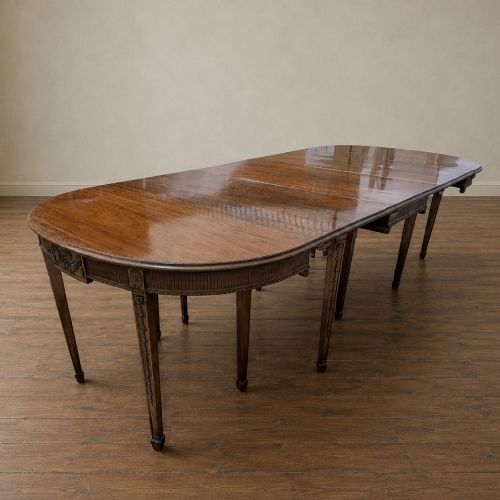
- A dining table designed to accept loose leaves supported by pull-out rails or a telescopic frame. This mechanism lets the top expand to seat large dinner parties.
- D-End
- A table form featuring semi-circular ends that can be detached or separated from central sections. When joined, they form a unified rectangular dining surface with rounded ends.
Large Edwardian Banquet Table: Frequently Asked Questions
How many people does a large banquet table seat?
These large dining tables generally accommodate ten to thirty guests depending on the length and the number of insertion leaves used.
Multi-pedestal configurations distribute chairs evenly along the sides without obstructing legroom.
What is the difference between oak and mahogany tables?
Oak tables often lean towards Arts and Crafts or refectory styles, displaying prominent grain and robust frames.
Mahogany tables typically follow Regency or Georgian revival designs, offering darker tones and formal pedestal bases.
How do extending mechanisms operate on these tables?
Extending versions use pull-out runners or central pillar arrangements to separate the main top sections.
Additional leaves drop into the central gap to lengthen the surface for large gatherings.
How do I care for a wood banquet table top?
Protect the timber surface from direct heat and moisture using appropriate pads and table runners during meals.
Regular polishing with traditional wax maintains the lustre of mahogany and oak finishes.