




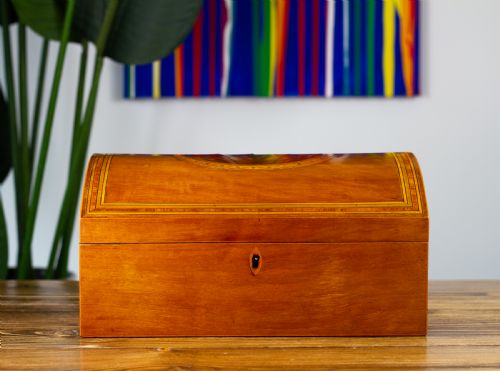


Large Tea Caddy
A large antique tea caddy is a capacious wooden or metal chest designed to store valuable loose tea securely under lock and key.
Large Tea Caddy
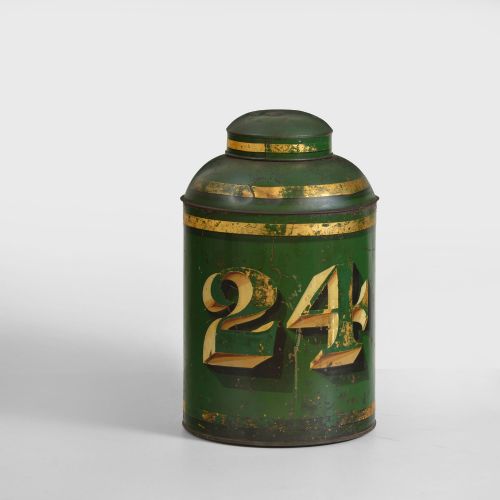
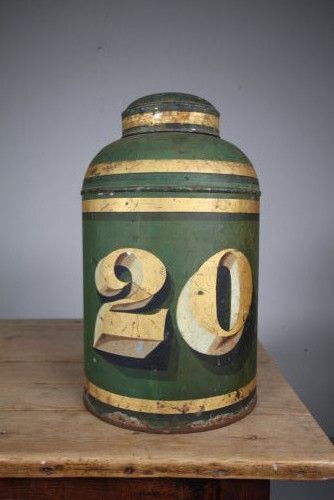
A large antique tea caddy serves as a substantial receptacle from the Georgian, Regency, and Victorian eras, built to hold several varieties of dried leaf when tea was an expensive commodity. These pieces range from timber boxes with internal lidded compartments to painted toleware canisters and silver vessels.
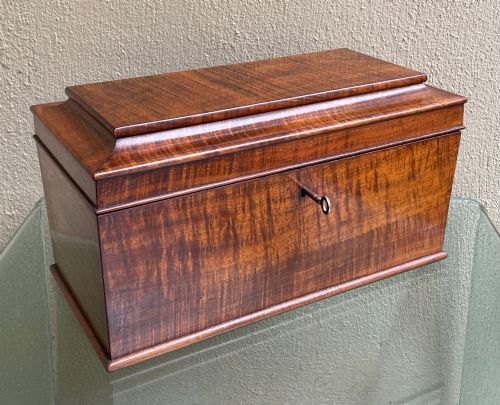
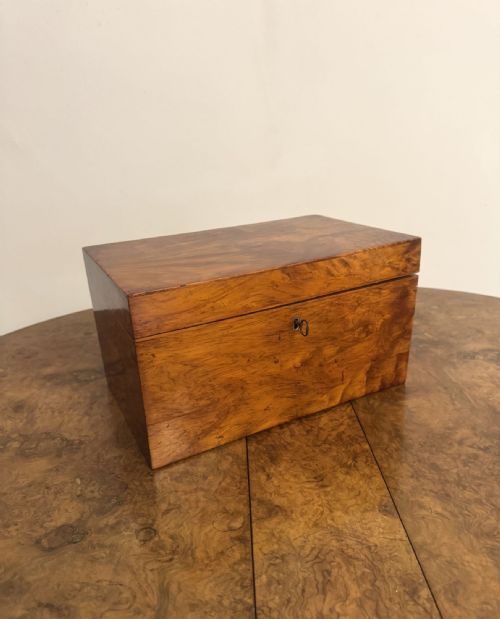
The most common examples on this page are mahogany, walnut, and rosewood boxes dating from the late eighteenth and nineteenth centuries, often featuring inlaid boxwood stringing or mother of pearl. Toleware canisters decorated in the Chinoiserie taste also appear regularly among the wood and metal forms.
Buyers select these larger containers for their generous proportions and fitted interiors, which frequently retain their original mixing bowls or foil-lined compartments. They function today as decorative storage for jewellery, keepsakes, or modern collections.
How they were made
Cabinetmakers constructed wooden large antique tea caddy examples using dense timbers such as mahogany, walnut, rosewood, amboyna, and satinwood, frequently applying burr veneers over pine or oak carcases. Boxwood stringing, brass lion paw feet, and mother of pearl inlay provided decorative contrast.
Metal versions relied on toleware, tinplate, and solid silver or silver plate, shaped into canisters and boxes. Surface decoration on the painted metal pieces utilised black grounds enriched with gilt Chinoiserie motifs.
Large Tea Caddy Retail Price Guide 2026
Typical asking prices for large tea caddy among the pieces listed under this phrase on Sellingantiques today, from the lower quarter to the upper quarter. They describe what is for sale here now, not the wider market.
Periods represented stretch from George III and Regency eras through the nineteenth century and into the Victorian period.
What varies in quality
The grade of timber veneer dictates much of the value, with highly figured flamed mahogany, burr walnut, and amboyna representing the upper tier of production. Crispness in the execution of boxwood stringing and mother of pearl inlay further separates standard joinery from superior cabinet work.
Internal completeness plays a major role, particularly the survival of original crystal mixing bowls, fitted lids to the internal compartments, and working locks with functional keys. Metal pieces depend on the preservation of original gilding and the weight of the silver or silver plate.
Walker and Hall·Mappin and Webb·H. Dunsheath
The Large Tea Caddy Glossary
- Toleware
- Painted or lacquered tinware manufactured to imitate Asian lacquer or decorative metal goods. It often displays gilt Chinoiserie scenes.
- Chinoiserie
- European interpretation and imitation of Chinese artistic traditions, popular in decoration during the Georgian and Regency periods. It employs motifs of figures, pagodas, and landscapes in gilt.
- Stringing
- Inlaid lines of contrasting wood used to outline panels on furniture and boxes. It provides a crisp linear border to mahogany and satinwood surfaces.
- Caddy spoon
- A short-handled spoon specifically designed to measure dry tea leaves from the caddy into the pot. Examples occur in silver with engraved or pierced bowls.
- Amboyna
- An exotic timber prized for its dense, mottled, and swirling grain patterns. Cabinetmakers utilised it as a veneer on high-status Regency boxes.
Large Tea Caddy: Frequently Asked Questions
How do I date a tea caddy?
Dating relies on timber choice, construction methods, and hardware styles such as escutcheons and feet. Georgian and Regency examples often feature distinct veneers and hand-cut dovetails.
Later Victorian pieces display heavier mouldings or machine-made elements. Hallmarks on silver mounts provide exact manufacturing years.
What was the glass bowl for inside?
The central glass bowl served as a mixing vessel where the host blended different varieties of black and green tea before brewing. It also held sugar lumps.
Many bowls are cut glass or crystal and lift out independently of the lidded tea canisters flanking them.
Why do most caddies have locks?
Tea was a heavily taxed and costly luxury item during the eighteenth and nineteenth centuries, making strict portion control essential for households.
Servants and guests were kept from accessing the dry leaves without permission, turning the key into a symbol of domestic authority.
Can I store real tea in it?
Dry tea leaves absorb ambient odours easily, so storing unsealed food in antique wood requires caution. Many interiors feature original foil linings that have degraded over time.
Using modern airtight inner packets inside the historic compartments preserves both the leaf and the antique fabric.