

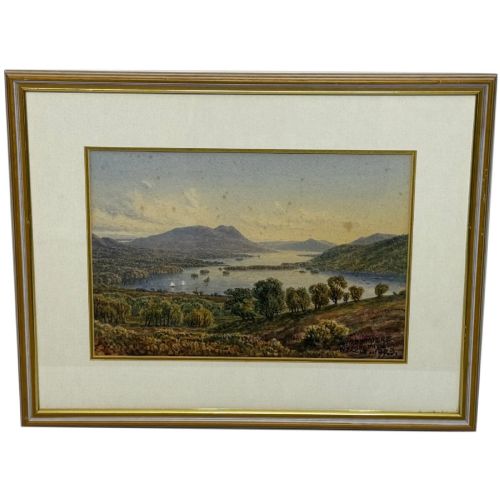


Lake Scenery Painting
Lake scenery painting captures tranquil waters and distant shores across periods from the Victorian era to the mid twentieth century.
Lake Scenery Painting
A lake scenery painting depicts bodies of water, mountainous backdrops, and pastoral shores within framed compositions. These works capture specific geographies ranging from English and Welsh lakes to Scottish highlands and Italian waters.
The selections on this page span the Victorian and Edwardian periods through to the mid twentieth century. Buyers encounter both intimate watercolour paintings on paper and larger oil paintings on canvas.
Many examples record named locations such as Windermere, Coniston Water, Loch Lubnaig, and Lake Garda. Other canvases portray anonymous frozen lakes with figures or atmospheric autumn landscapes.
How they were made
Artists executed these works using oil paint on canvas or watercolour paint on paper. Canvas supports permitted rich textures and deep layering, particularly in nineteenth century romantic and realist compositions.
Watercolour paintings on paper offered fluid transparency for capturing light upon water and sky. These works frequently reside within original gilded wood and gesso frames that complement the artwork.
Lake Scenery Painting Retail Price Guide 2026
Typical asking prices for lake scenery painting among the pieces listed under this phrase on Sellingantiques today, from the lower quarter to the upper quarter. They describe what is for sale here now, not the wider market.
Listings feature works spanning the Victorian, Edwardian, and mid twentieth century periods, employing oil on canvas, watercolour on paper, and gilded wood.
What varies in quality
Quality rests in the precision of brushwork and the handling of atmospheric light over water. Superior examples demonstrate a confident command of perspective, tonal depth, and natural colour relationships.
The framing also distinguishes the work, with period gilded wood and gesso moulding adding substantial presence. Signed pieces by established artists carry stronger provenance than anonymous compositions.
William Taylor Longmire·Alfred de Breanski·Alexis De Leeuw·Alfred de Breanski Snr·Tom Dudley·Fred Merriman·Percy Lancaster
The Lake Scenery Painting Glossary
- Watercolour
- A painting method where fine pigment is suspended in water soluble vehicle. These works utilise paper supports and delicate washes.
- Oil paint
- A slow drying paint made by mixing pigments with drying oils. This medium allows for thick impasto application and subtle blending.
- Gesso
- A paint mixture consisting of a neutral binder mixed with chalk, gypsum, or pigment. It served as a prepared base for wooden frames.
- Impressionism
- An art style characterised by relatively small, thin yet visible brush strokes and an emphasis on accurate depiction of light. British interpretations captured local atmospheric conditions.
Lake Scenery Painting: Frequently Asked Questions
How do I identify a Victorian lake painting?
Victorian lake paintings often feature romantic or realist interpretations of British landscapes with detailed brushwork. They frequently appear on canvas or paper within ornate gilded frames.
Examining the underlying stretcher bars, paper ageing, and stylistic conventions helps confirm the nineteenth century origin.
What is the difference between oil and watercolour?
Oil paintings utilise pigment bound in drying oils on canvas, offering rich textures and deep colour saturation. Watercolour paintings employ water soluble pigments on paper, producing lighter translucent effects.
Both mediums were popular for capturing lake scenery across different historical periods.
How should I hang a framed painting?
Hang paintings away from direct sunlight and fluctuating heat sources to protect canvas, paper, and gilded wood frames. Secure fixings matched to the weight of the frame ensure safe wall placement.
Proper placement preserves the integrity of both the artwork and its historical mount.
Are these paintings signed by the artists?
Some lake paintings feature artist signatures inscribed directly onto the canvas or paper surface. Other works remain anonymous while still reflecting distinct regional painting styles.
Signatures provide valuable context regarding the creator and period of execution.