

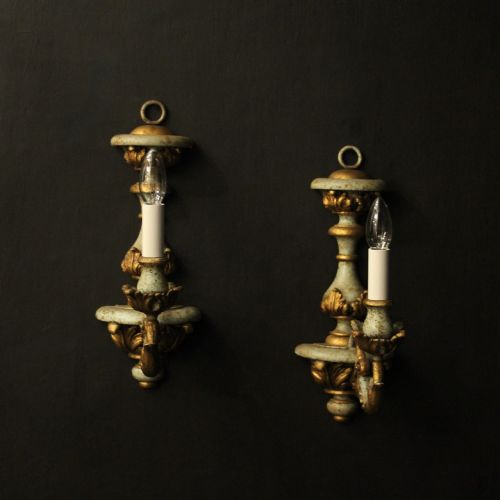
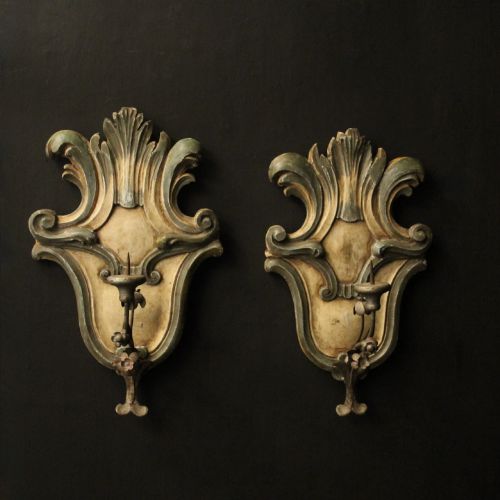
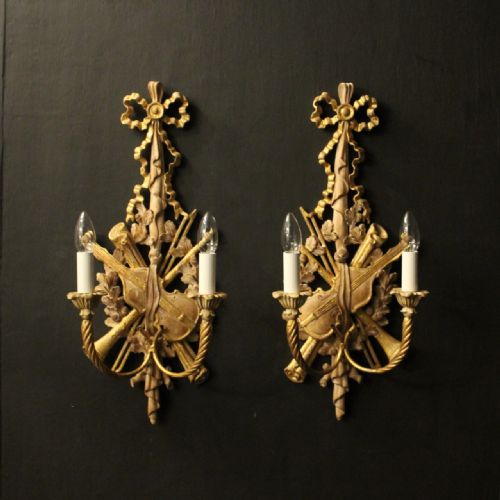


Italian Wooden Sconces
Italian wooden sconces bring warmth and sculptural presence to a wall, offering rich carved surfaces shaped across centuries.
Italian Wooden Sconces
When buyers search for italian wooden sconces, they encounter wall lights, brackets, and candelabras created across multiple periods from the eighteenth century through to the early twentieth century. These fixtures serve as functional illumination and decorative wall sculpture, appearing in forms ranging from single-arm lights to multi-armed configurations.
The most common examples on this page date from the late nineteenth and early twentieth centuries, particularly the nineteen-twenties and nineteen-thirties, alongside earlier nineteenth-century and eighteenth-century survivals. Florentine workshops contribute heavily to the selection, often taking the form of giltwood or silver-gilt wall lights intended to catch candle or electric light.
Makers and artisans constructed these pieces as pairs or single brackets, utilising carved wood as a primary base for intricate surface decoration. Styles span from Italian Baroque and Rococo Revival to Neoclassical and Florentine traditions, showing how regional workshops reinterpreted classical motifs over generations.
How they were made
Carved wood forms the structural core of these wall lights, providing a sturdy base for detailed ornamentation shaped by hand. Artisans applied gesso over the wooden foundation to create a smooth, receptive layer for subsequent gilding or painting.
Surface decoration relied on gold leaf and silver leaf, applied to achieve shimmering metallic finishes that reflected ambient light in domestic interiors. Polychrome paint finishes also appear, introducing subtle colour and contrasting tones to carved foliage and figures.
Italian Wooden Sconces Retail Price Guide 2026
Typical asking prices for italian wooden sconces among the pieces listed under this phrase on Sellingantiques today, from the lower quarter to the upper quarter. They describe what is for sale here now, not the wider market.
Carved Blackamoor figures stand ready as candelabras, holding wooden arms aloft to light eighteenth-century rooms.
What varies in quality
The depth and crispness of the wood carving distinguish finer examples from simpler production, particularly in the rendering of acanthus leaves, scrolls, and figural elements. Sharp chisel work and undercut details demonstrate greater sculptural skill by the original artisan.
The integrity and application of the gesso and leaf layers dictate visual richness, where even ageing reveals the underlying warmth of the wood. Finer pieces maintain coherent proportions and balanced arm configurations that harmonize with the scale of the backplate.
The Italian Wooden Sconces Glossary
- Giltwood
- Wood that has been coated with a thin layer of gold leaf or gold paint. This technique creates a luminous surface that enhances carved details under low light.
- Gesso
- A plaster-like mixture applied to wood surfaces to prepare them for gilding or painting. It provides a smooth base that holds fine carved definition.
- Polychrome
- Decorated in multiple colours using paint or pigments. This finish highlights specific decorative motifs on wooden carvings.
- Pricket candle sconce
- A wall light featuring a sharp metal spike designed to hold a candle in place. It represents an older form of domestic lighting.
- Silver giltwood
- Wood coated with silver leaf rather than gold leaf, often antiqued to show subtle dark tones. This finish offers a cooler metallic gleam than traditional gold.
Italian Wooden Sconces: Frequently Asked Questions
How do I install these wall lights?
Most wooden wall lights require secure mounting to wall studs or appropriate wall anchors due to their solid wooden construction and decorative weight.
Electrical wiring must be adapted by a qualified electrician to safely integrate older sconces with modern household circuits.
Can I use modern lightbulbs in them?
Many sconces have been wired for modern low-voltage or LED candle bulbs to ensure safe daily operation without generating excessive heat.
Consult a professional restorer to check internal wiring and ensure lampholders match current safety standards.
How do I clean carved wooden sconces?
Dust surfaces gently with a soft, dry brush to prevent accumulation in the crevices of the carved foliage and gesso work.
Avoid liquid cleaners or polishes, as moisture can damage fragile leaf surfaces and aged polychrome paint.
How do I date an antique wooden sconce?
Examine the tooling marks on the reverse of the wood and the composition of the gesso layer beneath the surface finish.
Stylistic cues such as Baroque scrolls or Neoclassical symmetry help narrow the period of origin when combined with construction methods.