

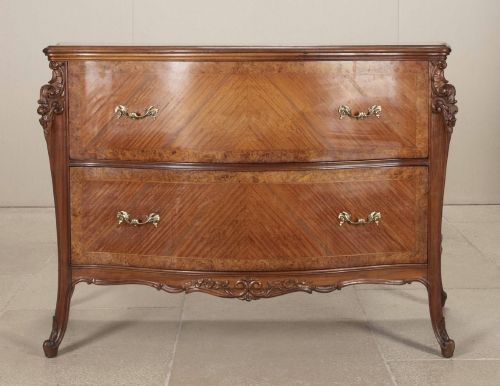


Italian Serpentine Drawers
Italian serpentine drawers are robust storage pieces shaped with characteristic curves, offering both generous capacity and distinctive continental presence.
Italian Serpentine Drawers
Italian serpentine drawers encompass commodes, chests of drawers and bedside tables built with sweeping, undulating fronts that define the form. These pieces emerge across several periods including the eighteenth century, nineteenth century and the early twentieth century.
The commode stands as the most common form encountered on this page, often featuring the bombe profile alongside the signature serpentine outline. Examples range from eighteenth century originals to later revival pieces created in the nineteenth and twentieth centuries.
Regional and stylistic variations span Italian Rococo, Venetian Rococo, Neoclassical and French Chateau aesthetics. Workshops constructed these items from solid and veneered timbers, occasionally applying painted finishes or faux marble tops.
Materials and construction
Cabinet makers utilised walnut, burr walnut, fruitwood, satinwood, olive-wood and ebonised wood to build these carcasses, frequently laying intricate veneers across the curved surfaces. Brass hardware and metal mounts were then fitted to secure and adorn the drawers.
Painted wood surfaces appear alongside natural timber grains, sometimes combined with carved detailing and giltwood highlights. Carved elements accent the structural lines of the commodes and bedside chests.
Italian Serpentine Drawers Retail Price Guide 2026
Typical asking prices for italian serpentine drawers among the pieces listed under this phrase on Sellingantiques today, from the lower quarter to the upper quarter. They describe what is for sale here now, not the wider market.
Several chests arrive equipped with faux marble tops, offering the grandeur of stone without the morning chill.
Assessing quality and execution
Quality rests in the precision of the serpentine curve and the harmony of the timber grain across the drawer fronts. Finer examples display meticulous matching of burr walnut, fruitwood or satinwood veneers that follow the complex contours without buckling.
The integrity of the structural carcass and the crispness of any carved decoration distinguish superior pieces from standard production. Painted surfaces reveal their standard through the subtlety of the finish and the preservation of the underlying detail.
The Italian Serpentine Drawers Glossary
- Serpentine
- A shape defined by a line that curves inward then outward, creating a gentle undulating front on chests of drawers and commodes. This contour requires skilled woodworking to achieve across timber veneers.
- Commode
- A low chest of drawers or cabinet originating in France but widely produced in Italy during the eighteenth and nineteenth centuries. These pieces typically stand on short legs and serve as principal storage furniture.
- Bombe
- A swelling, bulging profile applied to the sides and front of case furniture. It adds considerable visual weight and demands advanced cabinet-making techniques.
- Giltwood
- Wood that has been coated with a thin layer of gold leaf or gilt paint for decorative emphasis. It frequently highlights carved details on Venetian and continental commodes.
Italian Serpentine Drawers: Frequently Asked Questions
How do I date an Italian commode?
Dating relies upon examining the construction methods, timber choice, and stylistic markers visible in the carcass and hardware. Eighteenth century pieces display distinct joinery and timber ageing compared to nineteenth century revivals or later twentieth century interpretations.
Secondary woods, backboards, and drawer linings provide further physical evidence for determining the period of manufacture.
What is the difference between a commode and a chest of drawers?
While both provide storage through stacked drawers, the term commode specifically denotes a low decorative cabinet of continental origin. These often feature more elaborate serpentine or bombe shaping than standard upright chests.
Commodes traditionally functioned in principal rooms as both storage and display surfaces.
Where should I place a serpentine chest?
These pieces suit reception rooms, hallways or bedrooms where their curved fronts can be appreciated without obstruction. Their distinct profiles work well against plain walls that allow the silhouette to stand out.
Ensure adequate floor space is available to accommodate the undulating projection of the drawers.
How do I care for walnut veneer?
Walnut veneers require stable indoor humidity away from direct sunlight and heat sources to prevent timber movement or lifting. Regular dusting with a soft, dry cloth maintains the surface without the need for heavy polishes.
Wax can be applied sparingly to nourish older wood surfaces when they appear dry.