


Italian Renaissance Hall Seat
An italian renaissance hall seat brings architectural presence and carved historic gravity to a hallway or reception space.
Italian Renaissance Hall Seat
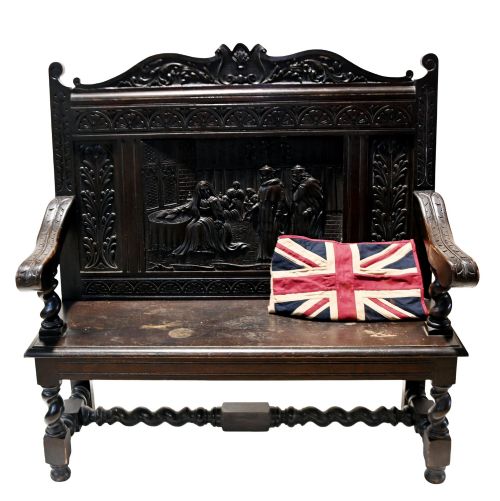
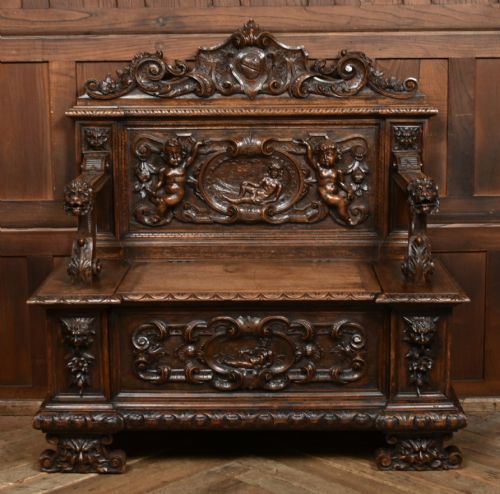
An italian renaissance hall seat encompasses heavy wooden benches, cassapancas, and high-backed seats rooted in historical revival styles and earlier centuries. These forms serve as grand architectural statements in large spaces, combining seating with storage or decorative display.
The selections available range from 18th-century walnut benches to 19th-century revival pieces drawing upon Renaissance motifs. Buyers frequently encounter variations including sgabello chairs, Savonarola armchairs, and long carved wooden benches.
Origins span Italian workshops alongside 19th-century revival interpretations created across Europe. The predominant forms utilise solid timber construction to project an imposing historic aesthetic.
Materials and construction methods
Construction relies heavily on walnut and oak, supplemented by fruitwood, pine, and mixed wood inlay. Carvers utilised these dense timbers to execute deep relief panels, figural elements, and intricate geometric patterns.
Textiles such as damask frequently provide upholstery for padded seats and backrests on armchairs and benches. Bone inlay occasionally appears as a contrasting decorative detail embedded directly into the wood surface.
Joinery techniques reflect traditional cabinetmaking practices designed to support substantial timber frames. Surface decoration combines hand carving with contrasting wood inlays and applied textile elements.
A daring nineteenth-century craftsman decided a hall bench simply required inlaid bone details to catch the eye of every passing visitor.
Judging quality in historic seating
Depth and crispness of the hand carving dictate the aesthetic hierarchy among these pieces. Superior examples display sharp, well-defined figural reliefs and architectural mouldings rather than shallow or softened detailing.
The selection and figure of the timber significantly influence overall merit. Pieces fashioned from solid walnut with rich grain patterns command greater appreciation than those utilising secondary woods or simpler pine construction.
Integrity of structural form and original decorative elements separates standard production from exceptional works. Fine inlay work and well-preserved structural joinery indicate superior craftsmanship.
White, Allom & Co.
The Italian Renaissance Hall Seat Glossary
- Cassapanca
- A traditional Italian wooden bench featuring a built-in chest beneath the seat. This form combines storage with heavy decorative backrests and arm supports.
- Sgabello
- A light wooden chair featuring a sculpted wooden seat and two carved solid board supports instead of traditional legs. These chairs were designed to be easily moved against hallway walls.
- Savonarola chair
- A folding armchair constructed from multiple intersecting curved wooden slats. The design originates from the Italian Renaissance and typically incorporates an elaborate carved crest rail.
- Damask
- A reversible figured fabric traditionally woven from silk, wool, or linen. It frequently appears as upholstery on historic seating.
- Bone inlay
- Small pieces of carved animal bone embedded into wooden surfaces to create geometric or figural patterns. This technique adds bright contrast against dark walnut or fruitwood.
Italian Renaissance Hall Seat: Frequently Asked Questions
Where should I place an italian renaissance hall seat?
These substantial seats function best in wide hallways, spacious entryways, or large reception rooms where their architectural proportions can be appreciated.
They provide a formal focal point while offering practical seating and occasional storage within large historic interiors.
How do I care for antique walnut wood?
Maintain the timber by keeping pieces away from direct heat sources and sudden humidity changes to prevent wood splitting.
Apply high-quality beeswax sparingly and buff gently with a soft cloth to preserve the natural lustre of the aged surface.
Are these seats comfortable for daily use?
Most historic examples prioritize architectural presence and formal posture over ergonomic lounging.
Wooden seats and upright backs encourage an upright stance, though upholstered versions provide a slightly softer sit.
How do I distinguish 18th-century pieces from 19th-century revivals?
Examination of tool marks, timber shrinkage, and joinery methods reveals the age of the construction.
Revival pieces often display the heavier, highly theatrical carving typical of nineteenth-century interpretations of earlier Italian designs.