

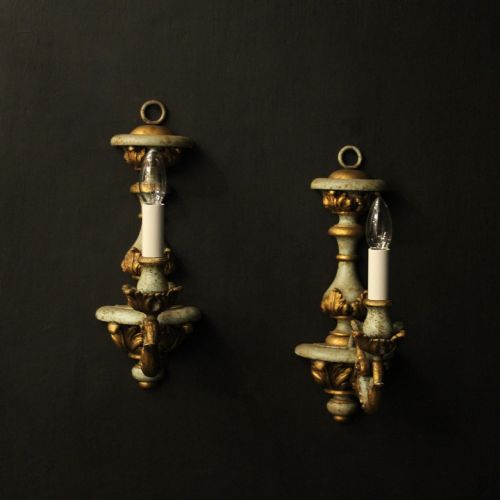


Italian Polychrome Wall Sconces
Italian polychrome wall sconces bring brilliant colour and historic charm to a room, offering striking illumination carved in wood.
Italian Polychrome Wall Sconces
Italian polychrome wall sconces are decorative lighting fixtures designed to mount directly onto walls, holding one, two, or three arms for candles or bulbs. When searching for Italian polychrome wall sconces, buyers encounter wooden forms dating from the nineteenth century up through the nineteen-thirties, spanning periods such as nineteen-hundred and nineteen-thirty.
The objects on this page belong to distinct stylistic traditions including Italian Baroque, Italian Florentine, Italian Rococo, Italian Neoclassical, and Italian Rococo Revival. Most examples listed take the form of pairs, featuring single, twin, or triple arm configurations designed to flank mirrors or doorways.
Origins remain firmly rooted in Italy, utilising traditional regional carftsmanship that blends sculptural woodwork with painted finishes. Buyers are most likely to meet twentieth-century pairs from nineteen-thirty alongside earlier nineteenth-century single examples.
Materials and construction
Carved wood forms the structural base of these pieces, often layered with gesso to create smooth surfaces for detailed ornament. Artisans then applied polychrome paint and gold leaf or silver gilt to achieve rich surface decoration.
The combination of carved wood, gesso, and polychrome paint gives each fixture its characteristic tactile depth and vibrant colour palette. Gilding accents highlight the carved contours, setting off the painted elements across Baroque and Rococo forms.
Italian Polychrome Wall Sconces Retail Price Guide 2026
Typical asking prices for italian polychrome wall sconces among the pieces listed under this phrase on Sellingantiques today, from the lower quarter to the upper quarter. They describe what is for sale here now, not the wider market.
Listings span from the nineteenth century to nineteen-thirty, uniting carved wood, gesso, paint, and gold leaf.
Assessing quality and craftsmanship
Quality rests in the crispness of the wood carving and the subtlety of the polychrome paint application. Finer pieces display delicate hand-carved details that retain their original layered finishes without heavy modern repainting.
The integration of gold leaf or silver gilt alongside the polychrome pigments distinguishes more ambitious workshops from simpler production. Preservation of the historic surface finish largely determines the character of each sconce.
The Italian Polychrome Wall Sconces Glossary
- Polychrome
- Painted in several colours. This surface treatment brings varied hues to wooden carvings and architectural elements.
- Gesso
- A plaster mixture applied to wood as a base for paint or gilding. It provides a smooth ground for intricate decorative details.
- Giltwood
- Wood decorated with gold leaf or powder. This finish catches candlelight and adds reflective warmth to wall lights.
- Girandole
- An ornamental branched candlestick or light fixture mounted on a wall. These often feature mirrors or elaborate carved backplates.
- Baroque
- An ornate artistic style marked by dramatic movement and rich detail. It heavily influences many of the scrollwork designs seen on these walls.
Italian Polychrome Wall Sconces: Frequently Asked Questions
How do I hang these wall lights?
These wooden fixtures mount securely to walls using appropriate fixings suited to the weight of the carved wood and metal arms.
Professional installation is recommended to handle any electrical wiring safely while protecting the antique structure.
Are these sconces wired for electricity?
Most examples accommodate modern electrical wiring adapted from their original candle-holding formats.
Buyers should check individual listings to confirm the current wiring setup and bulb fitting types.
How do I clean polychrome painted wood?
Dust gently with a soft, dry cloth to prevent accumulation without disturbing the delicate painted and gilded surfaces.
Avoid liquid cleaners or harsh solvents that might damage the historic polychrome pigments and gesso layers.