
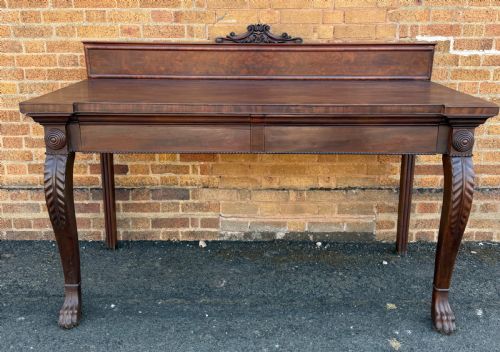


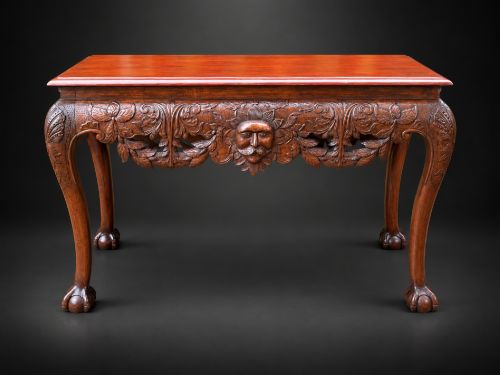


Irish Mahogany Sideboard
An irish mahogany sideboard brings deep timber and grand scale to a room, offering both surface space and storage through formal C19th craftsmanship.
Irish Mahogany Sideboard
When you search for an irish mahogany sideboard, you encounter formal dining furniture designed primarily for serving and display during the Georgian, Regency, and nineteenth century periods. These heavy timber pieces frequently appear as serving tables, console tables, and servers, often shaped by regional cabinet-making traditions on the island.
The versions most commonly met on this page span the George III, Regency, and William IV eras, alongside later revival pieces. They combine dark tropical hardwoods with architectural proportions, occasionally featuring carved details or contrasting veneers such as burr elm.
Materials and construction
Makers built these pieces using solid mahogany and flame mahogany veneers, selected for deep grain patterns and rich dark tones. Structural carcass work often incorporated secondary timbers, while polished brass hardware added functional contrast to drawers and mounts.
Joinery techniques ranged from traditional hand-cut dovetails in drawer construction to substantial carved legs and aprons. Surface finishes relied on hand-polished wax or shellac to accentuate the natural figure of the timber.
Listings here feature mahogany, brass, and burr elm across George II, George III, Regency, and William IV styles.
Judging quality in execution
Quality rests in the selection of the mahogany timber and the crispness of any carved decoration, from bold scrolling foliage to restrained gadrooned edges. Superior examples show careful book-matching of veneers and balanced proportions across wide console or serving tables.
The integrity of the structural frame, original hardware attachments, and the retention of surface patination further distinguish high-grade workshops from standard commercial production.
Robert Strahan & Co·Mack Williams And Gibton·The Woodworkers Ltd Kilkenny·Gillington of Dublin
The Irish Mahogany Sideboard Glossary
- Sideboard
- A large dining-room piece designed for holding dishes, silverware, and serving items. It often stands on four or six legs with drawer compartments.
- Serving table
- An open-framed table without lower cupboards, standing against the dining room wall for food presentation. Many pieces found in this category take this form.
- Regency
- A British and Irish design period spanning the early nineteenth century, noted for classical architectural restraint and bold use of figured timber.
- Flame mahogany
- A veneer cut from the fork of a mahogany tree where the grain twists to resemble flickering flames. It provides striking visual movement on drawer fronts.
- Console table
- A table designed to be fixed against a wall, frequently supported by decorative legs or brackets. In Irish furniture, these often double as serving tables.
Irish Mahogany Sideboard: Frequently Asked Questions
How do I date an irish mahogany sideboard?
Dating relies on stylistic markers, construction methods, and timber choice. Georgian and Regency pieces display classical proportions and hand-cut joinery, whereas later nineteenth-century or revival items often incorporate heavier carved decoration.
Examining secondary woods inside drawers and the ageing of the mahogany surface helps distinguish an original C19th build from later interpretations.
Where should I place a serving table?
These large tables suit dining rooms, grand hallways, or wide living spaces where their length and depth can be accommodated safely. Their traditional function as serving surfaces makes them practical against a principal dining wall.
Ensure the room has sufficient clearance around the piece, as deep console and serving formats project outward considerably further than standard side tables.
How do I care for antique mahogany timber?
Maintain mahogany surfaces by dusting with a soft, dry cloth and applying natural beeswax polish sparingly to preserve the moisture in the wood. Avoid placing the piece in direct sunlight or near heat sources to prevent timber splitting.
Regular, gentle upkeep protects the historic polish and allows the dark grain and veneer patterns to retain their depth.