

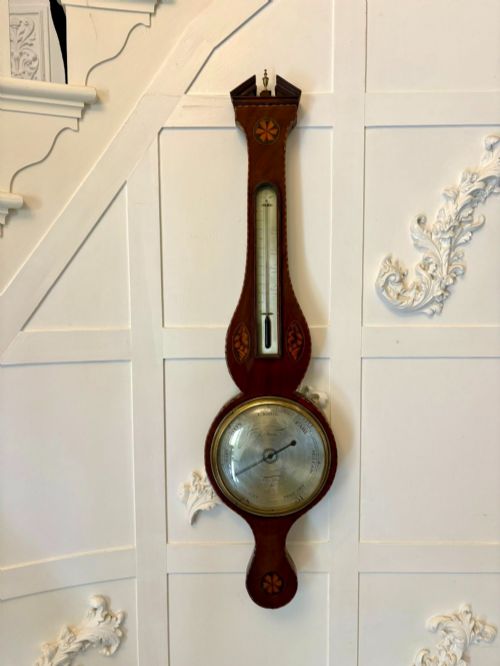
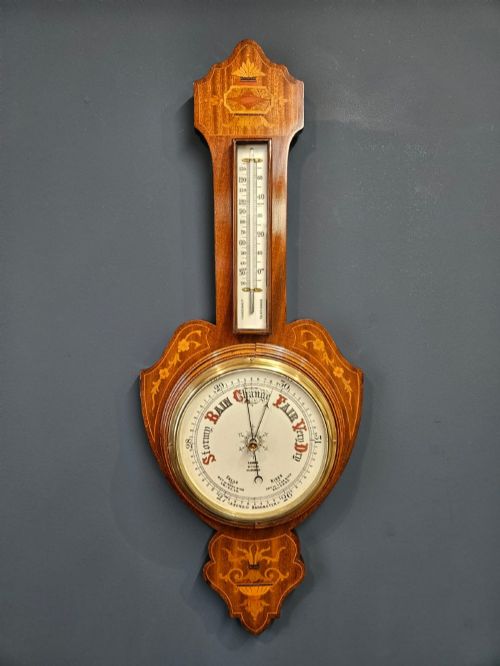
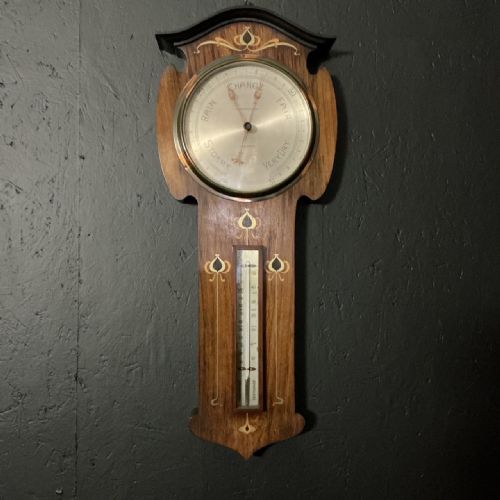
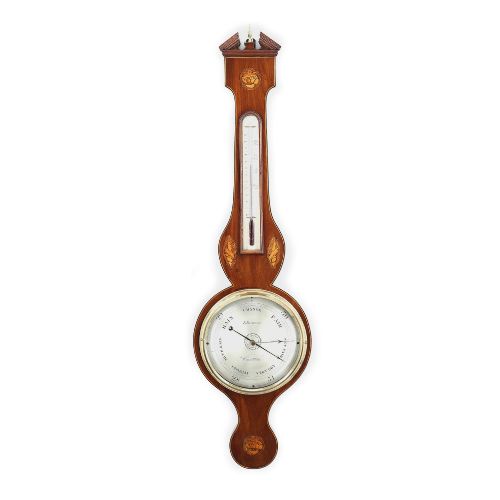


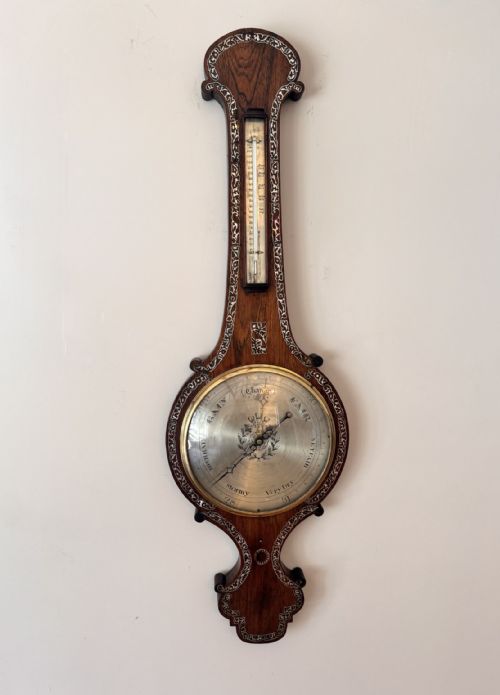


Inlaid Wall Barometer
An inlaid wall barometer records atmospheric pressure while bringing fine wood and shell decoration to a room.
Inlaid Wall Barometer
When you search for an inlaid wall barometer, you encounter instruments designed to hang in domestic spaces, primarily taking the form of wheel or banjo barometers alongside stick barometers. These pieces date from the eighteenth century through to the Victorian era and the 1930s.
The version you are most likely to meet on this page is the mahogany or rosewood banjo barometer, frequently accented with boxwood inlay, shell motifs, or mother-of-pearl. Such instruments combine meteorological utility with the prevailing cabinet-making styles of Georgian, Regency, and Victorian periods.
Makers housed these mechanisms in tall, slender wooden bodies designed for vertical wall display, often incorporating companion thermometers, hygrometers, or spirit levels on the dial face. The visual appeal rests on the contrast between dark tropical hardwoods and pale linear stringing or pictorial medallions.
How they were made
Cabinet makers constructed the bodies chiefly from solid and veneered mahogany or rosewood, chosen for stability and rich grain. Artisans then recessed boxwood, ebony, and mother-of-pearl into the primary wood to create geometric stringing, floral patera, and shell motifs.
Internal instrumentation relied on mercury columns in traditional stick and wheel barometers, or aneroid capsules in later nineteenth and twentieth-century examples. Dials were typically engraved on silvered metal or protected behind bevelled glass within brassbezels.
Inlaid Wall Barometer Retail Price Guide 2026
Typical asking prices for inlaid wall barometer among the pieces listed under this phrase on Sellingantiques today, from the lower quarter to the upper quarter. They describe what is for sale here now, not the wider market.
Materials recur across the selection in mahogany, rosewood, mother-of-pearl, and boxwood inlay.
What varies in quality
Quality separates ordinary utilitarian weather glasses from pieces produced by skilled makers and specialist opticians. The refinement of the cabinet work, the crispness of the boxwood and mother-of-pearl inlay, and the elegance of the case silhouette dictate the tier of the piece.
The integrity of the dial and the original mercury or aneroid mechanism influence the standing of the instrument. Signed dials from recorded makers command greater interest than unsigned shop stock.
B Besozzi of Weymouth·Ganthony of London·Prada of High Wycombe·Molton of Norwich·Luisetti of London·Fagioli of Clerkenwell London·Giana Shrewsbury·L Casatelli of Liverpool·Vecchio and Co of Shaftsbury·A Rivolta·J Groce York·Charles Aiano London·Pinchetti and Co London·F Salteri and Co Nottingham·Dominic Gatty·Schiavi of Chesham
The Inlaid Wall Barometer Glossary
- Banjo barometer
- A domestic weather glass housed in a case shaped like a banjo, featuring a small circular dial at the top and a larger dial below. This form dominated nineteenth-century hallways and parlours.
- Stick barometer
- A tall, narrow wall instrument where the mercury column remains exposed in a straight vertical tube against a long wooden backing. These represent the earlier and more scientifically direct approach to pressure reading.
- Aneroid barometer
- A weather instrument that measures pressure using a flexible-walled metal capsule containing a vacuum, avoiding liquid mercury altogether. This design emerged more widely in the later nineteenth century.
- Silvered metal
- A brass or copper dial plate treated with a silver finish and engraved with weather descriptions and barometric scales. The fine black wax filling the engraved lines allows for easy reading.
- Marquetry
- The art of forming decorative patterns on a wooden case using thin veneers of different timbers, shells, and metals. Neo-Classical examples often employ this technique for classical urn and floral motifs.
Inlaid Wall Barometer: Frequently Asked Questions
How do I read an inlaid wall barometer?
The upper dial or pointer indicates current atmospheric pressure, shifting towards rain or fair weather depending on the mercury or aneroid movement. Tapping the glass gently before reading helps settle the mechanism.
Many wheel barometers include a secondary pointer set by hand to track pressure changes relative to the current reading.
Are these barometers still accurate for weather forecasting?
While they continue to respond to real-time barometric pressure shifts, antique instruments serve best as general indicators rather than precision meteorological tools. Internal mercury tubes can develop tiny air gaps over centuries.
Modern digital sensors offer exact local metrics, whereas antique pieces provide a decorative historical guide to atmospheric trends.
Where should I hang a wall barometer?
Choose an interior wall free from direct sunlight, central heating radiators, and damp exterior stone. Wood cases expand and contract with severe temperature swings, which can warp the veneer or affect the internal cord and pulley systems.
Secure the instrument firmly to a wall plug or masonry anchor, as heavier rosewood and mahogany banjo cases carry substantial weight.
How do I tell a Georgian barometer from a Victorian one?
Georgian instruments often favour restrained proportions, fine boxwood stringing, and architectural pediments at the crest. Maker signatures on these early pieces frequently appear in script on the hygrometer or thermometer plate.
Victorian and later examples tend towards bolder mother-of-pearl inlay, broader mahogany or rosewood bodies, and occasional aneroid movements without mercury.