



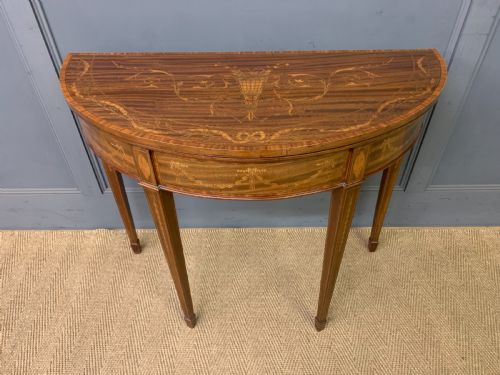


Inlaid Half Moon Console
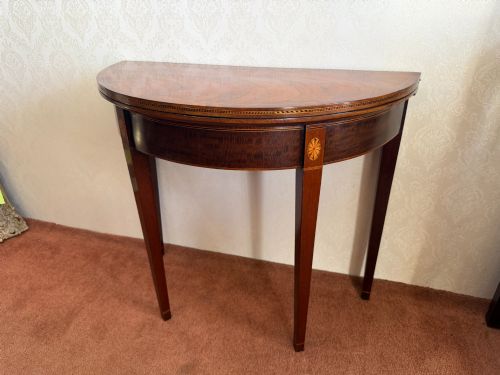
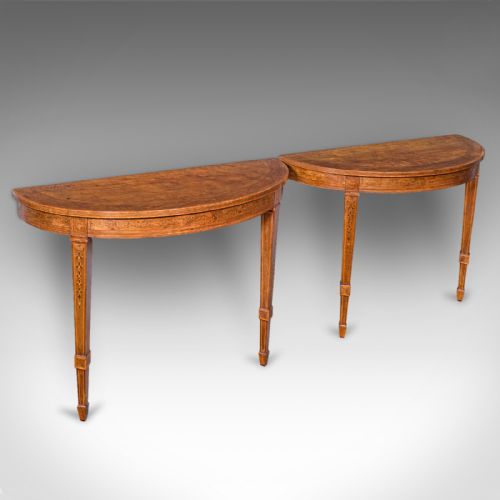
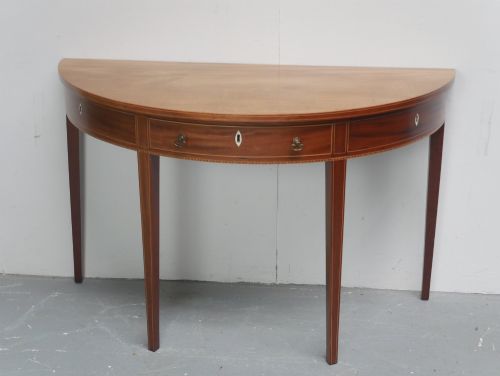
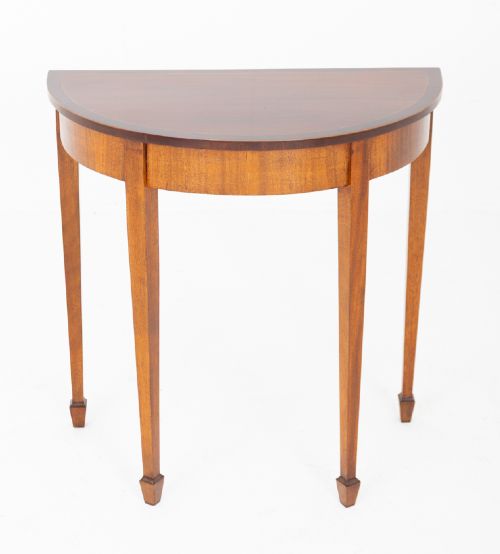
An inlaid half moon console brings a curved silhouette and sharp grain to a hallway or drawing room.
Inlaid Half Moon Console
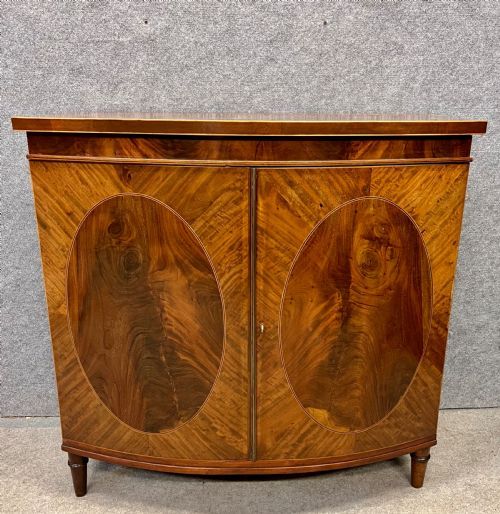
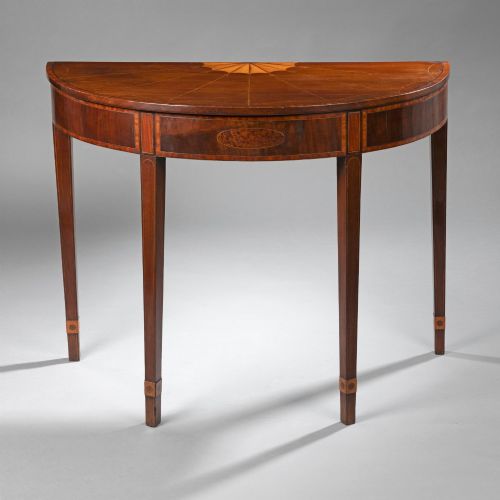
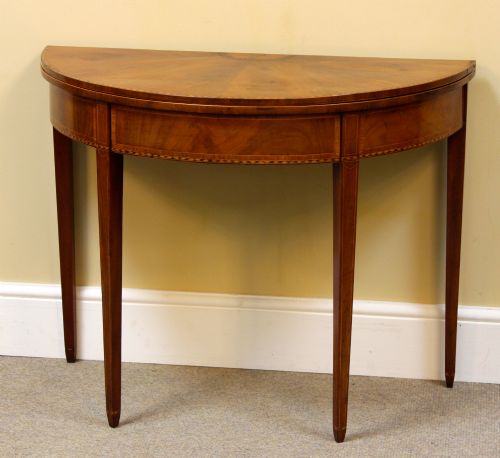
When you search for an inlaid half moon console, you find semicircular tables and cabinets designed to stand flat against a wall, often serving as card tables, tea tables, or serving pieces. The pieces available here span from the Georgian and Regency eras through the Victorian and Edwardian periods, including Sheraton Revival interpretations.
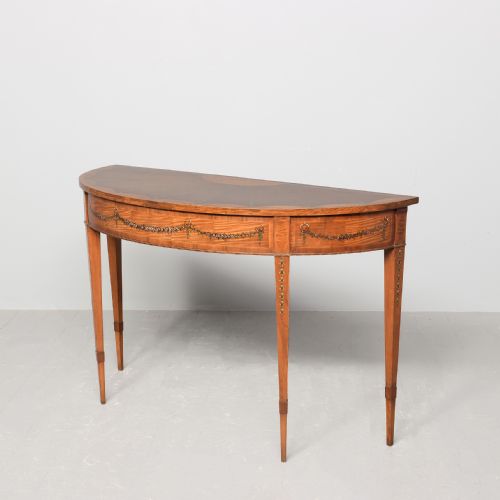
Most examples rely on mahogany or satinwood as a primary timber, shaped into the characteristic demi-lune profile. Console tables and card tables dominate the selection, frequently paired with folding tops or marquetry surfaces.
Materials and Technique
Cabinetmakers constructed these tables using solid timber frames overlaid with carefully selected veneers of mahogany, satinwood, and occasionally fruitwood or rosewood. Boxwood inlay and boxwood stringing provide linear contrast along the edges and apron borders.
Marquetry and painted decoration appear across 18th-century and revival pieces, embedding contrasting wood types into the primary surface. Brass hinges and swing-leg mechanisms support the fold-out leaves found on the card and tea table variants.
Inlaid Half Moon Console Retail Price Guide 2026
Typical asking prices for inlaid half moon console among the pieces listed under this phrase on Sellingantiques today, from the lower quarter to the upper quarter. They describe what is for sale here now, not the wider market.
Some card tables hide a secret compartment beneath the folding top for storing a deck of cards and counters.
Quality and Construction
The standard of a piece depends heavily on the precision of the timber selection and the crispness of the boxwood inlay. Finer examples display harmonious grain alignment across the demi-lune top and subtle, hand-cut marquetry rather than stamped motifs.
Structural integrity at the pivot joints of card tables and the stability of tapered legs indicate the standard of original craftsmanship. Surface finish and the preservation of original patination also separate standard production items from exhibition pieces.
Edward and Roberts·Pietro Ferrario
The Inlaid Half Moon Console Glossary
- Demi-lune
- A half-moon shape used for the tabletops and frames of console and card tables designed to sit flush against a wall.
- Inlay
- A technique where pieces of contrasting wood, such as boxwood or satinwood, are inserted into recessed cavities in the primary timber to create decorative patterns.
- Marquetry
- Elaborate veneer work forming pictorial or geometric designs using various coloured woods.
- Crossbanding
- A border of veneer laid around the perimeter of a tabletop with the grain running perpendicular to the central panel.
- Sheraton Revival
- A late 19th- and early 20th-century style copying the lighter, neoclassical furniture designs associated with the late 18th century.
Inlaid Half Moon Console: Frequently Asked Questions
How were demi-lune tables used?
These pieces functioned primarily as console or side tables against drawing room walls, often featuring fold-out tops to serve as card or tea tables when hosting guests.
Their compact semicircular footprint allowed them to occupy narrow hallways and tight spaces without obstructing passage.
What is the difference between a console and a card table?
A console table stands fixed against a wall as a decorative surface for objects or lighting. A card table incorporates a hinged top that unfolds to reveal a baize-lined playing surface supported by a swing leg.
Many demi-lune forms combine both functions by utilising a folding top on a console base.
How do I identify a Georgian piece from a revival piece?
Georgian pieces exhibit 18th-century construction methods, hand-cut joinery, and natural age-related wear to the timber and patination. Revival items from the Edwardian or Victorian eras often display machine-cut elements and cleaner, uniform finishes.
Wood species and secondary timbers inside the frame also help determine the true period.
Where should I place a half moon console?
The flat back sits flush against a wall, making these tables ideal for narrow entrance halls, landings, or living room perimeters. They provide surface space for decorative items while keeping floor obstruction to a minimum.
Pairing them with a mirror creates a traditional focal point in a hallway.