
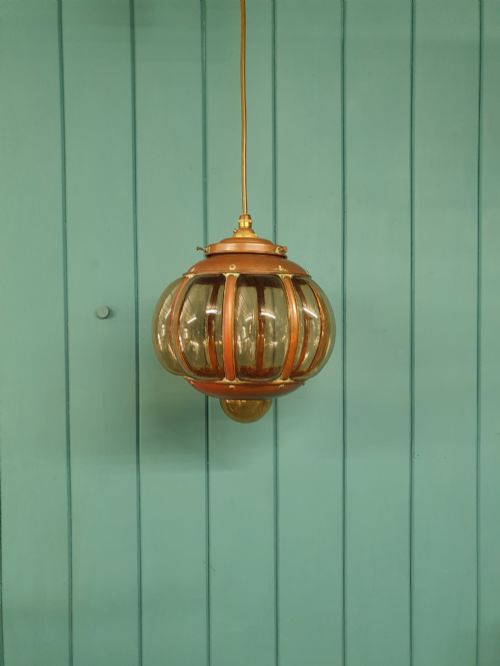


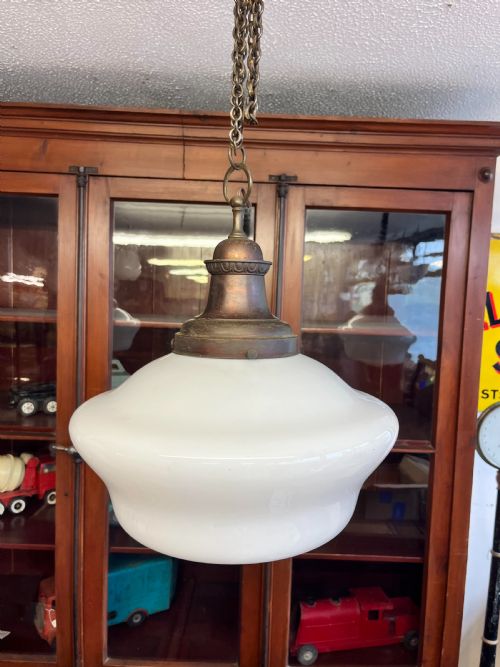
Industrial Glass Ceiling Shade
An industrial glass ceiling shade brings robust utility and practical overhead illumination into modern interiors, drawing on durable designs from the Victorian era to the mid-century.
Industrial Glass Ceiling Shade
An industrial glass ceiling shade is designed to provide direct, functional lighting for workshops, factories, railways, and maritime settings. These utility fixtures cross over easily into domestic spaces, bringing a robust character to kitchens, hallways, and living rooms.
The selections span several distinct periods, reaching from the Victorian era through the Edwardian period and into the 1920s, 1930s, and 1940s. Pieces frequently emerge from the industrial and Art Deco movements, with styles reflecting practical working environments.
Pendant lights and ceiling lights form the primary physical formats on this page. You will regularly encounter bell pendants, chapel lights, and specialised prismatic shades designed to diffuse bright light evenly across a large floor area.
Materials and construction methods
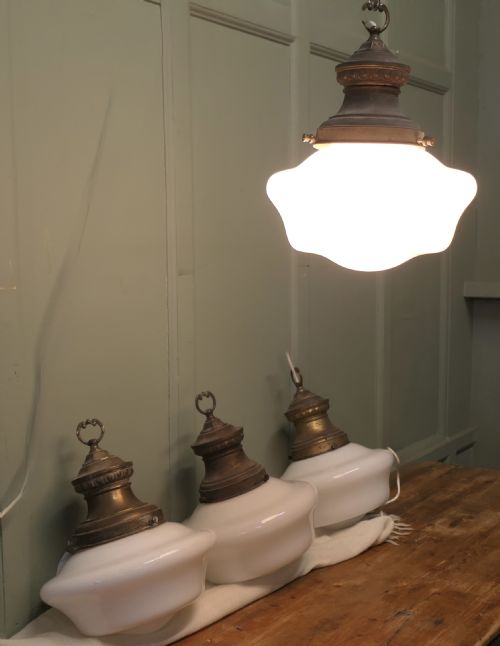
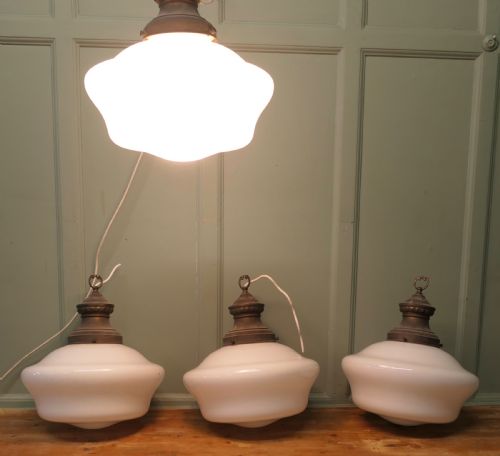
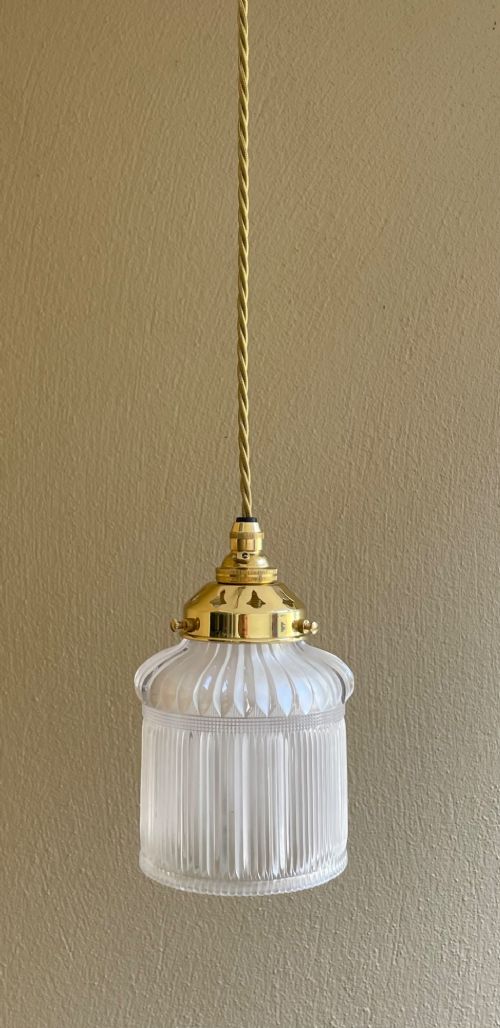
Glass forms the central visual component of these fixtures, with opaline glass, mercury mirrored glass, smoked glass, and specialised prismatic glass appearing frequently across the inventory. Prismatic glass shades utilise moulded optical ridges to bend and distribute light efficiently without harsh glare.
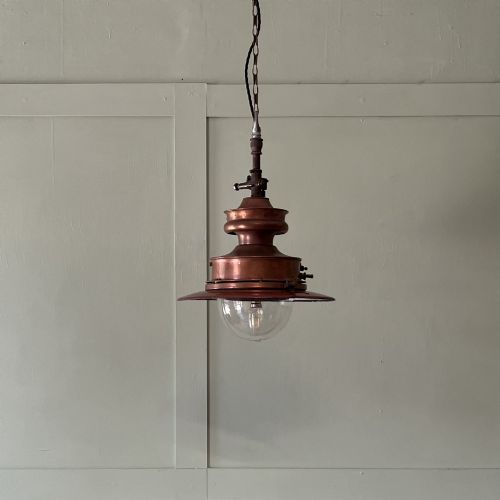
Metal components provide structural integrity, combining brass, copper, chrome, and standard industrial metals within the galleries and fixings. These sturdy metal mounts secure the heavy glass shades while withstanding demanding commercial conditions.
Listings span the Victorian era, Edwardian period, 1920s, 1930s, and 1940s, featuring glass, brass, copper, and opaline materials.
Judging quality in industrial lighting
Quality rests in the heaviness and optical clarity of the glass itself, alongside the engineering of the metal gallery. Thick, substantial glass and crisply cast brass or copper mounts indicate robust commercial manufacture.
Originality of components elevates a piece significantly. Retaining the matching period gallery, original hanging hardware, and authentic maker markings distinguishes a top-tier example from later assembled combinations.
The Industrial Glass Ceiling Shade Glossary
- Prismatic glass
- Glass moulded with precise optical patterns on the surface designed to control and diffuse light. This technique reduces glare while maximising illumination in large workspaces.
- Opaline glass
- A milky, translucent white glass that softens light evenly across the room. It became popular in utilitarian and domestic settings for its clean appearance.
- Gallery
- The metal collar or mount that grips the upper rim of a glass shade and connects it to the hanging suspension. Galleries are commonly cast from brass, copper, or chrome.
- Mercury glass
- Double-walled blown glass silvered on the interior to create a reflective mirror finish. It offers a distinct metallic sheen while remaining glass at the core.
- Pendant light
- A solitary light fixture suspended from the ceiling by a cord, chain, or rigid rod. These units hang downward to illuminate specific surfaces or zones.
Industrial Glass Ceiling Shade: Frequently Asked Questions
How do I clean an old glass shade?
Wash the glass gently in warm soapy water using a soft cloth, avoiding abrasive pads that can scratch vintage surfaces. Take care around older metal galleries to prevent moisture damage.
Dry thoroughly with a lint-free cloth before rehanging the fixture. Check that all electrical connections remain secure during the cleaning process.
What rooms suit an industrial pendant?
These fixtures work well suspended over kitchen islands, dining tables, and long hallways where direct downlighting is practical. Their utilitarian origins complement both modern minimalist spaces and traditional interiors.
Choosing the correct hanging height ensures the bulb remains out of direct eyeline while adequately illuminating the work surface below.
How do I identify a Holophane shade?
Holophane shades feature characteristic geometric prismatic ribs moulded directly into the glass. These precise ribs are engineered to redirect and scatter light evenly.
Many examples bear subtle maker stamps or distinct optical patterns that separate them from standard smooth glass shades.