




Indian Wooden Keepsake Box
An indian wooden keepsake box holds small treasures and personal valuables, bringing historic craftsmanship and rich timber into the modern home.
Indian Wooden Keepsake Box
An indian wooden keepsake box brings together a range of historic forms designed for storage and travel, including jewellery caskets, writing boxes, miniature campaign trunks, and trinket boxes. Buyers searching this phrase encounter practical containers created for personal effects, often with compartments intended for letters, rings, or small keepsakes.
The selections span the nineteenth century and the early twentieth century, showing influences from the Victorian period onwards. Pieces commonly adopt styles such as Anglo-Indian, Anglo-Indian Colonial, and Victorian Campaign, reflecting the movement of objects and makers between Britain and the subcontinent.
Most examples take the form of decorative boxes or small chests, ranging from sarcophagus shapes to reeded writing boxes. These containers served gentlemen and ladies alike, functioning as portable desks, dressing box accessories, or dedicated repositories for valuables.
How they were made
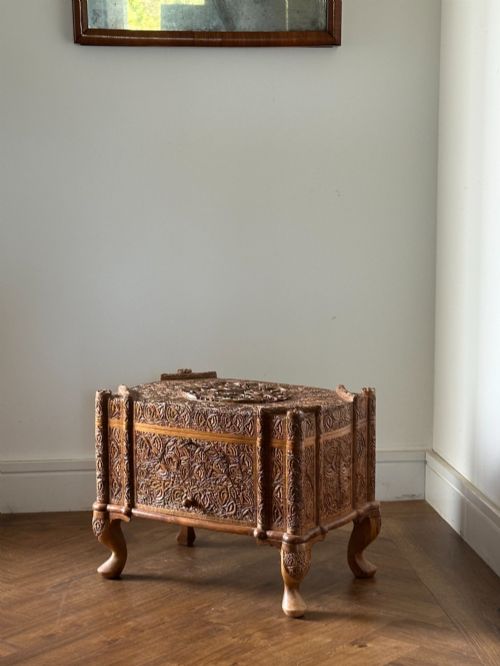
Makers utilised a variety of dense timbers, choosing hardwoods such as teak, ebony, rosewood, sandalwood, walnut, and coromandel to build sturdy carcases. These woods were frequently carved in deep relief with floral or geometric motifs, or finished with smooth surfaces that highlighted the natural grain of the material.
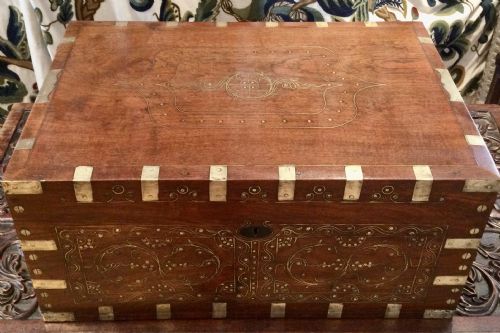
Specialist construction methods include the robust brass binding and recessed handles characteristic of campaign pieces designed for travel. Other distinct techniques involve the application of porcupine quill work, where natural quills are arranged in geometric patterns across the surface of the box.
Porcupine quills once travelled thousands of miles across the seas just to hold a Victorian lady's spare buttons.
What varies in quality
The standard of carving distinguishes exceptional examples from simpler containers, with deep, crisp relief work showing greater manual skill than shallow or mechanical incision. The choice of timber also dictates the character of the piece, as dense, highly figured ebony, sandalwood, or coromandel carries more presence than plainer domestic hardwoods.
Interior fittings and hardware further separate grades of production. Boxes equipped with fitted writing slopes, secret drawers, original velvet or silk linings, and heavy brass campaign mounts represent more ambitious commissions than basic unlined trinket containers.
The Indian Wooden Keepsake Box Glossary
- Anglo-Indian
- A style describing furniture and decorative objects made in India during the British period, often combining traditional local craftsmanship with European forms. These pieces frequently employ native hardwoods and intricate carved decoration.
- Campaign box
- A portable container built for military officers or travellers on the move, typically fitted with flush brass handles, reinforced corners, and robust locks. The construction prioritises durability and compact organisation.
- Sarcophagus-shaped
- A form featuring a domed or sloping lid atop a rectangular or faceted base, reminiscent of classical stone sarcophagi. This silhouette was popular for nineteenth-century jewellery caskets and workboxes.
- Porcupine quill box
- A decorative container surfaced with alternating sections of natural porcupine quills and bone or ivory inlay, originating largely from nineteenth-century Ceylon. The quills create a distinct textured, striped pattern across the exterior.
- Coromandel
- A heavy, durable timber derived from trees native to India and Sri Lanka, characterised by dark brown colouring with dramatic black streaks. It was frequently utilised for high-status nineteenth-century workboxes and stationery chests.
Indian Wooden Keepsake Box: Frequently Asked Questions
What were indian wooden keepsake boxes used for?
These boxes served multiple domestic and travel purposes, acting as secure repositories for jewellery, letters, coins, and personal documents. Writing boxes included sloping surfaces and inkwells for correspondence, while smaller trinket boxes held rings and pins on dressing tables.
Military officers and colonial officials also utilised robust campaign versions to transport personal items during long journeys. Their compartments kept delicate belongings organised and protected from dust and damp.
How should I care for antique hardwood boxes?
Preserving these boxes involves keeping them away from direct sunlight and sudden temperature changes, which can cause dense hardwoods to split or warp. Occasional light dusting with a dry, soft cloth maintains the surface without damaging historic finishes.
Avoiding modern silicone polishes ensures the timber breathes naturally. If the wood appears dry, specialist wax formulated for antiques can be applied sparingly and buffed gently.
What is the difference between campaign and regular boxes?
Campaign boxes were engineered for mobility, featuring flush brass corner brackets, recessed carrying handles, and sturdy locks designed to withstand rough transport. Their interiors often contained clever folding mechanisms or secure partitions for travel.
Standard decorative boxes prioritized stationary display and domestic storage over rugged portability. Consequently, they lacked the exterior brass reinforcement found on pieces built for military use.