
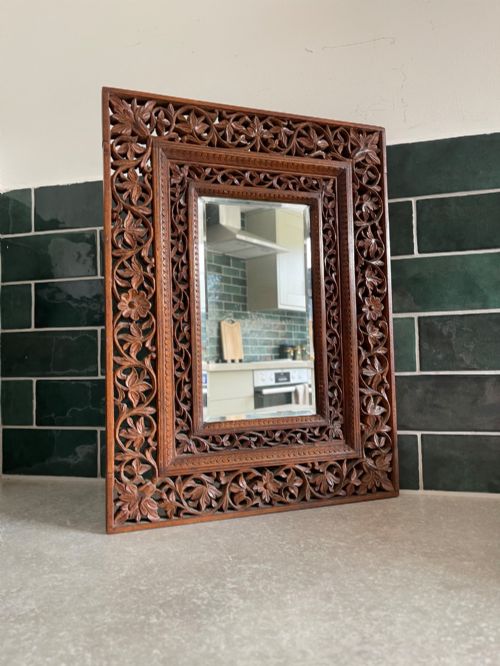
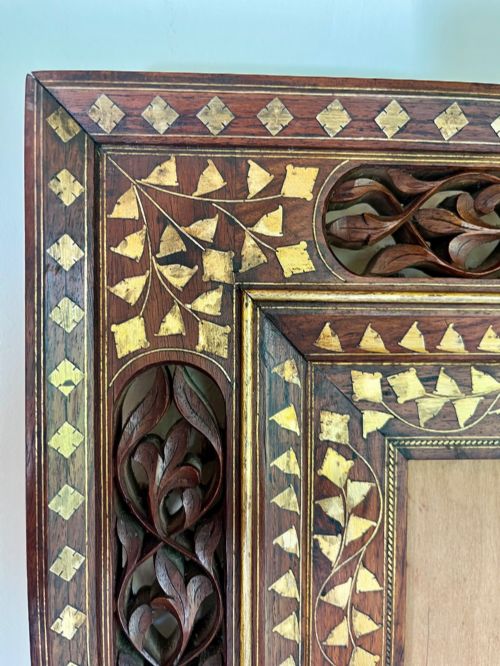


Indian Carved Wood Frame
These indian carved wood frame pieces bring dense floral relief and rich grain straight from the late nineteenth-century workshop into a modern room.
Indian Carved Wood Frame
When you search for an indian carved wood frame, you encounter decorative borders, mirror surrounds, and picture housings produced during the Victorian and Raj periods. The pieces on this page span wall mirrors, framed gouache paintings, and structural panels rather than simple mouldings.
Most examples originate from specific craft centres like Hoshiarpur or Kashmir, dating from the eighteen-eighties through to the nineteen-twenties. These items reflect the cross-cultural tastes of Anglo-Indian Colonial design, combining local carving traditions with British domestic requirements of the era.
How they were made
Artisans carved dense timbers using hand chisels to create deep relief motifs of foliage, geometric strapwork, and animal forms. Teak, walnut, and sheesham serve as the primary structural woods for these frames.
Many items incorporate contrasting materials set directly into the timber surface, including sheet brass wire inlay and pierced bone or metal elements. Joinery relies on traditional pinning and mortise techniques rather than modern adhesives.
Several folding chairs among these records suggest that nineteenth-century colonial officers enjoyed remarkably portable seating.
What varies in quality
The distinction between standard production and superior work lies in the depth and crispness of the chisel work. Finer frames display intricate undercut foliage where the background texture remains uniform and deeply recessed.
Material selection and inlay integration also dictate the standing of a piece. Superior examples use dense rosewood or walnut with tightly secured brass wire and minimal shrinkage cracks across the mitred joints.
The Indian Carved Wood Frame Glossary
- Anglo-Indian
- A style describing furniture and decorative objects made in India for British residents during the colonial era. These pieces blend indigenous craft methods with European room forms.
- Hoshiarpur
- A Punjabi town renowned for intricate wood carving and inlay work. Makers in this region specialised in geometric patterns using brass wire and resin.
- Sheesham
- A durable Indian rosewood variety utilised for structural frames and panels. It exhibits a rich dark grain that accepts deep chisel work without splintering.
- Gouache
- An opaque water-based pigment used in traditional Indian miniature painting. Framed gouache works from the Mughal school often accompany period surrounds.
- Relief carving
- A sculptural technique where motifs project from a background plane. Deep relief work creates strong shadow lines across the face of the moulding.
Indian Carved Wood Frame: Frequently Asked Questions
How do I hang a heavy carved frame?
These dense hardwood frames require substantial wall fixings rather than standard picture wire. Screw direct weight-bearing brackets into masonry plugs or wall studs behind the plaster.
Ensure the hanging wire or D-rings attached to the back match the actual weight of the timber and glass combination.
How should I clean carved wood?
Dust the deep recesses regularly with a soft dry brush to prevent dirt accumulation within the intricate relief patterns. Avoid liquid polishes and silicone sprays that build up in the carved crevices.
Feed the dry timber occasionally with a neutral microcrystalline wax applied sparingly with a stiff bristle brush.
What is brass wire inlay?
Brass wire inlay involves hammering thin metallic strands into pre-cut grooves across the wooden surface. This technique creates contrasting geometric patterns that catch the light against dark timber.
Makers in Hoshiarpur frequently employed this method alongside carved floral motifs.