




Impressionist Forest Landscape
Impressionist forest landscape works capture light and atmosphere among trees, offering buyers atmospheric oil paintings and watercolours spanning early twentieth century periods.
Impressionist Forest Landscape
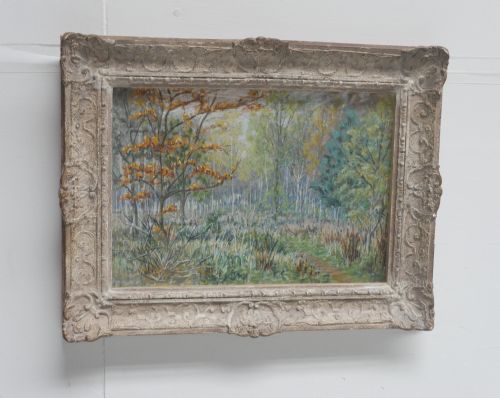
An impressionist forest landscape centres on natural woodland scenery rendered through loose brushwork and a focus on shifting light. Buyers encountering these works find oil paintings on canvas and board alongside delicate watercolours on paper.
The selections span from Edwardian and early twentieth century examples to mid-century Scandinavian and Scottish pieces. Subjects range from bluebell woods and sunset woodland areas to French and Danish rural views.
Works of an impressionist forest landscape often reflect regional British traditions alongside continental European interpretations. Artists capture seasonal shifts, from leafy summer scenes to winter woodland settings.
Materials and methods
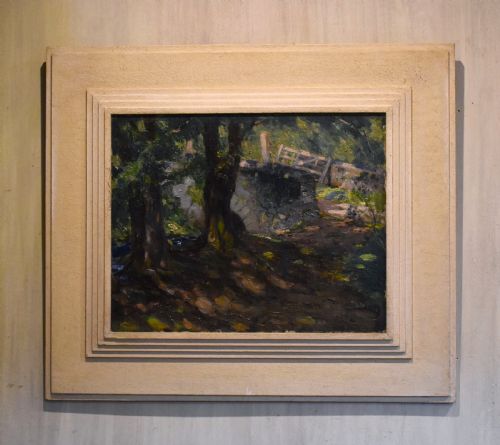
Artists create an impressionist forest landscape primarily using oil paint applied to canvas, board, or wood panels. This medium allows for thick impasto application and textured brushwork that mimics dappled sunlight through branches.
Watercolour on paper forms another significant portion of the selection, providing lighter and more fluid renderings of woodland scenes. Gilt framing frequently accompanies the oil paintings, enhancing the visual depth of the canvas.
Listings feature works executed in oil paint, watercolour, canvas, board, and paper across Edwardian and mid-century periods.
Assessing quality
Quality in an impressionist forest landscape rests upon the artist's handling of light, colour harmony, and brushwork dexterity. Superior pieces demonstrate a confident command of tone that convincingly evokes the atmosphere of a woodland canopy.
The integration of support materials, such as stable canvas preparation and appropriate framing, distinguishes finer works. The strength of composition and the subtlety of the colour palette ultimately elevate certain paintings above standard decorative pieces.
Thomas Bromley Blacklock·David Watts·James Proudfoot·Rowland Henry Hill·Ernest Higgins Rigg·Augustus William Enness·Emily M Paterson·Hans Kappel·Albert de Belleroche·Walter Emsley
The Impressionist Forest Landscape Glossary
- Impressionism
- A style of painting characterised by relatively small, thin, yet visible brush strokes and an emphasis on accurate depiction of light. This approach transforms static woodland views into vibrant atmospheric records.
- Oil paint
- Paint made of pigmented grains suspended in a drying oil, commonly linseed. It offers slow drying times that permit extensive blending and layering on canvas or board.
- Watercolour
- Paint consisting of colour pigments suspended in a water-soluble vehicle. It yields transparent washes of colour particularly suited for paper supports.
- Gilt
- A thin layer of gold applied to wood or other substrates to form decorative frames. This finish frames the painted surface to catch ambient room light.
Impressionist Forest Landscape: Frequently Asked Questions
What periods do these paintings date from?
The works span the early twentieth century through to the mid-century decades. Dates range from Edwardian examples up to nineteen sixty.
Most pieces reflect artistic movements active across Britain and continental Europe during these years.
Which materials are used most often?
Oil paint on canvas or board forms the majority of the works. Watercolour on paper appears frequently in the selection.
Wood supports and gilt framing also feature among the listed items.
How should I hang these artworks?
Select a wall with indirect natural light to protect the pigment and prevent glare on the oil or watercolour surface. Ensure the room humidity remains stable to preserve the canvas or paper support.
Pair the painting with a complementary frame style that respects the period of the artwork.
Are watercolours as durable as oils?
Watercolours on paper require framing behind glass to protect them from airborne dust and moisture. Oil paint on canvas or board possesses a more robust surface suited to ambient indoor conditions.
Both media benefit from avoidance of direct sunlight.