




Impressionist Fish Artwork
Impressionist fish artwork captures harbour life, maritime scenes and coastal vessels through loose brushwork and atmospheric light.
Impressionist Fish Artwork
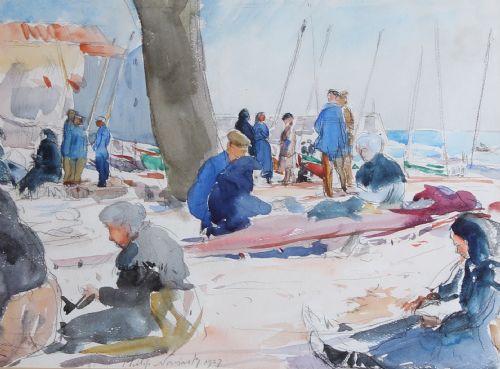
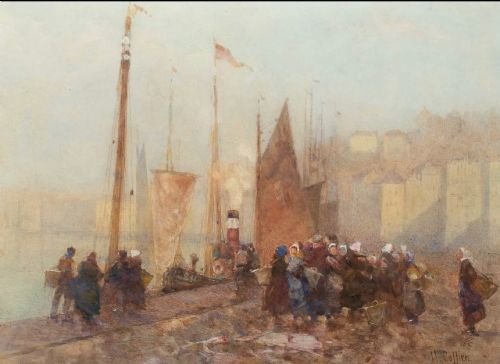
Impressionist fish artwork encompasses paintings and watercolours depicting harbours, fishing boats, and coastal scenes created during the nineteenth and twentieth centuries. These pieces record maritime activity from ports in Britain, France, and further afield, focusing on vessels at work and coastal landscapes.
The version most commonly met on this page is the early twentieth-century oil painting on canvas or panel, often portraying Cornish harbours or continental fishing ports. Watercolours and gouache works also appear frequently, capturing low tides and harbour walls with fluid pigments.
Makers represented include named British and European painters such as Owen Bowen, Frank Rousse, and William Lee Hankey, alongside works originating from the Newlyn school and various regional art traditions.
Materials and technique
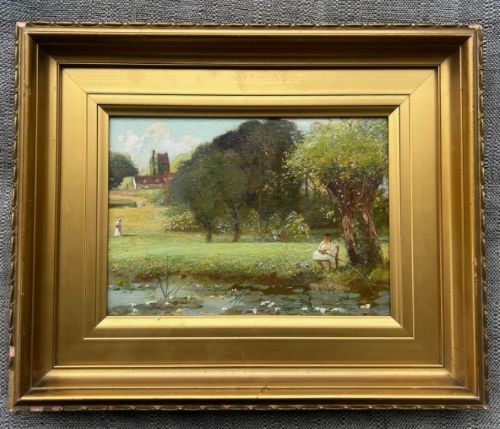
Artists relied primarily on oil paint applied to canvas, wood panels, or card, alongside watercolours and gouache on paper. Gold leaf occasionally frames or accents these coastal compositions.
Brushwork remains expressive and varied, utilising thick impasto in oil or transparent washes in watercolour to capture changing light on water, harbour walls, and fishing boats.
Impressionist Fish Artwork Retail Price Guide 2026
Typical asking prices for impressionist fish artwork among the pieces listed under this phrase on Sellingantiques today, from the lower quarter to the upper quarter. They describe what is for sale here now, not the wider market.
Materials in these listings combine oil paint, canvas, wood panel, watercolour, gouache, and gold leaf.
Judging quality
Quality rests in the handling of light and atmosphere, where confident brushwork conveys movement in water and sky rather than rigid architectural detail. Strong compositions anchor the bustling activity of harbour scenes with balanced tones.
The relationship between the support and the medium matters greatly, as panel or canvas surfaces allow oil paint to retain texture and depth over decades. Preserved framing and clear signatures by known painters further distinguish superior examples.
Hector Caffieri·Florence Adelina Hess·John Holland·Edward Matthew Elliott·Gyrth Russell·William Lee Hankey·Sir David Murray·Owen Bowen·Frederick William Hattersley·William Lambert Bell·Antonio Godoy·Fred Mayor·Henry Sykes·Hendrik Yan Wolter·Henri Ottman·Frank Rousse·Robert Leslie Howey·Augustus William Enness·Alec Caruthers Gould·Sonia Mervyn·John W. Gilroy·Maurice Sijs
The Impressionist Fish Artwork Glossary
- Impressionism
- A style of painting emphasising loose brushstrokes and the shifting effects of light rather than exact detail. It developed in the nineteenth century and influenced marine painters across Europe.
- Gouache
- An opaque watercolour paint that provides heavier coverage and solid colour areas. It often appears combined with traditional transparent watercolours in marine scenes.
- Impasto
- Paint applied thickly to a canvas or panel, standing out in relief. This technique gives texture to water surface reflections and vessel hulls.
- Panel
- A rigid wooden support used by artists instead of stretched canvas. Painters applied oil directly to the prepared wood surface.
- Seascape
- A painting depicting the sea, coastlines, or marine vessels. These works form the core of coastal art collections.
Impressionist Fish Artwork: Frequently Asked Questions
What periods do these artworks cover?
The pieces span from the nineteenth century through the Victorian and Edwardian eras, extending into the mid-twentieth century.
Most examples cluster around the early decades of the 1900s, reflecting the height of British and European impressionist coastal painting.
Where were these coastal scenes painted?
Locations range widely across British fishing ports such as Whitby, St Ives, Mevagissey, and Polperro. Others record continental harbours in France, Norway, Brazil, and the Channel Islands.
Artists frequently travelled to active working ports to capture local vessels and daily maritime routines.
How should I care for an oil painting?
Keep paintings away from direct sunlight and steady humidity levels to protect both the canvas and the wooden support. Avoid harsh chemical cleaners on the paint surface.
Dust gently with a soft, dry brush when necessary, leaving conservation cleaning to professional restorers.
Are watercolours framed differently from oils?
Watercolours require glass protection and acid-free mounts to shield the delicate paper and pigments from moisture and fading. Oil paintings on canvas or panel are typically framed openly without glass.
Original frames often accompany these works, matching the period of the painting.