


Horse Cart Landscape Painting
A horse cart landscape painting captures rural toil and quiet country tracks from the nineteenth and early twentieth centuries.
Horse Cart Landscape Painting
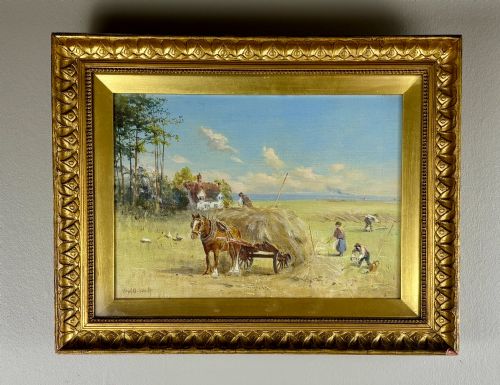
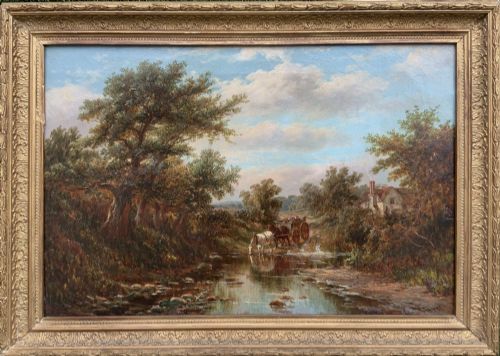
A horse cart landscape painting depicts rural scenes featuring working horses, agricultural carts, and country tracks across British and European scenery. These works record agrarian life, harvest time, and coastal labour through the brush of nineteenth and early twentieth century artists.
The version most commonly met on this page is a framed watercolour on paper, often showing harvest scenes or coastal cart transport from the eighteen-eighties to the nineteen-thirties. Oils on canvas also appear, bringing heavier texture and richer depth to woodland tracks and river crossings.
The compositions range from intimate West Country village views to expansive Yorkshire and Lancashire landscapes. Figures are frequently included working alongside their horses, hauling seaweed, timber, or hay.
Materials and Techniques
Watercolour pigment on paper dominates the selection, handled with fluid washes and precise detail to capture light and atmosphere in rural settings. Gouache also appears, adding opaque highlights to skies and water.
Oil on canvas provides a durable medium for larger landscapes, allowing artists to build thick layers of paint for fields, foliage, and tracks. These works are typically housed in wood and giltwood frames that protect the canvas and complement the composition.
Paper and canvas are supported by wood panels and glass framing where appropriate, preserving delicate watercolours against moisture and light damage over the decades.
One wartime watercolour records a quiet rural harvest during the First World War.
Variations in Quality
The skill of the brushwork and the precision of the draughtsmanship dictate the standing of a piece within its period. Stronger works demonstrate a confident handling of light, shade, and anatomy in both horse and human figures.
Compositional balance and atmospheric depth separate routine topographical records from accomplished artistic interpretations of rural life. The integration of the cart and horse into the wider landscape reveals the artist's command of perspective and mood.
James William Booth·George Hamilton Constantine·Herbert Royle·Frederick William Jackson·George Turner·Henry H Parker·James Edwin Meadows·David Cox·Myles Birket Foster·James Hardy Jr·David Bates
The Horse Cart Landscape Painting Glossary
- Watercolour
- A paint consisting of soluble pigment suspended in a water-based solution, traditionally applied to paper. It allows for translucent washes and delicate tonal shifts.
- Giltwood
- Wood that has been coated with gold leaf or a gold-coloured finish. This material is frequently found on decorative frames enclosing nineteenth-century paintings.
- Rural Realism
- An artistic style focusing on unvarnished depictions of countryside life and agricultural labour. It gained prominence in the nineteenth century as artists turned toward everyday rural subjects.
- Gouache
- An opaque water-based paint made from pigment combined with a heavier binding agent. It provides solid, flat areas of colour and sharp highlights on paper.
Horse Cart Landscape Painting: Frequently Asked Questions
What periods do these paintings cover?
The works span the nineteenth and early twentieth centuries, with dates stretching from the eighteen-sixties through to the nineteen-thirties.
This era encompasses Victorian, Edwardian, and early modernist movements in British and European art.
How should I care for a watercolour?
Watercolours require protection from direct sunlight to prevent the pigments and paper from fading over time.
Keep them behind glass in stable indoor environments away from excessive dampness.
What subjects appear besides harvest carts?
Artists also painted timber hauling, seaweed gathering on coastal shores, and market carts travelling through woodland tracks.
Villages, rivers, and winter woodlands frequently form the backdrop for these working scenes.
Are the frames original?
Many pieces retain period frames made of wood or giltwood that match the era of the painting.
Some works are glazed to protect the paper surface of the watercolours.