



Horse and Cart Art
Horse and cart art captures rural labour and transport through oil, watercolour, and chalk, bringing pastoral scenes into domestic interiors.
Horse and Cart Art
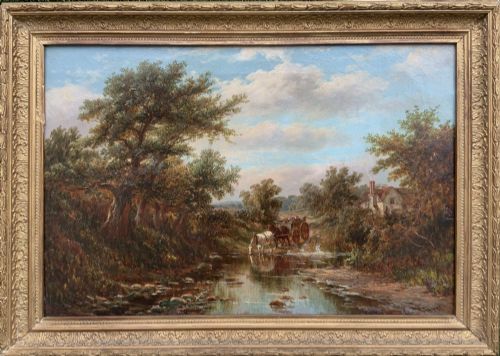
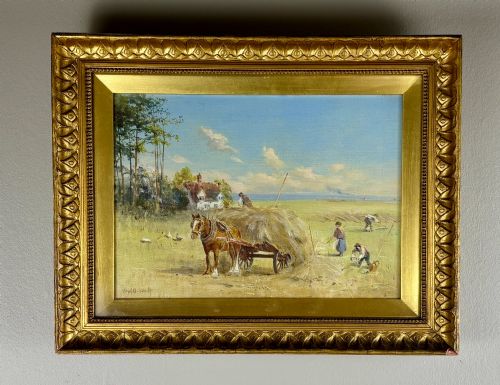
Horse and cart art encompasses framed watercolours, oil paintings, etchings, and drawings depicting rural transport, hay gathering, and coastal hauling. These works date from the nineteenth century through the early twentieth century, capturing agrarian life and rural landscapes.
The pieces on this page range from Victorian pastoral watercolours to Edwardian chalk drawings and later oil paintings. Subjects include harvest scenes, timber logging carts, and seaweed collection in coastal settings.
Makers recorded in the evidence span British and continental artists working across distinct regional landscapes, presenting horses harnessed to traps, farm carts, and market carriages.
Materials and techniques
Artists record these rural transport scenes using oil on canvas, watercolour on paper, and chalk or gouache. Support materials include canvas, paper, wood, and glass framing, frequently complemented by walnut or giltwood frames.
Watercolour works often employ fine washes to delineate atmospheric conditions like moonlight or coastal mist, whilst oil paintings build texture through layered brushwork on canvas.
Physical models also appear in the record, constructed as hand-made wooden scale replicas of farm carts alongside traditional paper prints and etchings.
Horse and Cart Art Retail Price Guide 2026
Typical asking prices for horse and cart art among the pieces listed under this phrase on Sellingantiques today, from the lower quarter to the upper quarter. They describe what is for sale here now, not the wider market.
Listings feature works created between the nineteenth century and the nineteen-thirties, executed in oil, watercolour, gouache, and chalk.
Distinctions in execution
The strength of a composition rests on the articulation of the horse's form and the structural accuracy of the cart. Works by established nineteenth and twentieth-century painters demonstrate superior handling of light, particularly in harvest and sunset settings.
Surface preservation of the paper or canvas dictates the visual clarity of watercolours and oils. Finer pieces retain pigment vibrancy without excessive fading or discoloration of the underlying support material.
Hugh Barry Scott·Thomas Thomas·Cecil Charles Windsor Aldin·James William Booth·Léon Joseph Voirin·John Augustus Atkinson·Edward Brice Stanley Montefiore·George Hamilton Constantine·Will Anderson·Robert Hollands Walker·Charles H Poingdestre·Herbert Royle·William Manners·Frederick William Jackson·Walter Duncan·George Turner·George Smith·Frank Saltfleet·Henry H Parker·William Kay Blacklock·Alfred George Stevens·Fred Lawson·John Baragwanath King·Reginald Mills·Robert Thorne Waite
The Horse and Cart Art Glossary
- Watercolour
- A painting method where paint is made of pigments suspended in a water-soluble vehicle. It is typically applied to paper supports.
- Oil painting
- The process of painting with pigments that are bound with a medium of drying oil. Canvas is the traditional support for these works.
- Giltwood
- Wood that has been covered with a thin layer of gold leaf or gold paint. It frequently forms the decorative border of period frames.
- Etching
- A printmaking process where lines are incised into a metal plate with acid. The resulting plate holds ink to print an image onto paper.
Horse and Cart Art: Frequently Asked Questions
What periods do these artworks cover?
The listed pieces span the nineteenth century, the Edwardian era, and the early decades of the twentieth century. Artists worked across these decades recording rural trades.
Styles shift from Victorian realism and pastoral depictions toward British impressionism by the nineteen-thirties.
What subjects appear in these works?
Primary subjects include farm carts during harvest time, timber hauling, seaweed gathering on coasts, and horses harnessed to traps. Figures frequently accompany the animals in rural landscapes.
Scenes also capture specific locations such as Whitby, Cornwall, and Warwickshire across different seasonal lighting conditions.
How should I frame these pieces?
Many works retain their period framing, including walnut and giltwood surrounds that complement nineteenth-century watercolours and oils. Glazing is common on works executed on paper.
Matching a frame to the period of the artwork helps preserve the historical integrity of the piece.
Are these works original or prints?
The listings comprise original paintings in oil and watercolour alongside original chalk drawings and etchings. Hand-made wooden scale models also feature among the physical objects.
Each listing specifies the exact medium used by the maker to record the scene.